EL PAÍS offers the América Futura section openly for its daily and global information contribution on sustainable development. If you want to support our journalism, subscribe here.
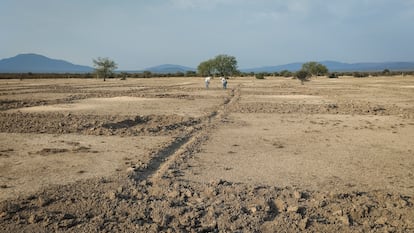
In the Zacatecan semi-desert, a mosaic of grasslands and bushes between the Sierra Madre Occidental and the Sierra Madre Oriental, life resists in extreme conditions. This region is part of the Chihuahuan Desert, the most extensive and diverse arid area in northern Mexico and one of the most diverse dry regions on the planet. Cacti, agaves, lechuguilla and governa grow here, and there is fauna adapted to the scarcity of water such as lizards, rattlesnakes and the Mexican prairie dog, a species endemic to the country. The average temperature is around 16.86 °C and the annual rainfall barely reaches 391.50 millimeters; Even so, pine forests capture and filter water that recharges the aquifers that support communities and wildlife.
But this territory faces increasing pressures. Droughts are increasingly frequent due to climate change and changes in land use, which reduces the water that sustains livestock farming and seasonal agriculture. In the search for income, overgrazing and overexploitation of aquifers accelerate desertification, compact the soil and limit the little rain from infiltrating, affecting basic crops such as chili, corn and pumpkin and reducing access to traditional resources such as oregano, lechuguilla and medicinal plants. Open pit mining fragments habitats, generates noise pollution and puts community health at risk. All this reduces grasslands and hits key species such as the golden eagle (Aquila chrysaetos canadensis) and the Mexican prairie dog (Cynomys mexicanus).
Part of this region was decreed as the Zacatecano Semidesierto Flora and Fauna Protection Area, northeast of Zacatecas, and includes Mazapil, Concepción del Oro and El Salvador, where around 32,398 people live. Despite this recognition, the communities face high levels of marginalization: more than 70% earn less than two minimum wages, close to 40% have not completed basic education and there are still homes without access to piped water. The local economy depends almost entirely on agriculture and livestock, activities that critically depend on increasingly scarce water. The lack of opportunities forces young people to migrate to the United States or nearby cities; Those who remain face risks of violence and recruitment by organized crime.
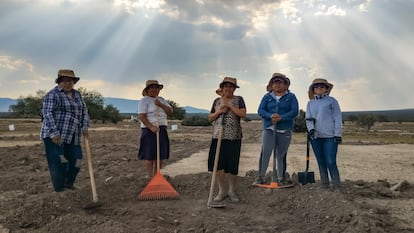
Against this backdrop, Natural Spaces and Sustainable Development (Endesu), in alliance with rural communities, promotes a response that seeks to heal the landscape to ensure the future. The project is based on Nature-Based Solutions and adaptive landscape management. Trained community brigades collect and plant native grasses to recover vegetation cover; They prepare the soil with contour lines and microbasins that capture and retain moisture; and promote the natural regeneration of degraded soils. They also promote regenerative landscape management practices and community water management, in a region where there are almost no perennial rivers and water access is limited. These actions seek to break the cycle between environmental degradation and rural poverty.
The restoration of the grassland is linked to the recovery of emblematic species and social strengthening. Between 2011 and 2017, Endesu developed a program to recover golden eagle populations and their habitat in Mexico, creating a model of conservation of nesting and hunting territories that protects large areas of grassland, recovers natural prey — prairie dogs, hares and wild turkeys — and increases the reproductive success of the golden eagle. This model has been applied since 2021 in northern Zacatecas, identifying nests, hunting areas and threats, and in 2023 it focused on restoring colonies of the Mexican prairie dog: when established, these colonies displace the xeric scrub, allow the return of native grasses and accelerate the recovery of the ecosystem. At the same time, community brigades in locations such as Tanque Nuevo and Tanque del Alto are trained in grassland restoration, water management, species monitoring, and regenerative livestock management. Initiatives like Educating from home, Young people preserving and Improving your community They train new generations of local monitors, generate temporary employment and strengthen social cohesion in the face of climate change.
All of this local effort adds up to a broader conversation: how to coexist with wildlife in a country where human communities and threatened species share territory. That is the heart of the International Meeting on Coexistence with Wildlife, a free meeting that will be held from November 6 to 9, 2025 in the Patio de Novices of the Antiguo Colegio de San Ildefonso, in Mexico City, and that can also be followed from the website. This space will bring together specialists, institutions, students and young professionals to share learning from three decades of conservation, analyze challenges such as climate change, managing conflicts with fauna and habitat restoration, and outline action routes for the coming decades. The Meeting, which celebrates 30 years of Natural Spaces and Sustainable Development, is also an open invitation: add your voice to the future of coexistence with wildlife.
For more updates, visit our homepage: NewsTimesWire