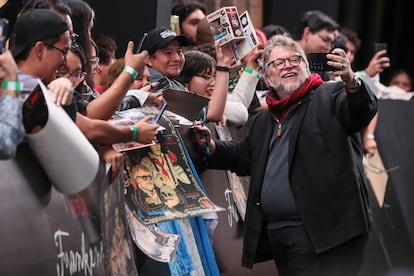
For Guillermo del Toro, the material for his films comes from his memories, his traumas, and his favorite monsters growing up. Frankenstein —his most recent film—, as he relates in an interview conducted at the St. Regis hotel in Mexico City, was the dream of an 11-year-old boy from the province. He remembers that he went on his bicycle to a supermarket of the defunct Maxi chain and bought a pocketbook (pocket book), from the Bruguera publishing house, of the masterpiece of the writer Mary Shelley and he said to himself: “I’m going to make this film.” Fifty years later, at 61, the director from Guadalajara, passionate about his country, admits that he could not skip Mexico to present a film that, like many of his projects—as he admits—“just barely missed it” and that has allowed him to “exorcise” his own history.
In a room designed to serve the media, surrounded by props, with a book on human anatomy like Victor Frankenstein’s, a replica of a skull or a quill in an inkwell, Del Toro, always smiling and friendly, cannot leave aside the “beauty” of a work that marked him since he was a child and that he claims is an autobiography of Shelley. She says that her adaptation, a gothic, fantasy and modern version of the British author’s book, seeks to fill biographical gaps that have not been actively used, but that are part of other works by the writer. Such as tyrannical father figures or the idea of war that marks the romantic movement.
“Romanticism is born from the recognition of death and love. And how they can function together. Romanticism is a very violent moment, very iconoclastic. Very anarcho, which seeks to destroy what was seen as a hypocritical society. People forget that Mary Shelley was 16 years old when she met Percy Shelley (her husband), who was 21 and married. They decided to elope against all the opposition of the family. He brought her a poison, laudanum, which was a tincture of opium. ‘Drink this poison and I’ll shoot myself in the head. And we’ll live forever together,’ he told her. Romanticism for me is the English. becoming mexicanized. Entering the melodrama at ease,” says Del Toro, laughing.
The filmmaker, winner of three Oscars, one for Best Director for shape of water (2018), still does not understand how his adaptation of Frankensteindue to the “astronomical figures” that he had against him and that, despite that, he developed for more than 20 years. Just as with his version of Pinocchio (2022), everyone told him no, until Netflix gave the green light to his creativity. The giant of streaming he prepared del Toro a premiere, this Monday, in keeping with the greatness of his most recent film. The Old School of San Ildefonso – an infrastructure dating back to 1583 – in the historic center of the capital, was dressed as a decorative and symbolic setting for one more of the stories that the director is usually interested in telling: about childhoods, children or terror.
“For me, the biography of humanity is one of broken families. So, all great movements, as tragedy does, shakespearian or the analysis of history, are absences of affection at an early age. Whether it is the Napoleonic war or political corruption, they are the absences of figures that complete the self in childhood. Do you see Blade 2 (another of your films)? It’s the story of a vampire son who once again says to his father, ‘Why did you create me like this?’ AND Frankenstein It is basically the story of another child who is created by a hurt child to remedy his childhood and reproduces the brutality. It’s not that the work is a metaphor, our life is the metaphor. It’s very curious when you say ‘I’m not going to repeat what I saw my father do incorrectly’ and at 41 years old you say, ‘Oh, at what point did I become my boss?’” he adds.
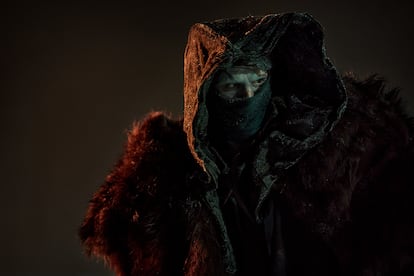
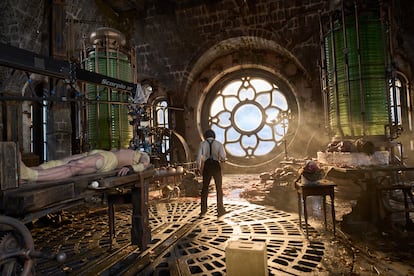
The parallels between Del Toro’s feelings, the work and his characters are undeniable. He is also director of Pan’s Labyrinth (2006) took the liberty of capturing a moment in the novel that had not been seen in cinema until now, which is the creation of the creature. The adaptations of Frankenstein They have always shown us the monster and the lightning strike that brings it to life, but not the antechamber that leads to it. The director from Guadalajara did not want to show that moment as one of terror, but, on the contrary, as one of “joy.” It was for this reason that he decided to film that sequence as a musical, likening Oscar Isaac (Victor Frankenstein) to an orchestra conductor who plays the score, a waltz plays and the structure of the creature begins.
“That moment, imagine, you have a guy who is 20 or 30 years old wanting to create a creature. That moment is the one when he is most turned on. He is happy. And it has to be a moment of excess anatomy, blood, tendons and muscles. From there comes the hangover that for all of us who were born in Mexico makes us ask ourselves, what do we do with the leftovers? The questions that someone from the first world does not ask ourselves are asked by us. Víctor throws them away. leftovers. It’s how he sees humanity. He doesn’t care. His idea matters. It’s a brutality that you only wonder about when you’ve grown up in a country where that language is everyday,” he adds.
“Because I am Mexican”
Del Toro, as usual, received rock star treatment when he arrived with his protagonists at the San Ildefonso school. He spoke with those present on the red carpet. He took photos, signed memorabilia, photos and posters brought by his fans before the screening of his film. The hubbub was so great that after presenting the film, he said that he was taking his actors, Isaac and Jacob Elordi (who plays the creature), who also arrived in Mexico City, “to get busy” while the film was being shown and that they would return later for a brief conversation with the co-executive director of Netflix, Ted Sarandos, who also made an appearance at the venue.
Two and a half hours later, with some tequilas and pulques on top—as del Toro admitted—the three returned to talk about the film. Although Sarandos’ questions were asked in English, both Isaac, of Guatemalan origin, and the director made Spanish prevail in the exchange of ideas. Except for Elordi, who took most of the shouting in his brief interventions in English and in an effort to say “Thank you very much” to his fans present.
The Mexican director is a defender of old-fashioned cinematographic creation, always trying to minimize computer-generated images, and of art “made by humans for humans.” Sarandos asked him why he puts so much effort into the details and the almost artisanal work he puts into each of his projects. In the midst of the wave of application and use of artificial intelligence in the audiovisual industry, Del Toro, very emboldened, responded with an answer that has already become a hallmark in his interventions and that aroused the applause of those present: “Because I am Mexican. The way of seeing art in Mexico is with two hands and two eggs. We don’t have the digital resources, damn it, but we have the craftsmanship, the art, the vision, the color, the texture. I’m not going to film like a film director of the first world, even if it is in the first world. Ingenuity, how to make something look bigger, more beautiful, more lavish, is the whole Mexican instinct.”
Since the “horrible” experience that Del Toro had with brothers Harvey and Bob Weinstein, who took away creative control of his first Hollywood film, mimic (1997), and tried to sink his career before it took off to the stratospheric level at which it found itself, the Jalisco director decided to never lose the creative direction of his projects again. It is for this reason that he also knows how to choose his battles. This in reference to the limited release of Frankenstein in theaters due to Netflix’s business model.
“I fight for the size of the screen. I am interested in this film existing in theaters, but what I fight most is for the size of the ideas. That is the vital thing. The vital thing is that the size of the ideas is never tamed, and that we always aim to make big films, films that transport you and films that show you the work of hundreds of people who care that you are sitting there,” he said.
For more updates, visit our homepage: NewsTimesWire