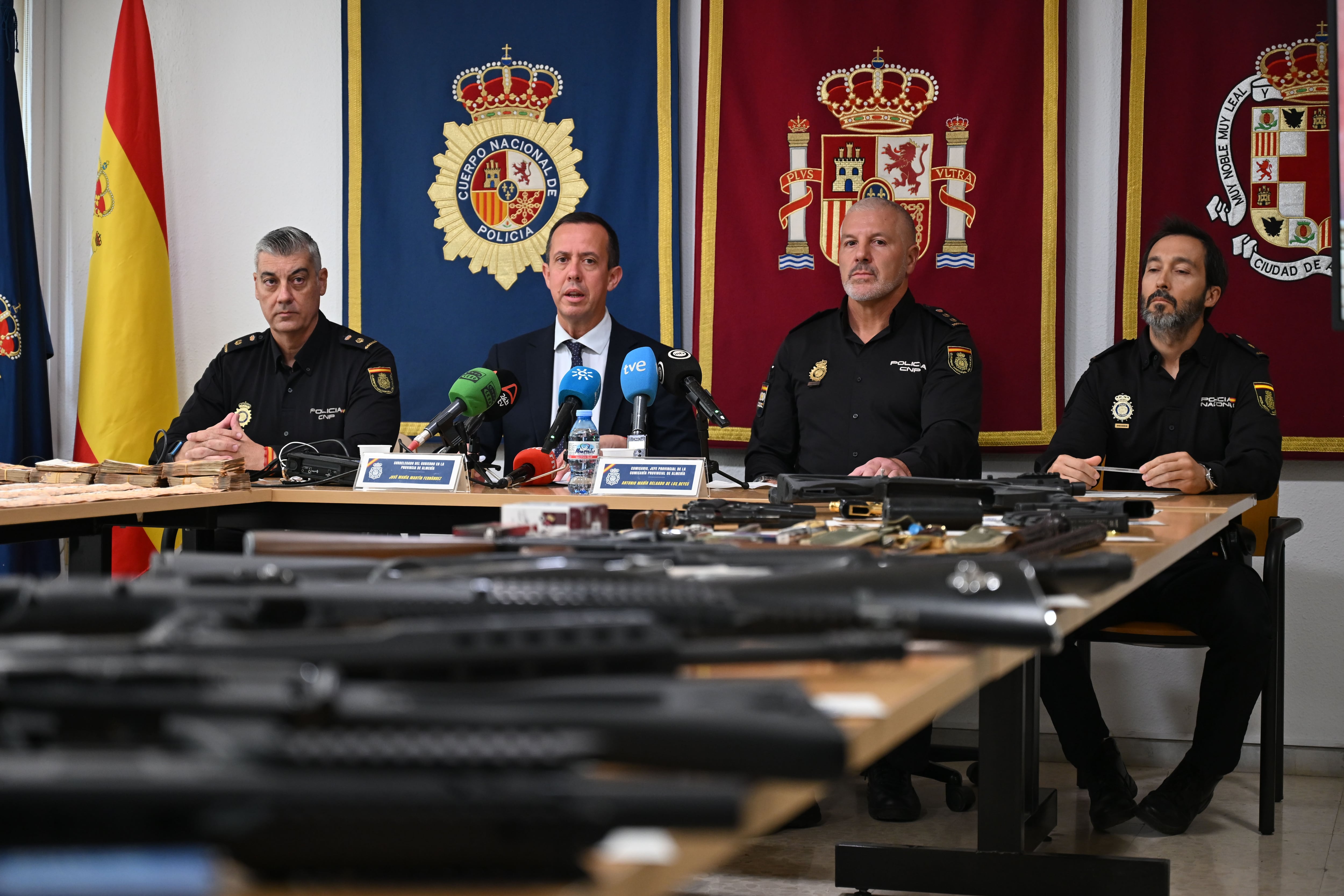
At six in the morning last Wednesday there were 325 police officers distributed between Almería, Granada and Huelva waiting for a signal. There were four drone teams, a helicopter, several special intervention groups, information agents. The objective, after the order, was to carry out 24 entries and searches simultaneously in homes related to a group of drug traffickers. The epicenter was in the capital of Almería, where the leaders of the criminal organization that was intended to be dismantled were based. That’s how it was. As a result of the actions, 4,500 marijuana plants, 600 kilos of buds and 400 lottery tickets were seized for money laundering. Also 20 firearms, the vast majority of them war weapons, that the gang used to defend their merchandise and resell them to other drug traffickers, according to police sources. Finally, there were 22 people arrested – 19 Spanish and 3 Moroccan – who have been brought to justice. The Almería anti-drug prosecutor has requested prison for all of them.
The operation, called Kremlin-Zakais the second part of another that took place last April in the Almeria town of Pechina (4,400 inhabitants) under the name Pentagon-Orenev and that had started two years before. On that occasion, in addition to arresting 25 people – 15 were sent to jail – the agents located more weapons than they expected: 23, among which there were short weapons, long weapons and even a rocket launcher. “Our intention is now to go up to the next step: to see where the weapons came from and what their channel was,” the investigators explained then. This is precisely what they have done: the analysis of all the documentation and all the electronic devices analyzed allowed the opening of a new investigation that implicates other members of the same organization, precisely those who were arrested this Wednesday. They are all part of the same family clan in the area, something that differentiates drug trafficking in Almería compared to other areas such as the Costa del Sol. “There are many people from Europe who come to different parts of the province to do business, but they do not reside here as happens in Malaga,” say the same sources.
The police work carried out since the spring made it possible to verify that the members of the network who had not been arrested continued with their two main activities. On the one hand, the cultivation, which they carried out in different homes in Almería, Granada and Huelva. Then they carried out all the following phases – leaf, bite, bud and pollen – and then vacuum packed it and sent it to the Netherlands, from where it was distributed throughout Central Europe. In exchange, they received cash—almost 300,000 euros in cash have been found—or, in some cases, payments in kind. Sometimes it was exchanged for other types of drugs and, other times, for firearms. “The first objective is to arm themselves to defend themselves from other criminal organizations. There is no longer a stash that is not defended by someone with long weapons,” sources from the investigation illustrate.
Most of the weapons come from the Baltic countries and areas near Ukraine and Russia. The same sources emphasize that once the group saw that it had access to these weapons of war, it also decided to traffic them and resell them. “The basic users are organized crime organizations that work in the south of Spain and are linked to drugs,” police sources emphasize.
It is a business that, like marijuana — whose price is multiplied by five or six in northern Europe — is very profitable: a weapon that could cost 6,000 euros could be sold for 30,000 or 40,000 euros more. “The margin is very high,” the researchers point out.
The ease of access to weapons and the fact that many of those investigated had police records for violent crimes led to the enormous police deployment on Wednesday, which was supported by the General Information Commissariat, the provincial police stations of Almería, Granada and Huelva, different police intervention units (UIP), the Operational Group of Technical Interventions (GOIT), canine guides, four drones, a helicopter and numerous prevention and reaction units (UPR).
During the 24 searches (which are added to the 50 carried out in the first phase of the operation) more than 3,000 marijuana plants and 600 kilos of buds ready to be shipped – valued at around four million euros – and eleven long weapons, nine short weapons as well as abundant ammunition of different calibers were seized. Also 130,000 euros in cash and almost 400 tenths of this year’s national Christmas lottery – one of the ways to launder money – and 14 electronic devices, including high-end mobile phones. Four vehicles, a watch valued at 12,000 euros and various supplies and tools for growing and handling marijuana have also been seized. The 22 people arrested have already been brought to justice, the last ones this Friday. The Almería anti-drug prosecutor has requested prison for all of them.
For more updates, visit our homepage: NewsTimesWire