who could
live between the two.
First I will love the world
and then I will love God
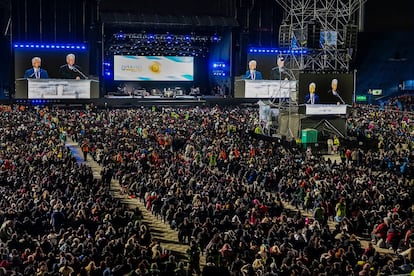
The gale of spirituality of the new album by the Spanish Rosalía crossed borders and oceans this Friday, the day of its debut. Her song of love for the divine and the evocation of saints and religious images of the same artist who three years earlier experimented with Latin rhythms and lyrics of sex and fame reached the ears of fans, but also of those who foresee the return of a global conservative current. On the same Friday, in Buenos Aires, 10,500 kilometers from Barcelona, more than 30,000 evangelicals gathered in a soccer stadium in the Argentine capital to hear the words of the American preacher Franklin Graham, Donald Trump’s favorite. An even greater number attended this Saturday.
Graham is the heir to the powerful evangelical dynasty founded by his father, Billy Graham. Like him, he remains close to power and is also the star of a world tour of “Christian revival” carried out in dozens of countries. The Festival of Hope repeats its format each time. It starts with evangelical musical shows that go in crescendo to the main course: the pastor’s preaching and his subsequent absolution of sins.
“People are searching. People are looking to find a purpose, a meaning in their lives. But there is something missing. Within us there is a void that can only be filled by God. And I tell you: God has a plan for your life,” Graham proclaimed from the pulpit raised above the stage of the Vélez Sarsfield stadium. “But we have a problem. And the problem is sin. Sin stops God from revealing himself and showing you his plan. Sin is a barrier between you and God,” he continued before an auditorium filled with teenagers and families with children.
In the long list of sins cited by Graham, homosexuality stood out — “God wants you to use sex, but it must be used within a marital relationship between a man and a woman. Not between two men. Not between two women” — and abortion — “abortion in the eyes of God is murder.”
His reactionary speech collides with current laws in Argentina, but it also shows the ongoing cultural battle defended by the far-right government of Javier Milei and which finds a growing echo in Argentina.
Graham’s preaching was interrupted several times by applause. The most thunderous was the one he received when mentioning the meeting he had with Milei last Tuesday. The American pastor said at the festival that Milei spoke to him about Moses, the Old Testament prophet with whom he likes to identify, and that he gave him a Bible, the same gift that attendees received at the end of the event.
President Javier Milei received evangelical preacher Franklin Graham, current president and executive director of the Billy Graham Evangelistic Association (BGEA) and the evangelical organization Samaritan’s Purse, at Casa Rosada.
In addition, he was accompanied by the member of the… pic.twitter.com/D878Wm8rr0
— Office of the President (@OPRArgentina) November 4, 2025
One day before, on October 31, the Argentine president received representatives of the Alliance of Evangelical Churches of the Argentine Republic (Aciera) at the Casa Rosada. The meeting was followed by an unprecedented act of prayer. Never before had an evangelical ceremony been held at the headquarters of the Argentine Executive. Nor had a president of this Latin American country declared that God appeared to him to reveal that he had a mission nor had he exhorted “the forces of heaven” to emerge victorious from the transformation that he promotes in Argentina with the blow of a chainsaw.
About 15% of Argentines identify as evangelical, a figure below the Latin American average, which is around 20%. Even so, both the number of believers in this cult and the power of its leaders is on the rise, although at a very great distance from what they have held for decades in countries like the United States and Brazil. “Until now there was a territorial evangelical presence that could not make the leap into politics,” says sociologist Ariel Goldstein, author of the book evangelical power.
The Argentine president began courting the Christian vote during his 2023 campaign as a strategy to reach the popular sectors, but he multiplied his gestures towards them this year. In the legislative elections held on October 26, six evangelical candidates were elected by Milei’s party, La Libertad Avanza, who will take their seats in December. Among them, Pastor Nadia Márquez, future senator, stands out, who maintains that abortion “is one of the largest genocides in history” and promotes the repeal of the law on voluntary interruption of pregnancy approved in Argentina five years ago.
For Goldstein, the main ability of evangelism is “its capacity for construction in emotional terms and belonging and in Argentina it advances in a context of social disintegration that has accelerated since the pandemic.” This sociologist warns that not all evangelical churches defend extreme right-wing positions like Graham’s. In 2023, some of them supported the Peronist candidate, Sergio Massa.
Even so, he believes that many Pentecostal pastors have become intermediaries between the Argentine right and the popular classes. “Milei’s government is suffering wear and tear, even though it has managed to retain an important part of the vote. One way to expand its social base to popular and middle sectors is through evangelism,” says Goldstein. Their example is Trump and former Brazilian president Jair Bolsonaro. The enormous applause from Argentine evangelicals upon hearing Milei’s name shows the success of that strategy.
For more updates, visit our homepage: NewsTimesWire