39 days and 20 hours had passed since the start of the longest partial government shutdown in the history of the United States when the spark of the agreement lit on Capitol Hill. It was around 7:00 p.m. this Sunday, with the first news that Democrats and Republicans had reached a principle of understanding in the Senate to reopen the funding tap for the Federal Administration, closed since October 1.
After 14 failed votes, a new proposal – presented hours earlier by the Republicans of the Upper House, with their leader, John Thune, at the helm – managed to convince eight rival senators, among whom were the negotiators: Tim Kaine (Virginia), Angus King (Maine) and Jeanne Saheen and Maggie Hassan (New Hampshire). With them, the conservative caucus (which has 53 seats and one dissident, the veteran Rand Paul, from Kentucky) thus added the 60 votes necessary to achieve the qualified majority required by the Senate filibuster rules to carry out important decisions; for example, budgetary ones.
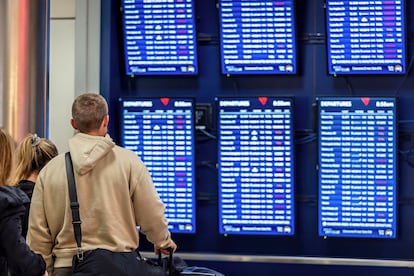
That agreement is not yet the last stop on the journey of what those familiar with Washington jargon call shutdownand which on this occasion has caused the suspension of the food stamp program for millions of needy people, pushed thousands of civil servants, deprived of their salaries, into hunger lines and wreaked chaos in airports throughout the country. It is more about the beginning of the end of closure.
There were still three extraordinary votes in the Upper House before the end of a day that is normally a rest day in the Capitol, but which this Sunday made an exception given the circumstances. Afterwards, the pact will travel to the House of Representatives for ratification and the subsequent signature of President Donald Trump. This process can take several days.
The agreement, the details of which are still not entirely clear, guarantees financing of the federal Administration until January 30. So, if the lack of harmony between both parties persists, the fight could return to the starting point and cause a new closure.
The budget proposal includes a provision with a point that Democrats sought: the reinstatement of federal employees laid off during the shutdown, and the guarantee that there will be no more massive workforce adjustments until the end of January. It also banishes the threat made by Trump that officials would not receive, as is customary, retroactive payment for salaries not received during these 40 days. And it funds the food stamp program until the end of 2026.
Left out is the great Democratic aspiration: to prevent the health subsidy program agreed upon during the pandemic as part of the law known as Obamacare (ACA) from expiring at the end of the year. This Sunday’s pact only includes the Republican commitment that there will be an isolated vote in the Capitol on that matter. Taking into account the distribution of power between both parties, it is highly unlikely that it will succeed.
Trump against insurers
Trump’s stance on the ACA doesn’t help either. The American president went so far as to propose over the weekend on his social network, Truth, that the ideal would be for Obamacare money to be given directly to citizens to skip the “sucking insurers.” Trump has also been especially persistent in recent days in asking his people in the Upper House to get rid of the filibuster. Finally, there was no need.
Democratic Senate Minority Leader Chuck Schumer on Friday launched his own proposal to reopen the public spending spigot. He requested as a condition a one-year postponement of ACA subsidies, to, from then on, negotiate with the other party with the open Administration, as Thune had been asking for weeks.
“Republicans just need to say yes,” Schumer asked them. But they immediately responded no. This Sunday, in a speech in the Senate, the Democratic leader announced that he would not support the latest rival proposal, because “it is insufficient to address the American healthcare crisis.” “Let there be no doubt, the American people know who is causing this trauma in the health system: Donald Trump and the Republican Party,” Schumer said, before predicting that his compatriots “will remember their (Republican) intransigence every time they have to pay an exorbitant sum for their health insurance.”
Five of the eight senators who finally decided to vote with the Republicans justified themselves in a joint press conference by saying that the agreement reached was “the only possible one after six weeks in which the American people have suffered from the closure,” according to Kaine. They also insisted that having initiated the commitment to a separate vote on the ACA program will serve “for Republicans to portray themselves to voters.”
The decision of these senators to break the unity that their party had been showing in these almost 40 days opens an internal crisis (another) in the party, which was short-lived by the joy of the resounding electoral victories achieved in New York, New Jersey, Virginia and California last week. These were an injection of confidence just one year after Kamala Harris’ phenomenal defeat against Trump in the 2024 presidential election.
Everything indicates that the agreement has been precipitated after the decision of the United States Air Authority (FAA) to order, since early Friday morning, the cancellation of hundreds of flights at the 40 main airports in the United States to address air saturation due to the resignations or resignations of controllers, federal employees affected by the government shutdown. On Sunday, more than 1,600 flights were suspended and delays continued to increase on the third day of the application of a measure with few precedents.
The administrative blockade has dozens of federal agencies closed or with low activity due to lack of funds. The almost 13,000 air traffic controllers and thousands of airport security workers have not been paid since October 1. Many have decided to take sick leave to look for another source of income with which to cover household expenses.
Another unpleasant consequence of shutdown has been the fight between the Trump Administration and the Democrats – with the intervention of a couple of federal judges and, finally, the Supreme Court – over the food stamp program (SNAP), vital for 42 million Americans. The Government has fought unspeakably hard not to pay them starting last week. This Sunday it was learned that he had even ordered the States to recover the money invested in those coupons during the judicial tug-of-war.
There are 750,000 officials suspended from employment and salary, who feared that the drama would continue until shortly before Thanksgiving (this year it falls on November 27) and who this Sunday followed the news from the Capitol with logical interest. Others, drivers among them, are considered “essential” and were obliged to go to work, but without pay.
Dozens of museums, monuments and national parks have been forced to close their doors or operate without surveillance or without basic services such as garbage collection. If this Sunday’s agreement in principle crystallizes, they will be able to reopen in the coming days. It will be when they recover the public financing lost due to the fight between Democrats and Republicans.
For more updates, visit our homepage: NewsTimesWire