“Just a few months ago, in a beautiful field of Pennsylvania, the bullet of a murderer pierced my ear. But then I felt, and now I believe even more, that my life was saved by a reason. God saved me to make the United States a great nation.” This phrase, in the inaugural discourse of Donald Trump, last January, is a sample of the concept of messianic charism, a type of leadership in which the leader is perceived as a providential savior, someone who embodies the redemption of a nation, with a transcendental mission that places him above the established institutions and norms. This type of charisma is based on the belief that the leader has extraordinary, almost supernatural qualities, and is the only one capable of guiding his community or nation towards a promised destiny.
Weber (1922) distinguished charisma as a form of authority based on devotion to a perceived as exceptional leader. We would be here in an extreme case of the personal charism, in which the leader is considered sent by a superior force and that, according to Weber himself, is usually associated with moments of crisis in which the population seeks a strong figure that promises to restore order, return the lost greatness or guide the people towards a superior destination. Also Schmitt, in his book Political theologyargued that, in times of crisis, sovereign power tends to be embodied in a charismatic figure that assumes an almost messianic role, deciding on the “state of exception” and being above the law.
To achieve this sacralization of his figure, however, Trump has needed more things than the phrase in the inaugural discourse. We review 5 elements below:
1. The existence of an unparalleled crisis
For a leader to be perceived as a Savior, it is necessary to draw the scenario of an almost apocalyptic proportions that only he can solve. In the case of Trump, the story of a United States in decay, besieged by internal and external enemies – the corruption of elites, uncontrolled immigration, unfair globalization – reinforces the perception that its leadership is not only necessary, but providential.
2. Use of symbology and messages
The sacralization of Trump’s figure is reinforced through symbols and rituals that consolidate their messianic role. Its public events generate an atmosphere of collective fervor. The iconography around his figure – from the flags with his face to the shirts with messianic phrases in favor of Trump – contributes to the idea that his leadership transcends the merely political. Government acts also seek to strengthen this idea. The first cabinet meeting began with a sentence that was postaled in networks. On March 19, in another iconic image, it was surrounded by 17 evangelical shepherds who prayed for him in the Oval Office. They did it by putting their hands on the president. The stamp was repeated in another event on May 1. Several of the participants are part of the White House Faith office, which was created on February 17. He also created by decree the commission of religious freedom.
Image and video examples:
3. The legitimacy based on the duty to save the country
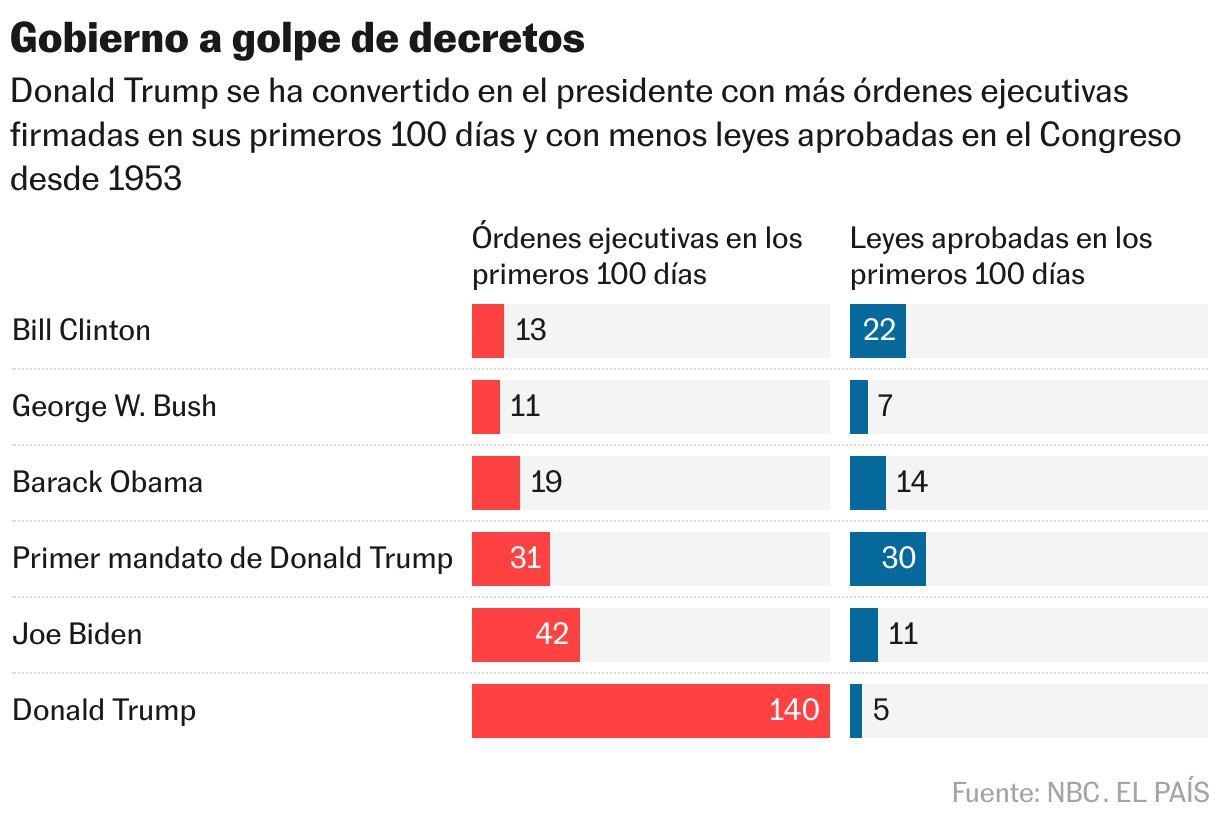
When a leader becomes the object of faith, politics ceases to be a rational deliberation space and transforms into an absolute field of loyalty, where any questioning is seen as a betrayal. The unprecedented attack on any person or entity that doubts or puts obstacles to what they are doing as a government (even if it is illegal) is a good example. The Congress also remains in the background before the will of the leader, which imposes its agenda through decrees and not of the traditional legislative processes. Nothing can stop Trump because what he does is legitimate and necessary to safeguard the future.
4. The role of the faithful community
A messianic leadership is not supported only in the figure of the leader, but in the community that follows with fervor. In Trump’s case, his support base does not see him only as a politician, but as the last bastion against forces that, according to his story, threaten the essence of the United States. LTo loyalty of these followers it is unwavering because without it, in their vision, the country will be convicted. They are organized in communities, on and offline, very polarized and active, which feed up not only content in their favor but, especially, of content that attack their adversaries, either through real or not. Its electoral campaign and now the White House have directly stimulated the creation of these groups. The last example is the new government website that collects positive news about Trump with the style of Drudge Report.

5. The sacrifice as proof of your mission
In messianic stories, the leader’s suffering becomes a validation of his destiny. In this sense, Trump’s murder attempt is not only a traumatic event, but a confirmation that he is a chosen one. In the narrative of his followers, the attack not only reinforces his role as victim of elites and internal enemies, but also elevates him to the nation’s martyr category. His survival, in this framework, is not a coincidence, but a sign of his divine purpose.
Image and video examples:
To deepen the subject
Books:
– Max Weber: Sociology of Power
– Carl Schmitt: Political Theology
– Alexander Dorna: the charismatic leader
– David O’Connell: God Wills It: Presidents and the Political Use of Religion
Articles:
– Xavier Peytibi: Communicate in the time of strong men
– D
– Juan Manuel Castro Carracedo: How Trump’s messianic rhetoric is based on his leadership and appeals to American identity
– María Pinho de Oliveira: Political sacralization or messianism? The political leaders of Nestor Kirchner, Hugo Chávez, Donald Trump and Jair Bolsonaro
– Eric Berger: ‘Standing Up for Christian Values’: Us Evangelicals Keep The Faith with Trump
– Adam Gabbat: ‘False Teacher’: Trump’s pick to Head the ‘White House Faith Office’ Roils Sub Fellow Christians
– Elizabet Dias and Ruth Graham: WHITE HOUSE OF WORLSHIP: Trump Elevates Christian Prayer and Power
Videos:
– Alex Connor: Trump: God’s Chosen President?
– Capturing Christianity: This Prophet predicted in 1983 That God Would One Day Use Trump
– The Bulwark: Christianity in Crisis: Trump, Politics, and The Future of Faith
Podcast:
– The Ezra Klein Show: Ross Douthat On Trump, Mysticism and Psychdelics
– David French and Russel Moore: Trump, Faith, and The First 100 Days
Antoni Gutiérrez-Rubí is a communication advisor.
For more updates, visit our homepage: NewsTimesWire