Last week, 153 Gazans landed in South Africa under murky circumstances. COGAT, the organization of the Israeli Ministry of Defense that controls the crossings of the Strip, assured that it had allowed them to leave and take off from an Israeli airport because “a third country”, without detailing which one, had agreed to receive them. But when the plane arrived on the runway in Johannesburg, the South African authorities and the Palestinian Embassy showed their confusion. They spent 10 hours on board, until receiving a 90-day visa, due to confusion over the arrival of passengers without an Israeli stamp in their passport.
The crisis put a project that the Palestinians have known about for half a year in the international spotlight. It was the latest operation by Al Majd Europe, an opaque organization that claims to have humanitarian purposes and that has removed hundreds of people from the devastated Strip in three operations since May. He sends them on charter flights to Malaysia, Indonesia, Kenya or South Africa.
“We just wanted to get out of that hell,” one of them, who escaped to South Africa, explains to this newspaper. The passengers paid between 1,000 and 3,000 euros, they did not know which country they were arriving in, they discovered it mid-flight or they landed in a different country than the one they expected as their destination, according to their stories, released after the controversy.
The ministries of Foreign Affairs of South Africa and the Palestinian National Authority (PNA) have accused the entity of exploiting the desperation of Gazans to promote their displacement and ethnic cleansing through the back door. It is a far from secret dream of the Israeli Government, particularly its most radical sectors, which aspire to depopulate the area of Palestinians as much as possible and build Jewish settlements there.
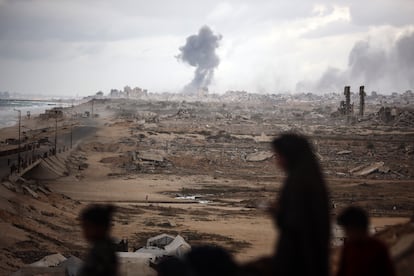
After devastating Gaza (more than 80% of the buildings are damaged, according to the UN), Netanyahu’s Executive has been canvassing dozens of countries for months to convince them to welcome its inhabitants. The Ministry of Defense created a Voluntary Migration Office to prepare their “safe and voluntary passage to third countries” and, in February, made the port of Ashdod and the Ramon airport (both in Israel) available to those who “want to voluntarily leave” the Strip, where the majority live poorly in tents, the UN has declared a famine around the capital and 7% of children remain malnourished after the ceasefire agreed in October, according to data released this Friday by the representative in Palestine of the World Health Organization, Rik Peeperkorn.
Katz made the announcement in full enthusiasm for Donald Trump’s idea of emptying Gaza of its population to turn it into the Riviera of the Middle East. The current ceasefire agreement buried it last month, at least on paper, by specifying that no one will be forced to leave or prevented from returning. Ramon, that airport at the disposal of the plan, is precisely where the controversial flights have been departing from.
In conversation with EL PAÍS, families from Gaza who have started the procedures to leave through Al Majd Europe defend their decision. The accumulated horrors of two years of invasion and the times that States have rejected their requests for evacuation make them see it as the only opportunity to reach a safe place. “No one in the world receives Gazans,” a Palestinian from the Strip protests under anonymity. She is willing to pay 2,350 euros for each family member—the sum that the group demands right now—to travel “anywhere.” “They use the excuse of stopping ethnic cleansing. What the hell! Do they expect us to continue suffering here with no means to survive?” he protests.
“I have tried every way to leave,” says another person on Al Majd Europe’s waiting list. Israeli restrictions leave a document signed by the World Health Organization certifying your need to leave for medical reasons worthless. “I want to live and see my son grow up,” he concludes.
In reality, the “escape from Gaza” operation for money already existed before the invasion. And it skyrocketed in the seven months between its start, in October 2023, and the seizure by Israeli troops of the Rafah crossing with Egypt, which cut off that escape route. More than 100,000 Gazans left the Strip during that period, according to data that the official Palestinian statistics agency admits it has not been able to update for months. They paid between 5,000 and 10,000 euros to a controversial Arab intermediary.
On its website, created in February, Al Majd Europe claims to assist Muslim communities in conflict zones and to have experience – which it does not demonstrate – in Türkiye and Syria. The Israeli newspaper Haaretz He noted on Sunday that the Office “referred” to Al Majd Europe to coordinate the departure of Palestinians with COGAT and points out as its promoter Tomer Janar Lind, an Israeli who has not denied organizing departures from Gaza. The organization defends that Israel is not among its founders, but rather “refugees” and volunteers.
Muayad Saidum, operational leader in Gaza according to the group’s website, tells this newspaper that cooperation with Israel is limited to security control “lacking a political dimension.” “All Palestinians, including (PNA) President Mahmoud Abbas, must coordinate their departure with Israel to travel from Gaza and the West Bank,” he justifies. Former police officer for the Hamas Government in Gaza and Palestinian bodybuilding champion, Saidum defines his work as “humanitarian.” “I can prove that each user asks us to travel,” he writes, ensuring that the departures will continue, despite the controversy: “Some implore us to rescue them.”
In a statement posted on its Facebook profile, it also argues that the entity does not announce the destination to users “for security”, so that neither Hamas nor the ANP could try to stop them, and that they can “return whenever they want”, although in reality it is Israel (which controls the Palestinian borders) that will eventually accept or not their return.
For those seeking to escape Gaza, contacting Saidum is a triumph. “He writes to those whom Israel approves to travel,” says one user. Beforehand, candidates go to another agent. An automatic response asks for passport photos for security control and states that the price covers “all expenses to the destination country.”
Once the payment is made, the user remains alert. A communication from Saidum a few hours in advance in a WhatsApp group created expressly It summons travelers to a point on the Strip, which they must reach as best they can, despite the circumstances on the ground. They are ordered to respond that they are participating in an evacuation organized by France if anyone asks them where they are going.
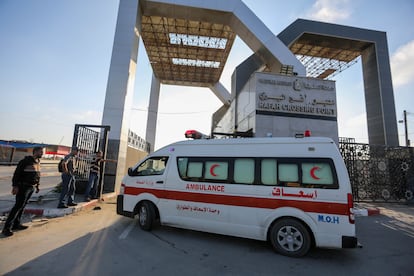
With the curtains drawn, the buses move towards Kerem Shalom, a passage between Israel and Rafah. Some passengers remember finding the Palestinian side of the crossing deserted. They are forced to abandon their luggage and transported more than 200 kilometers to the Ramon airport, near the city of Eilat, in the extreme south of Israel.
Gazans who were previously wary of paying the ticket now want to do so. “We know that Israel is behind this and will prevent our return, but we deserve the chance to escape from here,” says one woman.
The group’s first operation, in May, was free and expatriated 57 passengers, including Saidum, it states. The plane arrived in Budapest and some continued to Indonesia or Malaysia. A second, on October 27, transferred 150 Palestinians. They stopped in Kenya and most continued to South Africa, where they entered without problems.
The airlines involved in the routes deny having contacted Al Majd Europe or engaging in questionable practices. On board, however, atypical scenes occurred. Passengers on the second flight discovered that they were heading towards Nairobi when the captain announced it over the public address system.
The third operation, the one that unleashed the crisis, ended with 130 Palestinians in South Africa, dozens more bounced to other countries and the discontent of the authorities. Government sources cited by the local press explain the 10-hour wait with the need to ensure that there were no Hamas leaders on board. The border control authority publicly stated that the lapse was motivated by the demand for health and immigration controls. In the latter case, the standard requirements were not met. But they finally decided to let them pass for reasons of “empathy and compassion,” according to the country’s president, Cyril Ramaphosa.
The Minister of Foreign Affairs, Ronald Lamola, has made it clear that he will not allow similar episodes. “We do not want more flights of this type to our territory, because it is a manifest plan with the objective of expelling the Palestinians from Gaza,” he declared last Monday during a briefing to the press ahead of the G-20 summit scheduled this weekend in Johannesburg. “This appears to be part of a broader plan aimed at expelling Palestinians from Palestine to different regions of the world. It is a clearly orchestrated operation.”
The South African Government has maintained a leading profile in criticizing Israel’s war operations in Gaza, presenting the complaint for alleged genocide against Israel that has been analyzed by the International Court of Justice in The Hague since the end of 2023. Due to its history, it is also a global emblem of the fight against colonization processes.
For more updates, visit our homepage: NewsTimesWire