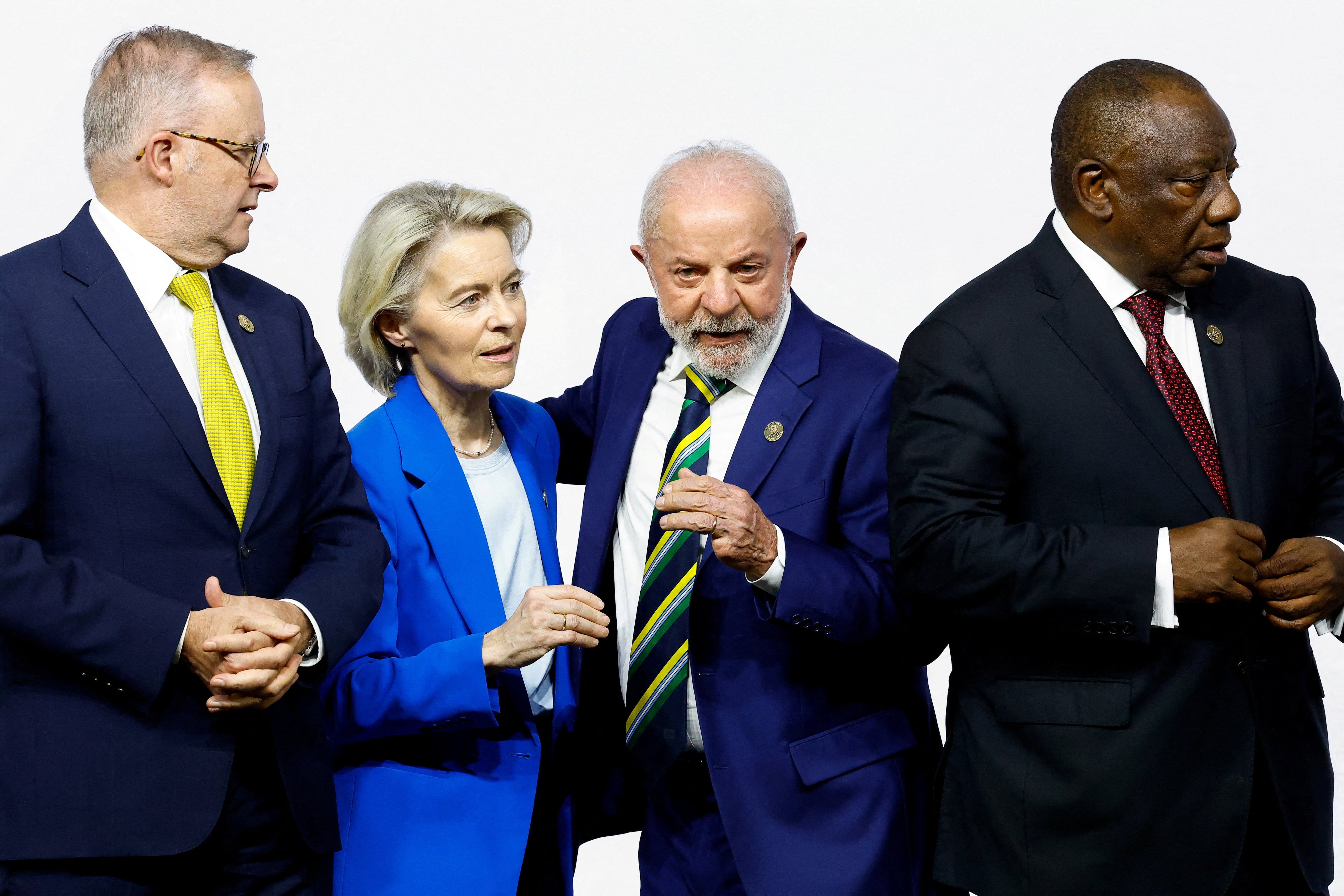
The president of Brazil announced this Sunday that the agreement between the European Union and Mercosur will be signed on December 20 in his country. Both Brasilia and Foz de Iguaçu are being considered as locations. Luiz Inácio Lula da Silva specified the date and pointed out the two cities during an appearance before the press in Johannesbusrgo (South Africa), after participating in the G-20 summit with the president of the European Commission, Ursula von der Leyen, and her French counterpart Emmanuel Macron, among other allies. “Possibly, it is the largest trade agreement in the world,” the Brazilian has proclaimed about an agreement that has been in the making for almost 25 years.
Lula has summarized in two figures the magnitude of what will be the largest free trade area in the world: it is an agreement that involves practically 722 million people between the EU and the four Mercosur countries (Argentina, Brazil, Paraguay and Uruguay) that add up to 22,000,000 million dollars of GDP. Both parties signed the political chapter of the agreement a year ago.
The tariff war waged by US President Donald Trump has significantly increased the urgency of both blocs to look for alternative partners and to close a trade agreement that has been in the making for so long. President Lula has enormous interest in closing it before the end of the year, when his rotating presidency of the South American bloc and that of Denmark in the EU will end. The Brazilian has confirmed that next year he intends to run for office in search of a fourth term.
France, which is the country that has led the opposition to the pact, demands a security clause to give its support. In a meeting parallel to the G-20, the French Foreign Minister, Jean-Noel Barrot, reminded his Argentine counterpart, Pablo Quirno, of the conditions imposed by President Macron as a prerequisite for French support for the agreement and, in particular, the need to finalize a robust safeguard clause with Mercosur partners,” according to a note from the French Foreign Ministry cited by Efe.
This clause consists of a legal mechanism that would allow one of the parties to temporarily limit imports of a specific product if they cause specific damage to a specific sector. France is especially concerned about the impact of beef exports from Brazil and Argentina on its ranchers.
Lula has admitted to the press that, once the text is signed in December, “there will be a lot of work to be able to start enjoying the advantages of that agreement, but we are going to sign it.”
For more updates, visit our homepage: NewsTimesWire