The visitor to the latest Fundación Telefónica exhibition in Madrid bursts out laughing when he sees his own image on the screen, but treated with the parameters of the big data. “54% chance of being a foreigner.” “32% chance of living in a peripheral neighborhood.” It’s normal to smile, it seems like a joke. Then the smile fades and the questions arise: “Is this how he sees me?” big data?” And more importantly: “Who makes use of that big data” Or better yet: “Will a report emerging from this leviathan end up in the hands of a human resources manager who will decide my hiring tomorrow?” The visitor breathes, it’s just a work of art. But then he discovers the next room, papered with the passwords of thousands of Madrid residents that were exposed during a security breach two years ago. “Will mine be written on this wall?”
The digital world is curious. We accept cookies like someone who eats a cookie without looking at the label: quickly, with confidence and, above all, without thinking too much. Meanwhile, we are leaving family photos in that eternal and ethereal amber, likes and comments like a digital breadcrumb trail. We do it in automatic mode, as if our time on the Internet left no trace. Little creatures.
That is why exhibitions like Today is a good day to talk about Digital Rights They arrive at the right time. In an ecosystem where infoxicationcyberbullying and data leaks are our daily bread, this exhibition serves as a reminder—sometimes sweet, sometimes uncomfortable—that in life on-line We also have rights (and responsibilities). Inspired by the 2021 Digital Rights Charter, the exhibition covers seven major digital territories. He does it with humor, with everyday examples and with installations that shake a little inside, signed by artists (Noemí Iglesias Barrios, Roel Heremans, Miguel Rangil, Domestic Data Streamers, Marc Lee, Hasan Elahi…) who know how to convert data, screens and algorithms into necessary questions.
A screen shows groups, sexual or racial, that have found a way to gain visibility on the Internet. In front, an electric hammer is drilling into the wall at the rate at which words are used on the Internet. Nigger either whorea sign that hate speech is also growing in this digital Wild West in which we live. Two sides of the same coin, neither of which should be ignored.
Curated by the artistic collective Domestic Data Streamers and Fundación Telefónica, the exhibition offers a broad overview of the work of artists and technologists who reflect on seven rights: freedom of expression and truthful information, privacy, identity, decent work, the right to be forgotten and digital inheritance, access to the Internet and human decision against AI. Next to nothing. The proposal, also promoted by the Digital Rights Observatory, does not seek to scare, but to awaken.
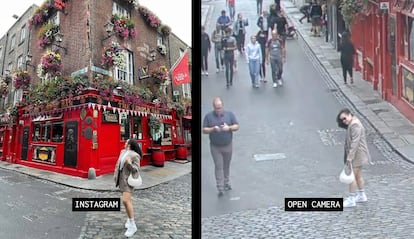
Not everything is murky, and to show a button: the evocator Synthetic Memories (from the Domestic Data Streamers collective itself, 2024), where generative AI is used to capture the memories of older people in photographs in an impressive creative exercise to which the protagonists themselves give their approval once they see the image. But, obviously, it also explores the murkier side of the metaverse. There is a particularly curious piece in the exhibition, The Follower (Dries Depoorter, 2023), which specularly contrasts two complementary realities: on the one hand, on a screen we see famous people influencers posing in one of his selfies on Instagram. On the other hand, and through access to public video surveillance cameras, we see the other camera of the coin: how they tuck in their bellies, how they pout, how they believe that no one is watching them. Few ways as effective as The Follower to understand that, in 2025, there is always someone watching, even if we don’t see it.
Browsing the internet should not be an act of faith, but rather a conscious exercise. And perhaps, after touring the exhibition, one will think twice before accepting cookies as if they were complimentary sweets or using the same password for everything. Today is as good a day as any other to talk about digital rights… but, above all, to start exercising them wisely.
For more updates, visit our homepage: NewsTimesWire