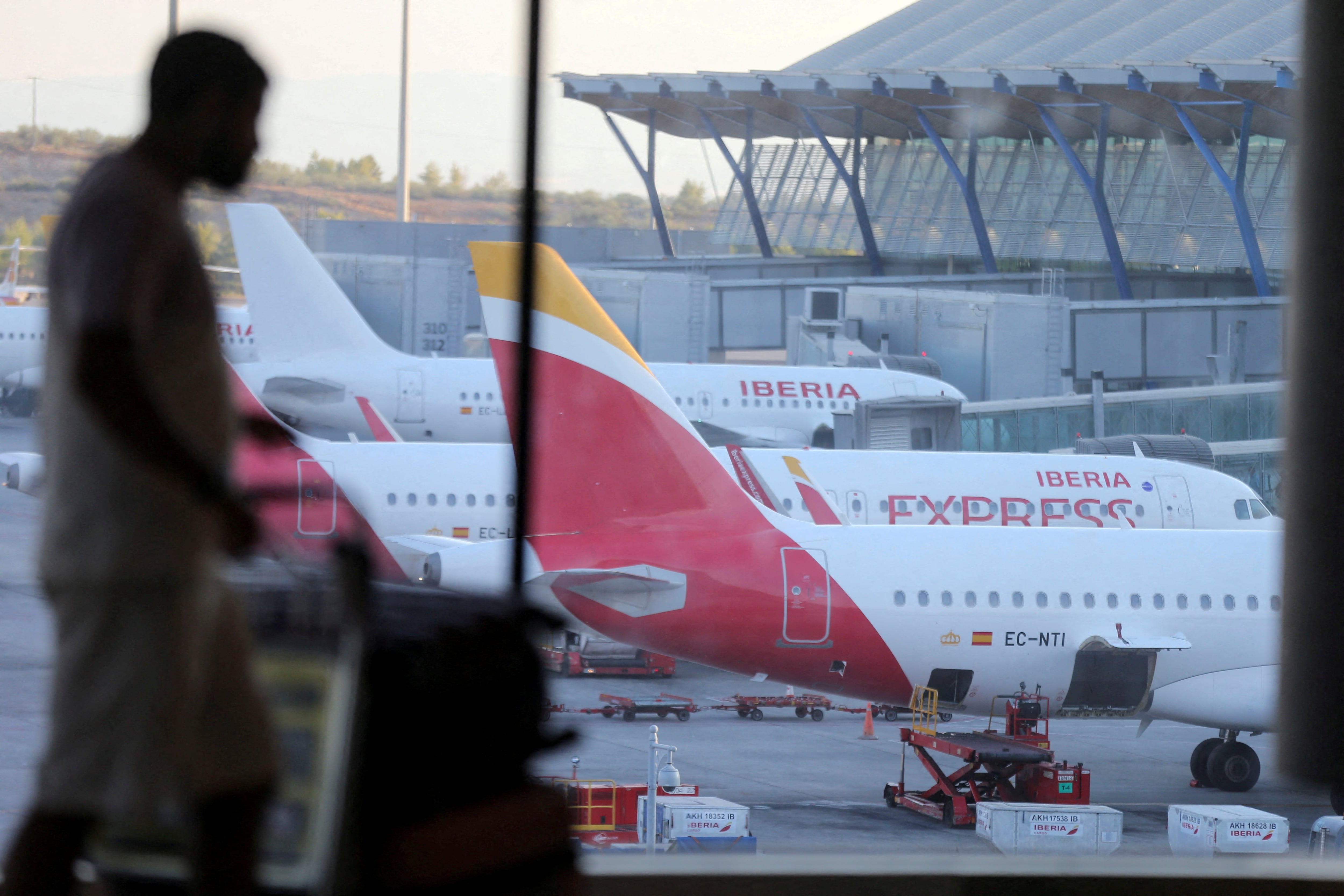
The Government of Nicolás Maduro has carried out its threat and on Wednesday night it has revoked the air traffic rights of Iberia, TAP, Avianca, Latam Colombia, Turkish Airlines and Gol. The Chavista regime’s argument is strictly political. The Ministry of Transportation and the National Institute of Civil Aeronautics (INAC) accuse the airlines of “joining the actions of State terrorism promoted by the United States Government, unilaterally suspending commercial air operations to and from the Bolivarian Republic of Venezuela.”
The revocation order has been published in the Gazette of the Bolivarian Republic of Venezuela without mentioning the other two Spanish airlines that have closed their connections with Caracas for security reasons: Air Europa and Plus Ultra. At the moment they would not be affected by the withdrawal of rights, although they stopped flying this Tuesday when Iberia had announced it on Saturday and has already left planes on the ground since Monday.
On the Air Europa website you can read that “flights to or from Caracas from March 28, 2026 are subject to government approval”, without further explanation. And a spokesperson for Plus Ultra confirms that the company maintains “flights canceled until December 1 following the guidelines of the notam (risk warning) sent by the Spanish aeronautical authority.”
The companies followed a recommendation from the US Federal Aviation Authority (FAA), which last Friday issued a warning due to a “possible risk situation” for flying over Venezuelan skies. The Spanish Aviation Safety Agency (AESA) joined this alarm on Monday in clear support for the decision of the three airlines of this country that connect with Venezuela. The advice is not to cross Venezuelan airspace, due to high risk and regardless of the flight height, at least until after December 1.
The alert responds to an unprecedented military deployment in the Caribbean, which days ago also included the largest US aircraft carrier, the Gerald Ford. On Monday, Venezuelan authorities gave a 48-hour ultimatum to these airlines to resume operations, openly threatening them with a cancellation of the granting of flight rights in the country.
The note sent by the AESA to the airline companies with bridges between Spain and Venezuela indicates that “until December 1, Spanish civil air operators are strongly recommended not to carry out any flights in the airspace within the Maiquetía FIR, due to the potential risk for civil aviation due to increased military activity, anti-aircraft weapons capable at all altitudes and lack of coordination between the parties to the conflict.” Both Iberia, Air Europa and Plus Ultra have kept up with the Maduro Government despite the threat of a veto in the Latin American country.
The regime’s unmitigated reaction is due to the fact that Venezuela, a country already diplomatically surrounded, is thus practically isolated internationally by the airlines’ decision. On Monday, in a meeting with Venezuelan authorities, representatives of the airlines presented their plans to reschedule the suspended flights. The step taken by the Government ignores the call for dialogue from the powerful airline association Iata, who warned that a measure such as the withdrawal of flight permits would disconnect Venezuela. Iata also referred to the fact that the decision to stop the airlines was temporary and adopted “after rigorous risk analysis to guarantee the safety of passengers, crews and aircraft, in accordance with the international standards established in Annexes 6 and 17 of the Chicago Convention.”
To the risk warning issued from the United States, which has for the moment set a precautionary period that extends until February, recommendations from other countries have been added, starting with the note sent by the Spanish AESA.
At least 36 weekly flights operate between Madrid and Caracas with an average of 300 passengers each, which complicates the reorganization of the offer at the beginning of the high season of the Christmas holidays. Only the withdrawal of flights between Madrid and Caracas until December 1 has affected around 6,000 travelers from Iberia, Air Europa and Plus Ultra.
The Spanish Minister of Foreign Affairs, José Manuel Albares, assured that all Spanish companies will have the support of the Government. Foreign Affairs also reiterated the Government’s recommendation not to travel to Venezuela unless necessary, a measure in force since the worsening of the political crisis after the 2024 elections and now reinforced by the uncertainty generated by the temporary suspension of flights.
The suspension of flights has a great impact on the region. Gol, which operates a regular route between Caracas and the Guarulhos airport in São Paulo, intended to maintain the cancellation of its flights at least until this Friday. Other companies, such as Copa, with connections from Panama and Bogotá, continue to operate, as do national airlines. Those that work in association with Spanish companies, such as Laser, have joined the measure recommended by the AESA.
For their part, Colombian authorities reported that at least 1,500 passengers on their routes with Venezuela have been affected by the suspensions that began last weekend. Given the diversion of air routes from Europe and South America that usually flew over Venezuela, Civil Aeronautics of Colombia reinforced surveillance and communication systems.
For more updates, visit our homepage: NewsTimesWire