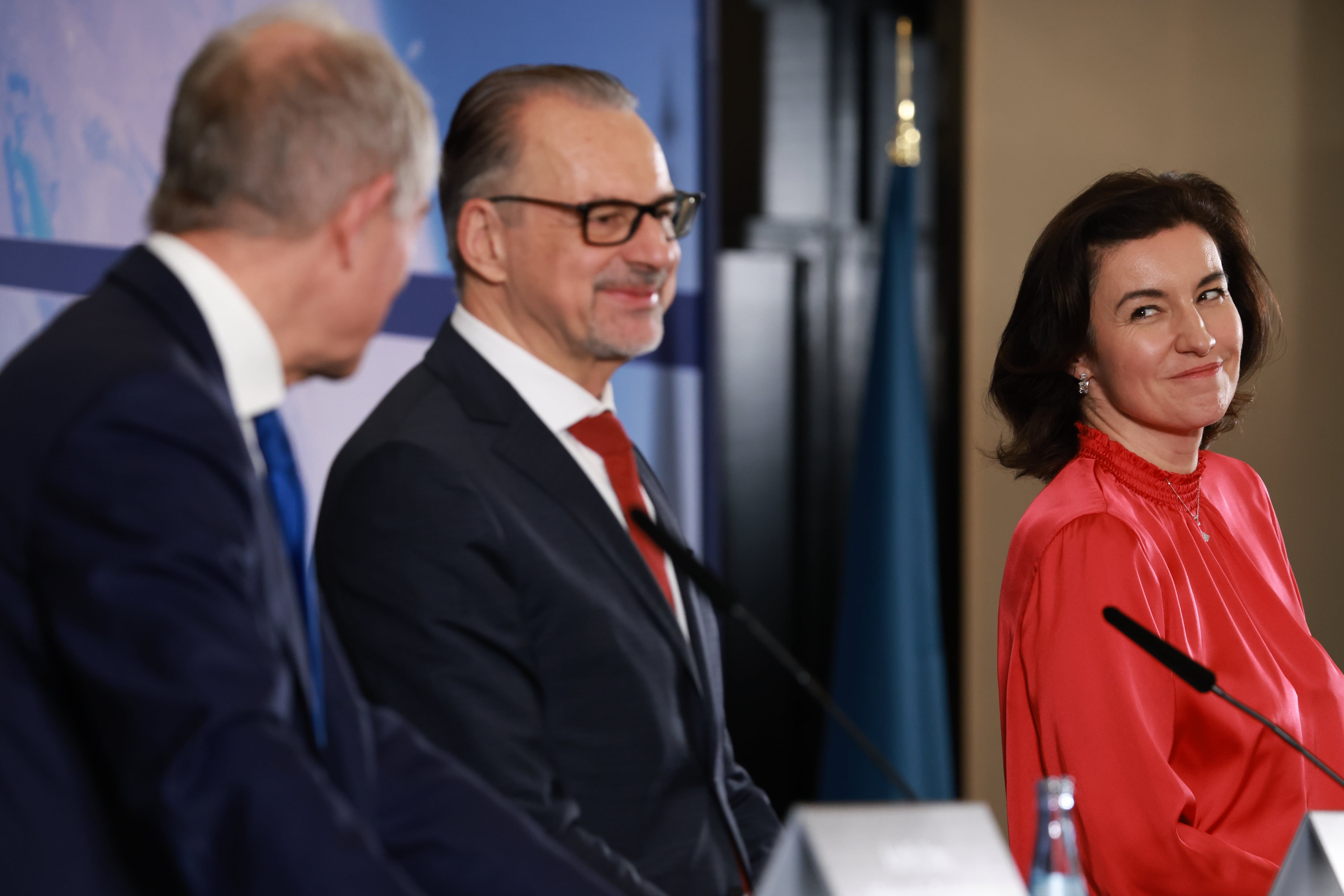
The director general of the European Space Agency wanted to see a commitment from its 23 member countries—including Spain—that Europe was not going to be left behind in space, and it has had it. The meeting of ministers of the nations that make up the ESA concluded today in Bremen, Germany, with the agreement of a budget of 22.1 billion euros for the next three years. Austrian Josef Aschbacher was impressed: “It’s a record level of commitment,” he said at a press conference. “You have written a new page in history,” he added before the dignitaries of the summit, which was attended by the Minister of Science, Innovation and Universities, Diana Morant, and the director of the Spanish Space Agency, Juan Carlos Cortés.
The ESA needed a budgetary boost to alleviate an increasingly worrying reality: from being the second largest power in space it has become the third, already many bodies away from the two absolute leaders, the United States and China, whose drive seems to never stop to the point of being the favorite to land astronauts on the Moon in 2030, even before its North American rival. The reality is that cooperation with the American partner is faltering since Donald Trump arrived at the White House, so Europe could have to continue alone with missions of utmost importance.
The ESA has managed to save one of its flagships at the last minute: the project to send the first European exploration vehicle to Mars as part of the Exomars mission. The project has suffered significant delays due to the War in Ukraine and was hanging by a thread due to the possible departure of the United States. But Aschbacher has reported that the American agency NASA has confirmed its participation, which is essential, since they provide the launcher, the energy unit based on radioactive isotopes and the brakes, which are essential to not end in failure, as happened to its predecessor mission launched in 2016. The project, which will be launched in 2028, continues 100%, ESA has assured.
ESA also expects to maintain US support for other major scientific missions. Among them is LISA, a constellation of three ships separated by more than a million kilometers, but linked by beams of laser light that are designed to capture gravitational waves produced by black holes. The project has a budget of about 1.7 billion euros. It is also expected to move forward with New Athena which, with a similar budget, will be the largest X-ray space telescope in history. The director general of ESA also pointed out that, with the new budget approved for science, he hopes that in the future a robotic mission can be approved that would make the long 10-year journey to Saturn’s icy moon Enceladus, where it will land and analyze the compounds that come out of its powerful geysers in search of traces of life.
The summit has been a success for Spain, which has become the fourth largest country in the organization, behind Germany, France and Italy, the traditional leaders of the organization in industrial and financing terms and far surpassing the United Kingdom.
At this meeting, Spain has committed 1,854 million euros for the next three years, an unprecedented budget that can translate, if sustained, into more Spanish astronauts who can travel to space, in addition to the main candidate: Pablo Álvarez from Leon. However, the current uncertainty surrounding the funding of the US space agency means that Álvarez will travel to the International Space Station. There is also no news about the possible trip of reserve astronaut Sara García, for whom a place on a private mission would be possible if the Ministry of Science committed to paying for it.
Spain has committed to increasing its annual contribution to the ESA by 155 million, up to 450 million each year until 2030. Spain also plans to substantially increase its contribution to the ESA’s optional programs. Specifically, the budget for these chapters will rise from 500 million euros to 1,400. Spain, through this contribution, will be able to accompany the Elche company PLD Space in the commercialization of the Miura 5 launcher and the development of advanced versions of the launcher, with an investment of 169 million euros through the ESA European Launcher Challenge (ELC).
For more updates, visit our homepage: NewsTimesWire