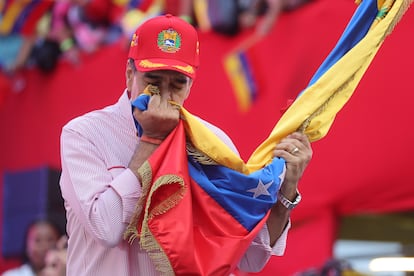
The president of the United States, Donald Trump, met this Monday with his national security team to discuss the next steps in relation to Venezuela, as confirmed by the White House without giving more details about what was discussed, while tension has been at a high for days due to the possibility that the Republican chooses to give orders to attack targets within the South American country.
The White House has also confirmed that on September 2, when US forces sank the first drug boat in Caribbean waters in their anti-drug campaign, they carried out a second attack that killed the two survivors detected after the first hit. Spokeswoman Karoline Leavitt has attributed the order to Admiral Frank Bradley, head of the Special Forces command.
The meeting took place 24 hours after Trump confirmed having had a telephone conversation with Maduro. In that call on November 21, according to an exclusive from the Reuters agency, the US president demanded that the Chavista leader leave power before last Friday, November 28, in exchange for guaranteeing his safety during his transfer to a third country. According to the sources cited by Reuters, that offer is no longer standing.
The expiration of the deadline without Maduro having left power precipitated Trump’s statement in which he announced the closure of Venezuelan airspace on Saturday, according to the agency.
Among his conditions, Maduro asked for amnesty for himself and his family, the end of the international sanctions that punish him and a hundred senior Venezuelan officials, and the withdrawal of the charges he faces before the International Criminal Court. It also proposed the formation of an interim government headed by Vice President Delcy Rodríguez until elections are held.
If the agency’s information is confirmed, Maduro’s options become considerably more complicated. The Chavista government is seeking a second telephone conversation, according to Reuters.
In this afternoon’s meeting, the Secretary of Defense, Pete Hegseth, was one of the participants. Also present were, among others, the Secretary of State, Marco Rubio; the Chief of Staff, General Dan Caine, and Trump’s Chief of Staff, Susie Wiles, as well as Wiles’ number two and the president’s main domestic policy advisor, Stephen Miller. The beginning of the meeting in the Oval Office—not in the Crisis Room, as would occur in the event of some type of operation underway—had been set for 5:00 p.m. in Washington (11:00 p.m. Spanish peninsular time). White House spokesperson Karoline Leavitt had indicated that, in addition to Venezuela, another series of issues would be addressed.
Although he has admitted to having spoken with Maduro, Trump has not given any indication as to whether that call yielded any kind of fruit. “I wouldn’t say it was good or bad; it was a phone call,” he declared to the journalists who accompanied him on board the plane. Air Force One upon his return to Washington on Sunday night, after having spent the Thanksgiving celebrations at his private residence in Florida, Mar-a-Lago.
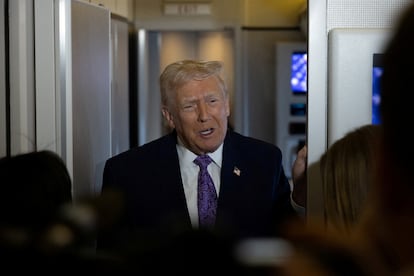
A day earlier, the president had set off all the alarms by announcing to international airlines that they should consider Venezuelan airspace “completely closed,” in what seemed like a warning that some type of US action was imminent. But in his statements to the press on Sunday, he seemed to try to calm the waters and warned against “giving it more importance” or “reading too much between the lines.”
The direct contact between the two presidents had raised hopes of a diplomatic solution to the conflict between the two governments. Washington accuses Maduro of “narcoterrorism” and of leading the Suns cartel, a way of referring to corrupt groups and individuals within the Venezuelan government and armed forces linked to drug trafficking. Last week, the State Department included the Suns cartel on its list of foreign terrorist organizations. The United States also considers the Chavista leader an illegitimate president, due to the irregularities perpetrated in the electoral processes, especially those of 2023.
The fight against drug trafficking is the argument that Washington alleges to justify the gigantic military deployment it has maintained in the Caribbean since August. Since September 2, US forces have carried out at least 21 attacks against suspected drug boats in international waters in that sea and in the eastern Pacific, killing at least 83 people in what has become known as “Operation Southern Spear.” The inclusion of the Suns cartel on the list of terrorist organizations provides Washington, in the opinion of this Administration, with new tools to launch a new phase in the operation that includes objectives in Venezuelan territory.
Among those attending this Monday’s meeting, Rubio is a well-known hawk towards the Chavista regime. He is one of the great architects of the very heavy-handed policy towards Caracas, including the US military deployment.
Hegseth, for his part, finds himself in the middle of a strong controversy after the newspaper Washington Post published information that, if confirmed, could make the head of the Pentagon guilty of war crimes, according to several legislators. According to information from this medium, on September 2, in the first attack against an alleged drug boat, in which 11 people were on board, two people survived and could be seen clinging to the remains of the boat. The Secretary of Defense—or of War, as he prefers to call himself—had given an oral order: “kill them all,” which led to ordering a second attack that finished off the crew members.
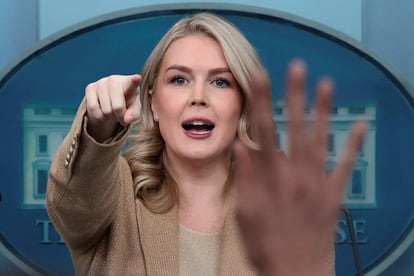
In his weekly press conference this Monday, Leavitt confirmed that, indeed, this second attack occurred. As he explained, the decision came from the head of the Special Operations Command, Admiral Frank Bradley, for reasons of “self-defense”, in “international waters” and “in accordance with the laws on armed conflict.” The admiral “acted within his powers” to give that order, stressed the spokesperson, who exonerated Hegseth of any responsibility.
Leavitt has not given arguments to justify that the second attack complied with the laws of armed conflict. The Pentagon manual on the Law of War of 2023 precisely gives as an example an order to attack shipwrecked people after an action at sea as a case in which the order of a superior must be rejected.
In his article, the post indicates that Bradley “told people on a conference call that the survivors were still legitimate targets because in theory they could call other traffickers to rescue them and their cargo, according to two sources. The admiral ordered the second attack to carry out Hegseth’s directive to kill them all.”
The Pentagon and Hegseth the information published by the post. On Sunday night, the Secretary of Defense posted an allegedly humorous image about the attack campaign on his social media account. It is a parody of a collection of children’s literature, in which the title “Franklin puts narcoterrorists in the spotlight” appears and in which the character of a turtle opens fire on alleged drug boats.
Trump has also rejected the accusations against his Pentagon chief, although more ambiguously. “I don’t know anything about this,” he declared on board the Air Force One. The president also declared: “We’ll take a look at that. (…). No, I wouldn’t have wanted that. Not a second attack. The first attack was very lethal, it was good. And if there were two people left…” After leaving that assumption in the air, he insisted again: “Pete said that didn’t happen.” Asked again, he again referred to what the Secretary of Defense had told him: “I don’t know. Let’s clarify it. But Pete said that he did not order the death of those two men.”
For more updates, visit our homepage: NewsTimesWire