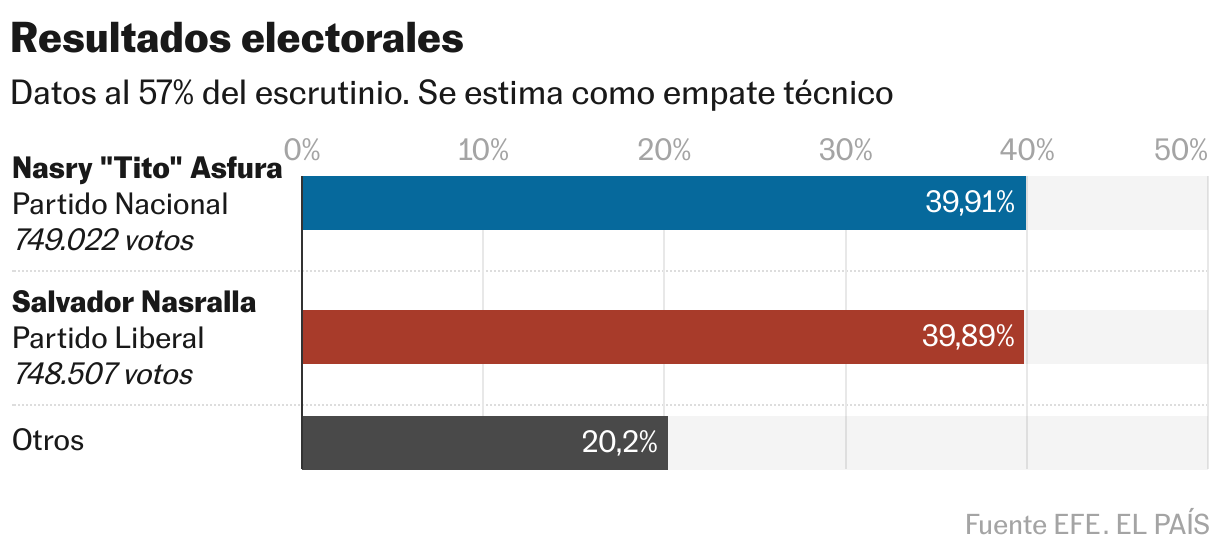
The preliminary results of the general election in Honduras have left its citizens with a taste of surprise. Very few in this Central American country expected that the elections would be decided vote by vote due to a technical tie between the two right-wing candidates, the liberal Salvador Nasralla and the nationalist Nasry Asfura, whose difference in count is only 515 votes. Nasralla has proclaimed himself the winner on social networks and has shown data from his party that gives him an advantage over his opponent, but Asfura has opted for caution. While uncertainty reigns in this Central American country, electoral authorities have asked for calm and to wait for the scrutiny to close. “Given this technical tie, we must be patient and wait for us to finish counting the minutes,” said Ana Paola Hall, head of the National Electoral Council (CNE). The law gives the electoral body up to 30 days to define a winner. The Army has said that it will only recognize whoever is elected after all the minutes have been counted.
The CNE closed the preliminary vote count, known as TREP, but has said that they are not definitive results. The pressure from the candidates and the electorate to know a winner of the race was joined this Tuesday by a problem with the transmission of the data. The electoral body acknowledged in a press release that the service contracted to release the minutes has presented “technical problems,” which further delays the recount process. “The company reported that packages of minutes transmitted on election night are still pending processing. The CNE has demanded the earliest possible technical solution,” the institution reported. The ruling party has demanded a quick recount of all the minutes and in a statement has stated that the delays show that “the process was affected by irregularities that compromise its transparency.”
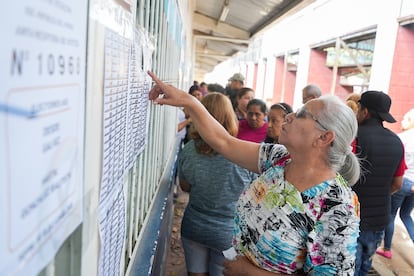
Hall congratulated his compatriots for participating in Sunday’s election and for maintaining their composure despite the close results. The day after the election, normality reigned in Tegucigalpa, despite the fear of an outbreak if the vote did not favor Libre, the party in government, whose representatives had warned that they would not accept defeat. Some businesses remained closed and others did not remove the wooden sheets with which they protected their windows. The margin with which the ruling party has lost is so large that its supporters have barely had time to take the blow.
On Monday, several of the Government ministers began to accept that defeat and say goodbye to their positions. This was the case of Daniel Sponda, Minister of Education, who wrote on the social network X: “In democracy, we also learn from defeat. We lost an election, but not our cause.” The same was expressed by Octavio Pineda, Minister of Infrastructure and Transportation, who reported that he has already begun the transition process and has instructed his team to deliver all the information to the new Government that emerges from the complex vote counting.
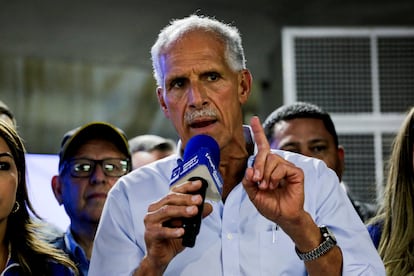
While Asfura and Nasralla maintained the electoral face-to-face while awaiting the outcome of the authorities, the candidate of the ruling Libre party, Rixi Moncada, acknowledged on Monday that Trump’s intervention affected her performance in the election. “In an unprecedented act in our history, the North American president condemns and threatens me for my participation, recognizing me as the main opponent and saying: “The intelligent people of Honduras would reject Rixi Moncada”… “I cannot collaborate with Moncada and the communists”, which without a doubt was understood by the people as coercion, if their vote favored me,” said Moncada. Manuel Zelaya, who founded the party after the military coup that overthrew him in 2009, also spoke about the result. “Libre is a party of ideals tested in the streets and with great social and democratic results in the exercise of the presidency with Xiomara Castro,” he wrote in X, referring to his wife and current president. Castro has not spoken.
The electoral authorities are under pressure to present an official closure of the votes as soon as possible, before uncertainty heats up already quite inflamed spirits after a highly polarized electoral campaign full of insults and threats. The country is experiencing dark hours while supporters of both sides demand that their candidates claim victory. Asfura is still surprised to have come back from third place in the polls to barely touching the presidency. The National Party for which he is competing in this election has a dark history of politicians related to corruption scandals, inefficiency and links to drug trafficking, as is the case of former president Juan Orlando Hernández, known as JOH, sentenced in the United States to 45 years in prison for drug trafficking.
Despite this condemnation by the American justice system, President Donald Trump announced a surprise pardon and support for Asfura last Friday, three days before the elections. He did so in a message on his social network, Truth, in which he also conditioned support for the Central American country on the election of the conservative candidate. On Monday night, the Republican magnate turned to the same channel to sow doubts about the count. Contrary to the official position of his Government, which had asked for patience, he said that Honduras is “trying to change the results of its presidential election.” “If they do, it will be hell!” he said.
Asfura, who receives 39.9% of the votes and comes from a family of Palestinian origin, gained fame among Hondurans as an efficient politician during his term as mayor of Tegucigalpa, because he promoted several urban infrastructure projects and public service works. The candidate, who calls himself X on the social network Daddy to orderdid not waste a minute to exploit Trump’s support: he posted photos of himself on the networks next to the Republican and the Argentine Javier Milei, who has also endorsed him. Asfura has promised economic reforms to attract foreign investors, but has also said he will strengthen the armed forces of a country still suffering from the wounds of the 2009 coup.
For his part, Nasralla, who totals 39.8% and is running for the head of the Government for the third time, is a face well known to Hondurans, because he is a popular television presenter. He came into this election as a standard bearer against the corruption of political and business elites who have embezzled from the State, with cases such as corruption in the security system that cost Hondurans more than 200 million dollars or the infrastructure project known as Trans-450, a metrobus for Tegucigalpa that was never completed, but embezzled 150 million dollars from public coffers. Nasralla has tried to convince the electorate that he is not part of the traditional political class and that his election will represent a new, “cleaner” way of governing. Corruption is an issue that hurts in this country and is possibly one of the reasons why Nasralla is also one step away from taking over the presidency. The final decision is in a recount that has a country that has turned its back on the transformation project of a left that has proven ephemeral.
For more updates, visit our homepage: NewsTimesWire