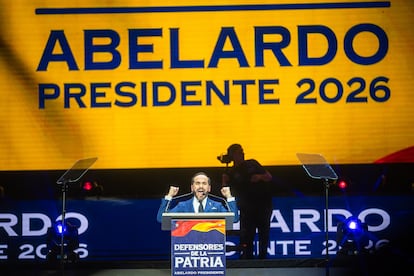
Abelardo de la Espriella is the biggest novelty in Colombia’s presidential race. The return of electoral polls has highlighted the paradox contained in the aspiration of the strident criminal lawyer, who for the first time enters electoral politics after becoming known for his participation in the peace process with paramilitary groups and his admiration for former president Álvaro Uribe (2002-2010). The representative of the far right has strongly emerged among the three leaders, behind the left-wing senator Iván Cepeda and ahead of the centrist Sergio Fajardo, but he is at the same time the weakest candidate in a possible second round.
For now, ‘El Tigre’, as he likes to call himself, has surpassed his competitors on the right, with the promise of a strong hand, that of “gutting” the left and constant references to “the homeland.” He has also called for a large coalition of all opponents of President Gustavo Petro, but his name still arouses resistance, even among conservative sectors. Some of the qualms are due to the shadows he accumulates in his past as a lawyer. Two of them, with their own names: Alex Saab, Nicolás Maduro’s financial operator, and David Murcia Guzmán, the creator of DMG, a financial pyramid that defrauded more than 200,000 savers.
Both were his clients, as other right-wing candidates have blamed him for rejecting the alliance he proposes. “I believe in unity to rescue Colombia from the clutches of the radical left. But all my life as a journalist I have denounced criminals and the corrupt. That is why I would not unite with someone who has defended them and lived off of them. You cannot be against the drug dictator Nicolás Maduro and receive payments from his main front man Alex Saab, to try to get him clean,” Vicky Dávila, former director of the magazine, criticized him. Week.
“Welcome, but I want to see someone who has worked for the poor, not someone who has been a lawyer for people who brought down hundreds of thousands of poor people,” said former Bogotá mayor Enrique Peñalosa, referring to David Murcia. “It surprises me that, being such an educated and worldly man, you continue to confuse the lawyer with the client,” De la Espriella defended himself.
The lawyer of Maduro’s alleged front man
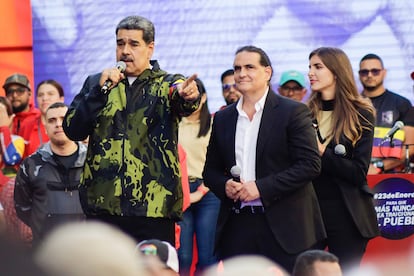
Since 2015, De la Espriella was the lawyer for Saab, the mysterious Barranquilla businessman once imprisoned in the United States for money laundering and alleged front man for Nicolás Maduro. Released in December 2023 during a prisoner exchange between Caracas and Washington, Hugo Chávez’s heir appointed him Minister of Industry and National Production of Venezuela in October 2024. “He is a great lawyer and friend,” Saab described the criminal lawyer in an interview with The Spectator in April 2021, when he was detained in Cape Verde awaiting extradition to Miami. “He simply served as my lawyer for a few years and stopped being one a couple of years ago. He is still my friend and political differences have nothing to do with the exercise of his profession,” he said then.
“There are two Colombian characters who are key to understanding his achievements: former senator Piedad Córdoba and lawyer Abelardo de la Espriella,” writes journalist Gerardo Reyes, director of the Univisión investigation team, in his book about the man identified as Maduro’s financial operator. “Saab always counted on Córdoba, who sympathized with the FARC guerrillas, and at the other extreme with his talkative friend, advisor and guide, the far-right lawyer Abelardo de la Espriella,” he says in Alex Saab (Planet, 2021). “He kept Saab and his family out of prisons using tricks,” he says. The most serious of all, having passed on the information about an arrest operation to Saab and members of his family in Barranquilla, on the eve of it happening, Reyes details. “His best client was Alex Saab, and at the same time he wrote columns saying that Maduro had to be killed, from which his best client got money,” the investigator emphasizes.
That reference points to “Death to the Tyrant,” a column that De la Espriella published in July 2017 in The Herald from Barranquilla. “Good Venezuelans and the entire international community must understand that the death of Nicolás Maduro is necessary to guarantee the survival of the Republic. It would not be a common murder, but rather a patriotic act that is protected by the Venezuelan constitution and that is, moreover, morally irreproachable,” he wrote then, without mentioning his friendship with Saab, or that he was by then his representative.
The relationship was very close, agrees journalist Roberto Deniz, from Armando.info, who has exhaustively investigated corruption in Chavismo, in general, and the business behind the state plan to distribute food boxes called CLAP, in particular. “When Abelardo began to defend Saab, there were already plenty of indications that he was a man close to Maduro,” explains Deniz. The first reference to a business of the ponytail businessman in Venezuela dates back to November 2011, when he signed an agreement to build prefabricated homes in the Miraflores Palace, in Caracas, in front of Hugo Chávez himself, the then chancellor Maduro and Juan Manuel Santos, president of Colombia. At the time of that ceremony, which went viral, he was an unknown character – Santos later said that he whispered in the Colombian chancellor’s ear: “Who is this man?” Over the years, he accumulated functions until he became a kind of super minister in the shadows of the Chavista regime, capable of doing any business and evading any sanction.
He was baptized as Maduro’s “front man” by a well-known Chavism dissident, Luisa Ortega Díaz, Venezuela’s attorney general from 2007 with Chávez until 2017 with Maduro and who fled to Colombia on a boat due to death threats in August 2017. At that time, De la Espriella announced that he intended to sue Ortega for defamation. “Saab is not part of the Venezuelan government, it is a State contractor that has fully complied with all the works it has carried out,” he told The Herald. “If I were a partner of Nicolás Maduro I would not be defending him. The country knows my position against the Venezuelan regime,” he assured. He hid behind the fact that he was only linked to housing construction and had no relationship with food companies, but Armando.info had already documented that he was behind the Hong Kong company that handled CLAP boxes, with several expired products.
The alleged break between De la Espriella and Saab occurred only in July 2019, after the United States included the businessman on the so-called Clinton list, as the list of the Office of Foreign Assets Control, or OFAC, is known, for allying “with members of the Maduro regime to run a large-scale corruption network.” In her counterpoints with the criminal lawyer, her former friend Vicky Dávila has suggested that the ties with Saab have been prolonged. “Colombians have to know the truth about the relationship of the candidate Abelardo de la Espriella with the lawyer Daniel Peñarredonda, for years deputy director of his law office (De La Espriella Lawyers) and today, and for years, with close ties with Alex Saab and his wife Camila Fabri,” the former director of Week.
The DMG family
The biggest recent scam in Colombia was that of the DMG company, named after its founder, David Murcia Guzmán, who equates it to a “family.” The firm raised multimillion-dollar sums in a pyramid scheme and was beginning to branch out to other Latin American countries when it was accused of laundering and illegal and massive money collection. The rise of the phenomenon forced the Government of Álvaro Uribe (2002-2010) to decree a state of emergency to respond to hundreds of thousands of people affected by a massive fraud that is difficult to quantify.

The renowned General Óscar Naranjo, then head of the Police, highlights three characteristics of Murcia in the podcast DMG: The Ant’s Dream. That he appeared as a kind of redeemer; who showed himself like a King Midas, who turned whatever he touched into gold; and that he was a mass agitator, with an enormous discursive capacity to mobilize citizens. “It may be the most complicated, pathogenic, criminal mentality that I faced,” says Naranjo, who later served as vice president of Juan Manuel Santos.
At the time, De La Espriella acted as his lawyer. He publicly stated that his client, then a fugitive, was willing to surrender to the authorities if they guaranteed his safety, but he made it clear that this was an official “persecution.” He never did. The head of DMG was arrested in Panama, without offering resistance, and extradited by Uribe in early 2010 to the United States, where he was tried for money laundering. He returned to Colombia in June 2019 to continue serving his sentence.
De la Espriella’s contacts allowed him to negotiate with the Prosecutor’s Office and guide the defense towards a judicial negotiation, but for that Murcia had to accept the charges, says a source who worked at DMG. That was not an option for Murcia, which has always defended the theory of persecution, which is why he ended up estranged from the current candidate, who resigned from the case. De la Espriella insists that he left as soon as he realized that the accounting that his client had shown him was not the same as the one the Prosecutor’s Office had.
For more updates, visit our homepage: NewsTimesWire