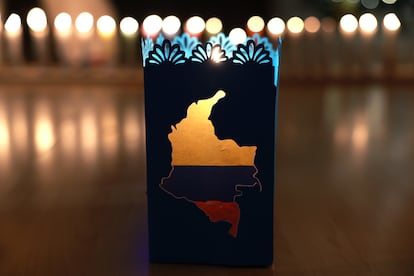
There are six hours until the ritual begins in Colombia. Six hours for the streets, balconies, platforms and parks to be filled with light. In Spain, about 8,000 kilometers away, night has already fallen and the time difference brings forward the celebration: Candle Day has arrived either La Noche de Velitas, a Colombian tradition that is celebrated every December 7, the eve of the Immaculate Conception, but that beyond the religious aspect has become a cultural celebration that announces the official beginning of Christmas.
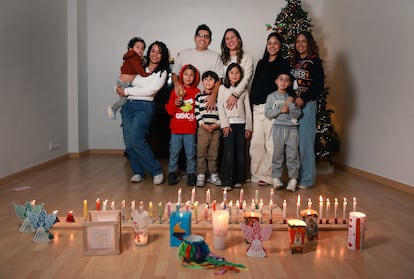
The doorbell rings in Madrid, Karol Ortega opens the door and the children burst in with screams of excitement, while the adults hug each other with melancholy. The scene repeats itself over and over again. The tradition traveled with the migrants. Light a candle to thank, to ask, to feel at home: that is the purpose of tonight. “It is an occasion to bring to the present what we experienced as children and reconnect with the land, with our roots and with the family. It is like an invisible veil that unites us,” says the 35-year-old therapist who emigrated to Spain more than two decades ago.
On the table there is custard, buñuelos and grapes – typical Colombian dishes -, along with cheese boards with ham and chorizo. The pattern repeats itself: Colombian parents celebrate the Day of the Candles with their children, while those same children also participate in the San Isidro festivities. They grow up immersed in both cultures. Ortega meets every year with his children Sofía and Nicolás, ages 8 and 5, to explain to them that this celebration is not Spanish, but Colombian. Meanwhile, in Colombia, people walk quickly with bags full of candles and lanterns—small lamps made of paper, cardboard or plastic that are illuminated with a candle inside—, trying to get home to reunite with their families. On each corner you can hear a different atmosphere: some neighbors bring out speakers and horns to play music, others turn on the radio with the most popular songs, such as Farolito by the Cuban Gloria Estefan.
There are few ways to feel close. Through a video call, excited faces appear seeking to recreate the feeling of home. With waterlogged eyes they remember how this day was lived in Cali, the city where the adults in the family were born. There is laughter, music and memories, but also nostalgia and heartbreak.
The maintenance of traditions in the diaspora allows migrant families to preserve their identity and transmit it to new generations, explains Cecilia Estrada, director of the Chair of Refugees and Forced Migrants at the Universidad Pontificia Comillas. The academic defends the importance of reproducing rituals to sustain identity in the midst of a process of change such as migration. It also highlights that sharing these practices with people from other countries reinforces the sense of belonging and also makes it easier for migrants to meet compatriots, creating spaces of support. “Community rituals, even outside, help celebrate and reaffirm that belonging,” he says. “Culture also migrates,” he adds, recalling that transculturation – the process by which one culture incorporates elements of another – is necessary both for those who adopt it and for those who transmit and receive it.
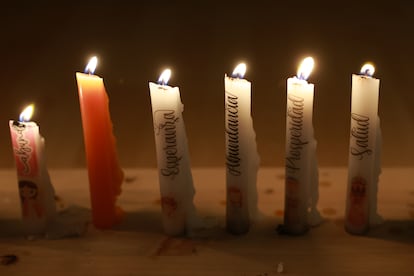
Laura Oliveros slides the screen of her mobile phone until a voice stops her: “This is how you can label your candles,” explains a woman through TikTok. He gets up from the couch, searches through his boxes and discovers that the materials are the same ones he uses to make piñatas. During the day she works in a restaurant, takes her two children to school, Martín and Lucas, and organizes household chores. But when night comes, space opens up for his creativity: he labels candles with names, glitter and drawings. Her husband encourages her, helps her get the missing materials and encourages her to sell them. This is how his business was born. Malu Piñatas and morewith which in its first year it managed to sell more than 100 packages of candles.
December is the most difficult month. “It’s when the family gets together. When we’re all happy. It hurts me a lot not to be able to be there,” says this 37-year-old woman from Cali. Through candles he shares that grief with other migrants. “It makes me happy to deliver a package of candles and see the faces of those who receive it. It’s something I can’t explain,” she says, her voice breaking. He also makes bluffs. “It’s my way of keeping the tradition alive; in some way I try to teleport and feel,” says the woman, who after 12 years in Spain dreams of living Christmas again with her parents and sisters.
He opens the hood of his car, takes out a black box and uncovers the small bags in which he carries the candles. Each one has a word: love, health, family, abundance. Others are named after people like Paola or María. It is his last delivery in Madrid. While carrying one of her children, she rings the bell of a warehouse and goes up to the second floor where a woman is waiting for her. This is Blanca Arias, a 50-year-old Colombian who emigrated to Spain 23 years ago. The candles she has ordered are not for herself, but for her Spanish daughters-in-law, who now light candles every December 7. “We have never lost tradition,” says the entrepreneur, who remembers how difficult it was to find that type of candles in Spain.
Some traditions can also hurt when lived alone. Estefanía Salazar arrived in Spain three and a half years ago. “I have all my family in Colombia. There is a part of me that is there and the other is here,” says the 22-year-old. She remembers that when she was little, every December 7 she lit the candles with her mother in the country where the streets are illuminated with small flames that multiply on balconies, sidewalks and parks. His mother taught him to say thank you before asking. Now that he is a migrant, he claims to celebrate this date with more devotion and affirms: “It is something very beautiful about our country that deserves to be shared. It represents us.”
For more updates, visit our homepage: NewsTimesWire