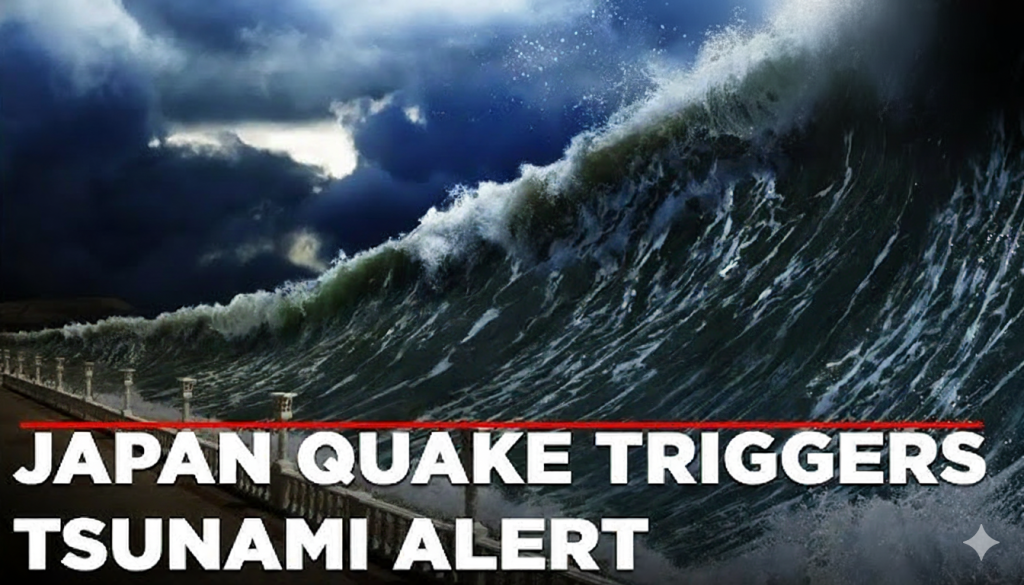
7.6 Magnitude Earthquake Strikes Northeastern Japan, Tsunami Warning Issued
TOKYO, Japan:
A powerful and potentially devastating earthquake, registering a magnitude of 7.6, has struck the coast of northeastern Japan.
🌊 Tsunami Alert
The Japan Meteorological Agency (JMA) has issued a major Tsunami Warning for the affected coastal regions, specifically predicting dangerous wave heights.
-
Predicted Wave Height: The JMA warns that tsunami waves could reach up to 10 feet (3 meters).
-
Affected Areas: The warning encompasses coastal port areas stretching across the northern prefectures, with the initial waves anticipated to impact regions from Aomori to Iwate.
-
Evacuation Order: Authorities have strongly urged residents in all designated low-lying coastal areas to immediately evacuate to higher ground and stay away from the shore until the warning is lifted.
📍 Earthquake Details
-
Magnitude: 7.6
-
Location: The epicenter is believed to be off the coast of Aomori Prefecture.
-
Depth: The earthquake was relatively shallow, which often increases its destructive potential and the risk of generating large tsunamis.
Monitoring agencies are closely watching the situation as the first waves are expected to make landfall. No immediate reports of major damage or casualties are available, but the focus remains on coastal safety.
🚨 Major Earthquake and Tsunami Warning in Japan
TOKYO: A devastating earthquake with a magnitude of 7.6 has been recorded in Japan’s northeastern regions.
-
The Japan Meteorological Agency (JMA) has issued a Tsunami Warning for the northeastern coastal areas, predicting waves up to 10 feet (3 meters) high.
-
The initial tsunami waves are expected to reach port areas from Aomori to Iwate in the northern regions.
Introduction:
Japan, situated in one of the world’s most seismically active zones, has once again been hit by a major natural disaster. A powerful earthquake, registering a magnitude of 7.6, has been recorded in the country’s northeastern parts, including vital coastal areas. Following the quake, the Japan Meteorological Agency (JMA) has issued a severe Tsunami Warning, prompting immediate evacuation orders for coastal populations to seek higher ground.
Earthquake Details and Epicenter:
The earthquake, which occurred around local night time, measured a powerful 7.6 on the Richter scale. The tremors were so intense that they were felt hundreds of kilometers away. The epicenter was located offshore, at a relatively shallow depth, which significantly increases the risk of generating a destructive tsunami. While initial reports on damage in the northeastern regions are being assessed, an earthquake of this magnitude is feared to have caused severe damage to infrastructure.
The Threat of a Severe Tsunami and Warning:
Immediately after the quake, the JMA issued a warning indicating that tsunami waves along the northeastern coast could reach heights of up to 10 feet (approximately 3 meters). Waves of this height are capable of causing devastating flooding and widespread damage to coastal areas, ports, and low-lying settlements. The areas facing the highest risk are the port regions stretching from Aomori to Iwate, where the initial tsunami waves are expected to arrive.
Government’s Immediate Response:
The Japanese government and emergency services reacted instantly, issuing a high alert. A Mandatory Evacuation Order has been put in place for all at-risk coastal prefectures, which may also include parts of Hokkaido. The public has been instructed not only to stay away from the shore but also to immediately move towards the safest and highest buildings or locations. The warning emphasizes that a tsunami is not a single wave but a series of waves that can arrive over many hours, making it necessary to remain in safe areas for an extended period.
Impact on Transportation and Infrastructure:
As a precautionary measure, the East Japan Railway has temporarily suspended certain Shinkansen (Bullet Train) services operating between Tokyo and the northeastern regions. Operations at airports and ports have also been halted to allow for damage assessment and to manage the emergency situation. The safety of energy facilities, particularly nuclear power plants, is being checked, although these facilities are generally designed to withstand earthquakes.
Historical Context and Japan’s Resilience:
This earthquake brings back memories of the devastating 2011 Great East Japan Earthquake and Tsunami, which shook the nation. However, since that tragedy, Japan has made extraordinary improvements in its tsunami warning systems, earthquake-proof construction, and public preparedness training. This robust system provides hope that widespread loss of life can be averted, provided the public acts swiftly on the evacuation orders.
Conclusion:
This severe earthquake in northeastern Japan once again highlights the destructive potential of natural disasters. The focus is currently centered on ensuring that the evacuation orders issued by the government and rescue teams are followed promptly. The next few hours will determine the intensity with which the tsunami waves hit the coast and the extent to which the public’s quick relocation to safe areas succeeds in preventing loss of life. The situation remains critical, and the public must continue to monitor the latest updates closely.
- https://newstimeswire.com/