The outcome of the Honduran elections on November 30 with the publication of results not accepted by an important sector of the country’s political class, although accepted by a large part of international observation, allows us to reconsider different aspects derived from what happened. These are issues of the domestic dynamics of the country and the environment that shapes Donald Trump’s actions towards the region that constitutes his backyard and over which, with increasing urgency, he projects his unrestricted dominance.
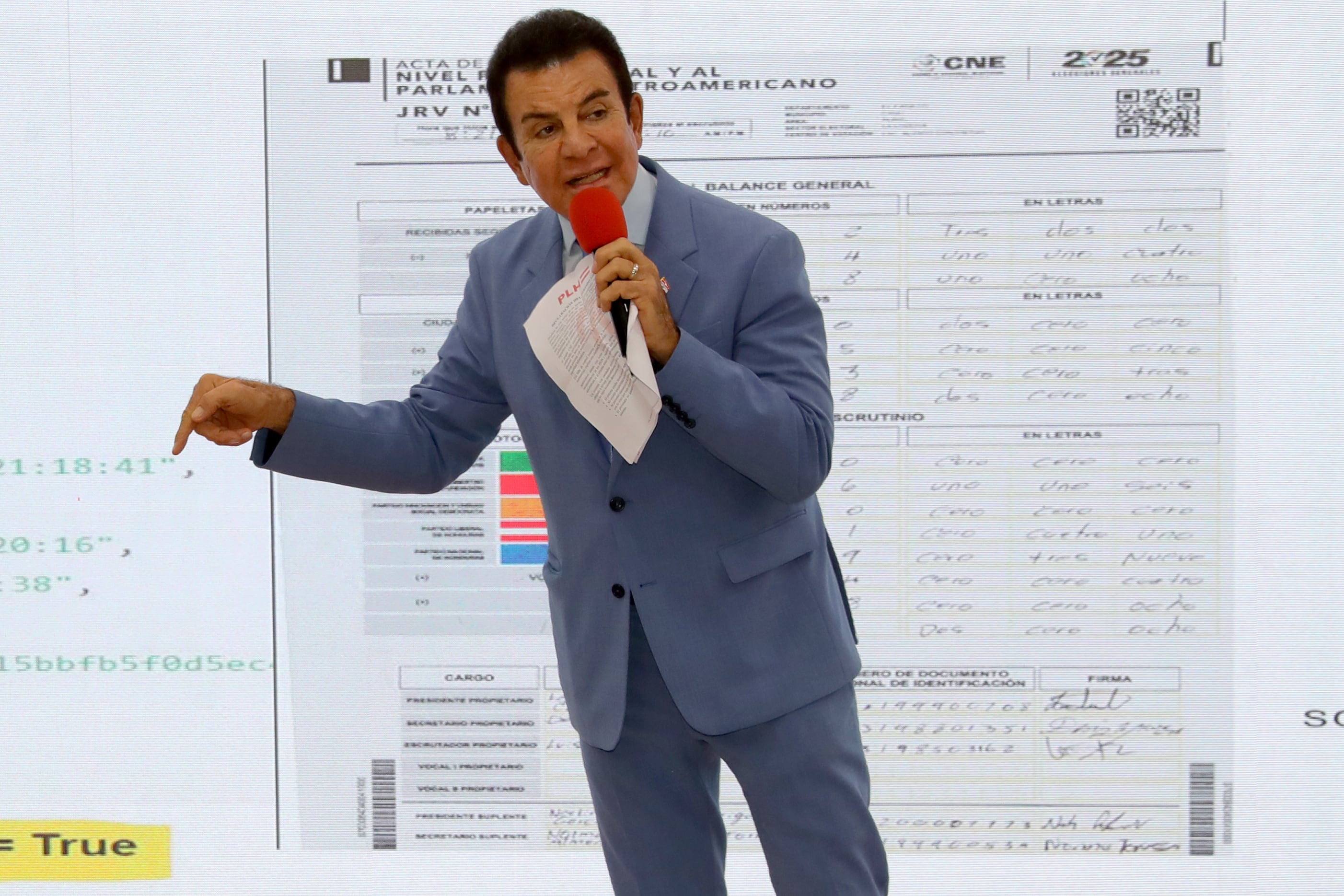
The electoral framework has drawn a triangular political performance scenario defined by three edges. Firstly, there is evidence of a serious shortcoming in the management capacity of an electoral process, which in itself is not complex and is only complicated by the Honduran geography, but which still keeps alive the memory of the controversial 2017 elections when security forces opened fire on protesters, killing at least 16 people. Long pauses without results and inconsistencies in the minutes have been present all along. Palpable proof of state insolvency and inefficiency regarding a fundamental periodic task when conducting elections whose performance was awarded to a Colombian company.
Secondly, the participation of half of the electoral roll reflects the magnitude of the political disinterest of a society devastated by corruption and vandalized by crime inserted in the drug trafficking circuit. Furthermore, Honduras has some of the worst indices in different socioeconomic indicators in Latin America. The former mayor of Tegucigalpa, possible winning candidate, Nasry Titus Asfura has obtained around one million three hundred thousand votes in a country with an estimated population of eleven million and a census of six and a half million. Barely forty thousand votes separate him from the liberal and several-time candidate and television commentator Salvador Nasralla
Finally, the result of the electoral dynamics has shown two notorious realities: the survival of the old division between liberals and nationals (conservatives) that has cornered into irrelevance the political option built around former president Mel Zelaya and his project conceived in the Libre party that has obtained 20% of the vote. This sort of return to the bipartisan tradition has buried the experiment aligned with 21st century socialism that led to the interruption of Zelaya’s presidential mandate in 2009, who a decade later would retaliate when his wife, Xiomara Castro, became president after her unquestionable victory in the 2021 elections.
Oblivious to the domestic order, this electoral process has been affected by the unusual positioning in favor of one of the candidates by President Trump. A type of execution that had already occurred a few weeks before when the tenant of the White House took sides for the formation of Javier Milei in the legislative elections held in Argentina. The explicit endorsement of the candidate Asfura of the National Party 48 hours before election day was a decisive push in an extremely close race and which, together with the anomalies noted above, is providing arguments to challenge the process by the rest of the candidates.
However, outside of this explicit expression of support, the decision by Donald Trump that has the most relevant consequences, not only in the elections themselves but also in the order of both the country and the international community, is the pardon communicated twenty minutes later to former Honduran president Juan Orlando Hernández (JOH), who had been sentenced in 2024 by a New York court for drug trafficking crimes to a sentence of loss of freedom of 45 years and who was released from prison on the 2nd. of December.
The indiscriminate use of the pardon is further evidence on the path towards the configuration of a sultanist regime in the United States. It represents an example of President Trump’s inconsistency and incoherence, and is also a bad example of an atrabiliary attitude regarding the fight against drug trafficking. On the coasts, a hundred alleged drug traffickers are massacred while the regime of Nicolás Maduro is condemned, while in the Oval Office someone convicted through due process is released for being, along with his brother Juan Antonio Hernández, a logistical manager of the drug business.
Candidate for the National Party, JOH was president between 2014 and 2022. During his two terms in government – the second was very controversial for violating the no-reelection clause – he turned Honduras into a narco-state. His immediate arrest and extradition to the United States after the end of his mandate was then an unquestionable step in the fight against drug trafficking. Now the situation has taken a complete turn, although a majority of Honduran society repudiates the freedom of the former president.
JOH claims the parallelism of his political career with that of President Trump, whom he unabashedly flatters in an exercise of shared victimization and celebration of the resilience of the American sultan, in his four-page letter requesting clemency dated October 28. JOH exacerbates Venezuelan evil and the way in which both were attacked by “radical leftist forces” as well as the lawfare unrepentant of the Biden Administration. Weighty arguments within the current narrative that are introduced in a failed electoral process in times of post-democracy.
For more updates, visit our homepage: NewsTimesWire