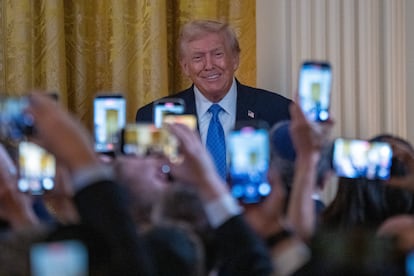
The president of the United States, Donald Trump, has ordered the “total blockade of sanctioned oil tankers” entering and leaving Venezuela. This Tuesday, the Republican president cleared up the few doubts that could remain about Washington’s interest in Venezuelan oil as part of the offensive against the Government of Nicolás Maduro, which he had been justifying solely as a war like drug trafficking. Trump has argued in a message on his social network that the phenomenal US military deployment in the Caribbean will continue “until (Chavismo) returns to the United States of America all the oil, land and other assets that were stolen from us.”
“The illegitimate Maduro regime is using the oil from these stolen fields to finance itself, as well as for narcoterrorism, human trafficking, murder and kidnapping,” the message continues. “Due to the theft of our assets and for many other reasons, including terrorism, drug trafficking and human trafficking, the Venezuelan regime has been designated as a FOREIGN TERRORIST ORGANIZATION. Therefore, today I order a TOTAL AND COMPLETE BLOCKADE of all sanctioned oil tankers entering or leaving Venezuela.”
Some 18 oil tankers under sanctions from the United States Department of the Treasury, fully loaded with oil, are in Venezuelan waters and are being monitored by Washington, as indicated this Wednesday by the digital Axios, and reported by the Efe agency. Eight of those vessels are classified as large cargo ships, similar to the Skipper, which was seized by Washington last week. Axios stressed that Donald Trump’s Government plans to seize these oil tankers if they enter international waters.
It was not immediately clear what Trump was referring to in his message when he said that the Venezuelan regime appropriates American oil, “land or any other assets.” Nor, how do you expect these to be “returned to the United States IMMEDIATELY.” When talking about the designation of the Venezuelan regime as a terrorist organization, the US president seemed to be talking about the designation as such of the Cartel of the Suns, allegedly linked to the Chavista authorities.
The Venezuelan Government took just a couple of hours to respond. In a statement, Chavismo repudiated the republican’s announcement and described it as a “reckless and serious threat” against the country. “It assumes that the oil, land and mining wealth of Venezuela are its property (…) it intends to impose in an absolutely irrational manner a supposed naval military blockade with the aim of stealing the wealth (…).” The text calls on the “people of the United States and the people of the world” to “reject” this “extravagant threat that once again reveals Trump’s true intentions to steal the wealth” of Venezuela.
Trump’s message comes almost a week after the US military intercepted the ship Skipper with Venezuelan oil in waters off the coast of that country, in a spectacular operation to which Washington wanted to give maximum publicity. Trump said he would keep the shipment destined for Cuba and China. The next day, sanctions were announced against half a dozen shipping companies transporting Venezuelan oil and six other similar vessels, opening the door to new confiscations. Punishments were also imposed against three of Maduro’s nephews.
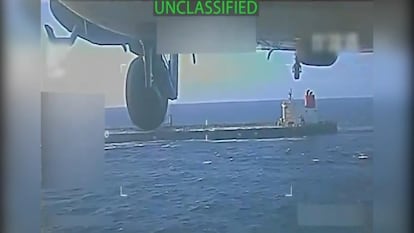
The sanctions prior to this escalation in the Caribbean Sea, imposed on ships or oil flows related to Venezuela, left a swirl of loaded oil tankers waiting weeks and even months to set sail and avoid conflicts. Last Wednesday and after the confiscation of the SkipperAs reported by Reuters, more than 80 vessels loaded or waiting to load oil were in Venezuelan waters or near its coasts, including more than 30 under US sanctions, according to data compiled by TankerTrackers.com.
The global ghost fleet includes 1,423 tankers, of which 921 are subject to US, British or European sanctions, according to an analysis by maritime data specialist Lloyd’s List Intelligence. They tend to be old, their ownership is little known and they sail without top-level insurance coverage that meets the international standards of major oil companies and many ports.
The companies recently sanctioned by the US Treasury Department are owners of oil tankers with flags of the Marshall Islands, Panama, Hong Kong or the Cook Islands, identified for using deceptive practices to hide their location, either by omitting their location or transmitting a false location. They are the so-called ghost ships that continue to operate clandestinely transporting Venezuelan oil, above all, to Asia. In reference to one of these ships, the H. Constancethe Treasury Department notes that it “has repeatedly manipulated its transmissions to conceal its location and cargo of Venezuelan oil.”
That media military operation against the ship Skipper and the sanctions that followed were interpreted as an escalation in already high tensions in the Caribbean, where Washington maintains its largest military presence in decades. Since then, Trump has continued to threaten to attack targets in the South American country, although he has not followed through on those threats. This new step, in any case, is, according to analysts, a way to suffocate the financing channels of the Venezuelan regime. The leaders of Chavismo depend on the sale of oil to China to avoid the economic sanctions imposed by the United States that are suffocating the Venezuelan economy.
“The United States will continue to deny financial lifelines to the illegitimate regime, which Maduro continues to use to oppress the Venezuelan people. The United States is committed to keeping the American people safe, using any tool at its disposal to eliminate threats of drug trafficking and crime in our hemisphere,” the US Government said at the time.
Although the main justification for the US offensive against Venezuela has been the fight against drug trafficking, Trump has long publicly declared his interest in Venezuela’s oil reserves. His 2023 speech is famous, four years after failing in his first attempt to overthrow Nicolás Maduro, in which he said: “When I left, Venezuela was about to collapse. We would have taken it over, we would have gotten all that oil, it would have been right next door.” And he added: “It would have been fair. But now we buy oil from Venezuela. We are making a very rich dictator. Can you believe it? Nobody can believe it.”
For more updates, visit our homepage: NewsTimesWire