Italy 2-Germany 0. The most decisive European summit in recent times has ended at dawn, with a significant political agreement for Ukraine and a kick forward in the pact with Mercosur. After more than 16 hours of talks, the EU heads of state and government, meeting in Brussels, have agreed to issue Eurobonds in the amount of 90 billion euros to finance kyiv’s needs. Without that money – which will only have to be returned to its European partners when Russia pays for the damage caused in its imperialist war – the invaded country could run out of funds in March of next year. It’s a quick solution. It is about responding to the most urgent thing. Ultimately, the leaders agree to continue exploring the “reconstruction loan” using Russian assets frozen by EU sanctions. The rejection of Belgium, the country where the majority of these reserves are kept, and the doubts of the rest of the partners to offer him the blank check that the Belgian Government required to mutualize the risk of the operation, derailed the measure.
The German Chancellor, Friedrich Merz, emerges as the clear loser of that meeting; also the president of the European Commission, the conservative Ursula von der Leyen: Europe, clearly, is changing. And the national-populist governments get their way. Berlin sponsored the use of Russian assets as leverage to secure financing for Ukraine, against the wishes of the Hungary of the ultra Viktor Orbán and the Belgium of the Flemish nationalist Bart de Wever. And Berlin wanted to close the trade pact with Latin America. Finally, this agreement with the Mercosur countries (Argentina, Brazil, Uruguay and Paraguay) is postponed until January, and it will be the European taxpayer, and not Russian assets, who will ensure that Ukraine can continue fighting on the front.
“There will be no Eurobonds in my lifetime,” former Chancellor Angela Merkel said a few years ago. “The objective is to use Russian assets” and not issue common debt, conservative Merz has repeated in recent days. It will not be like that: the EU resorts to Eurobonds for the second time in less than five years. The first time was with the pandemic. Now, with that existential risk posed by the bankruptcy of Ukraine, its defeat on the battlefield at the hands of Putin’s Russia.
The summit lasted throughout Thursday and held great surprises. With Brussels paralyzed by farmers, France and Poland opposed Mercosur, but it was finally the Italian Giorgia Meloni who pushed to delay the agreement until January. Meloni spoke with Luiz Inácio Lula da Silva, assured him that he agrees to support Mercosur, but asked for a few days, a maximum period of one month, to stifle internal pressure against that agreement. “After almost 26 years of negotiation, I believe that a three-week delay is tolerable,” justified Von der Leyen, who has the Union’s trade powers.
But the highlight of the day was Ukraine. kyiv will have its money, but not all the symbolism that was intended: whether it wanted to or not, it would be Russia that would pay for the damage caused. The EU has failed to mobilize the assets of the Central Bank of Russia that remain frozen in the EU due to sanctions. However, Member States will borrow €90 billion on the capital markets, secured by the EU budget margin, to finance Ukraine over the next two years.
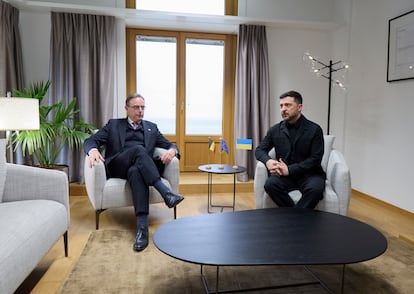
The Kremlin’s Trojan horses also achieve a way out and will not participate in this financial scheme. The plan “will have no financial obligations from the Czech Republic, Hungary and Slovakia,” the leaders agreed.
Ukraine will have the funds. Avoid bankruptcy. But the pre-holiday summit, the last meeting of an extremely difficult year for the EU, in which it has awakened to a new world in which Donald Trump’s United States is no longer the ally it was, ends with a certain bittersweet taste. The clear objective of most of the partners was to create that symbolic financial lifeline with Russian reserves immobilized by sanctions in the EU. And, although they claim that they will continue working on it, it has not been achieved.
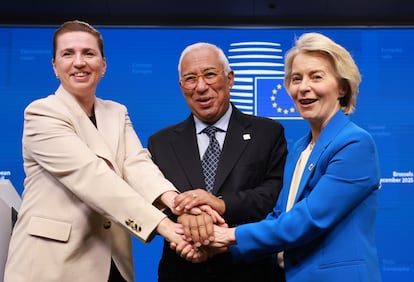
“We have fulfilled the commitment to finance Ukraine for the next two years with 90 billion euros, and agreed that Ukraine will only return that money when Russia pays for the damage caused by the war. In addition, we will keep Russian assets immobilized until Russia pays,” remarked the president of the European Council, António Costa, in a press conference in the early hours of the morning, together with Von der Leyen. The German also spoke of a duty accomplished.
Like Chancellor Merz. “I think this is a pragmatic and good solution that has the same effect as the solution we discussed for a long time (mobilizing Russian assets), but it is clearly too complicated,” he launched after the marathon summit.
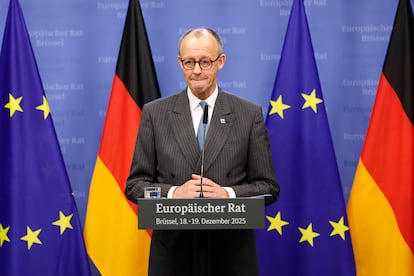
In another room of the European Council, meanwhile, Wever’s Belgian assured that the EU had avoided “chaos and division” by betting on common debt to help Ukraine, that is, Eurobonds, instead of resorting to frozen Russian assets. “We have remained united,” declared the Flemish nationalist, who cast himself to the maximum in his refusal and in his requests for “unlimited” guarantees to the rest of the partners so that they would share the risk of the operation: the vast majority of the Russian sovereign assets frozen in the EU are located in Euroclear, in Brussels.
Belgium (and it is not the only one) fears retaliation from the Kremlin. Not only economic, but also hybrid warfare. The Italian Giorgia Meloni – along with others such as Austria and Bulgaria – had also expressed their preference for the issuance of joint debt. France, where there are Russian assets in private banks, has not moved fully to support the Russian sovereign reserve route.
The EU fulfills its promise, it does not let Ukraine fall. And it sends the message to the United States that it will continue to foot the bill. “The absence of a decision would have been a disaster,” summarized French President Emmanuel Macron after the summit.
For more updates, visit our homepage: NewsTimesWire