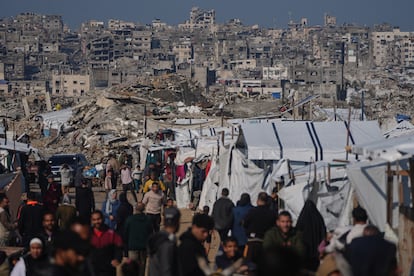
For Gazan Rayan al Jeir, the first winter in the Strip with a ceasefire is far from being a respite. Storm Byron – the same one that passed through different countries in Europe and the Middle East without causing major damage – has just left him out in the open again. “The heavy rains and strong winds have destroyed our tent,” he laments in WhatsApp messages. Now he is looking for a new place to settle with his family, but “many areas have been flooded” and “it is difficult to move through the mud and puddles.”
The Al Jeir are one of 55,000 families affected by the storm, which has blown away or flooded tents, or the belongings they housed, according to UN data. More than 4,000 Gazans have been left without shelter (not even made of cloth) after the unequal battle between torrential rains and the precarious tents in which some 900,000 Gazans live. They are almost half of the population, because Israel has damaged or destroyed more than 80% of the buildings in the Strip in two years of invasion.
Winter is the new enemy that Gaza faces, with almost the same weapons. Hospitals have recorded 13 deaths since last week due to collapses caused by the storm or hypothermia.
One of the latest cases, that of Jalil Abu al Jair, is particularly horrendous. He died when he was barely two weeks old, after a cold night, in a tent in the Al Mawasi area, to which the family had been displaced from their home in Khan Younis. “His body was cold. His hands and feet were frozen, his face was stiff and yellowish, and he was barely breathing. I woke up my husband immediately to take him to the hospital, but he couldn’t find any means of transportation to get there,” his mother, Eman, told Al Jazeera. The rain was so intense that they could not even reach the hospital on foot. They did it the next morning, in a cart pulled by a donkey. The little boy was immediately taken to pediatric intensive care, with a respirator. Two days later, he died.
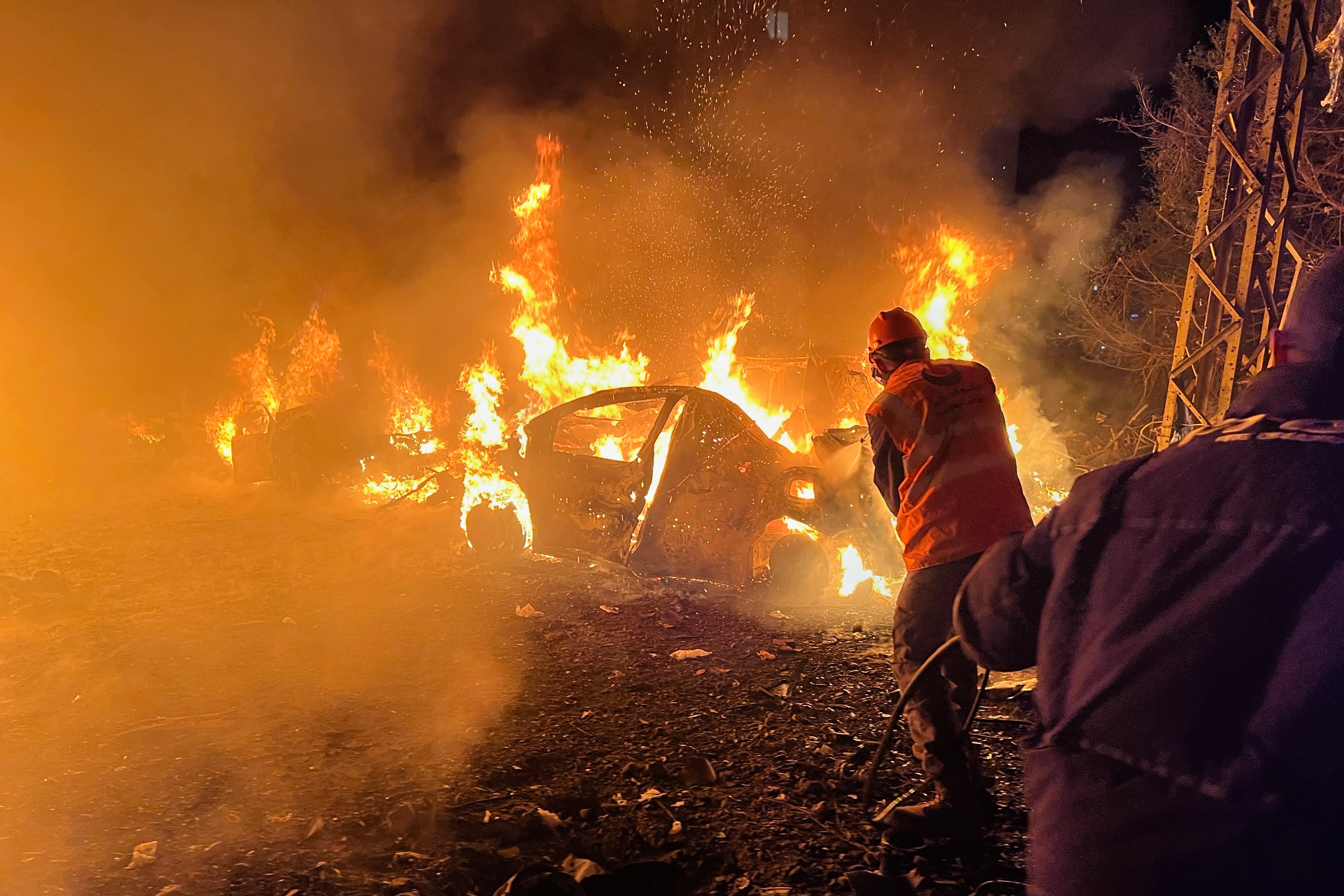
This is the Gaza of the ceasefire, trapped without knowing how long in a kind of limbo between an atrocious past and an uncertain future. Neither in peace (Israel continues to bomb daily and has killed 401 Palestinians in two and a half months of ceasefire) nor technically in war, since US President Donald Trump decreed its “end” in October, with the entry into force of the first phase of the permanent truce. This past Wednesday and between comedy and tragedy, Trump even boasted—in a speech on the occasion of his first year in office—of having brought “peace to the Middle East for the first time in 3,000 years.”
Little, however, has changed life in Gaza, if we exclude that Israel no longer bombs constantly by land, sea and air but more punctually, nor does it completely block the entry of food and water, as a collective punishment. Many Palestinians, in fact, use expressions like “Ceasefire? What ceasefire?!” or “This is just a slower death” when talking about their new situation.
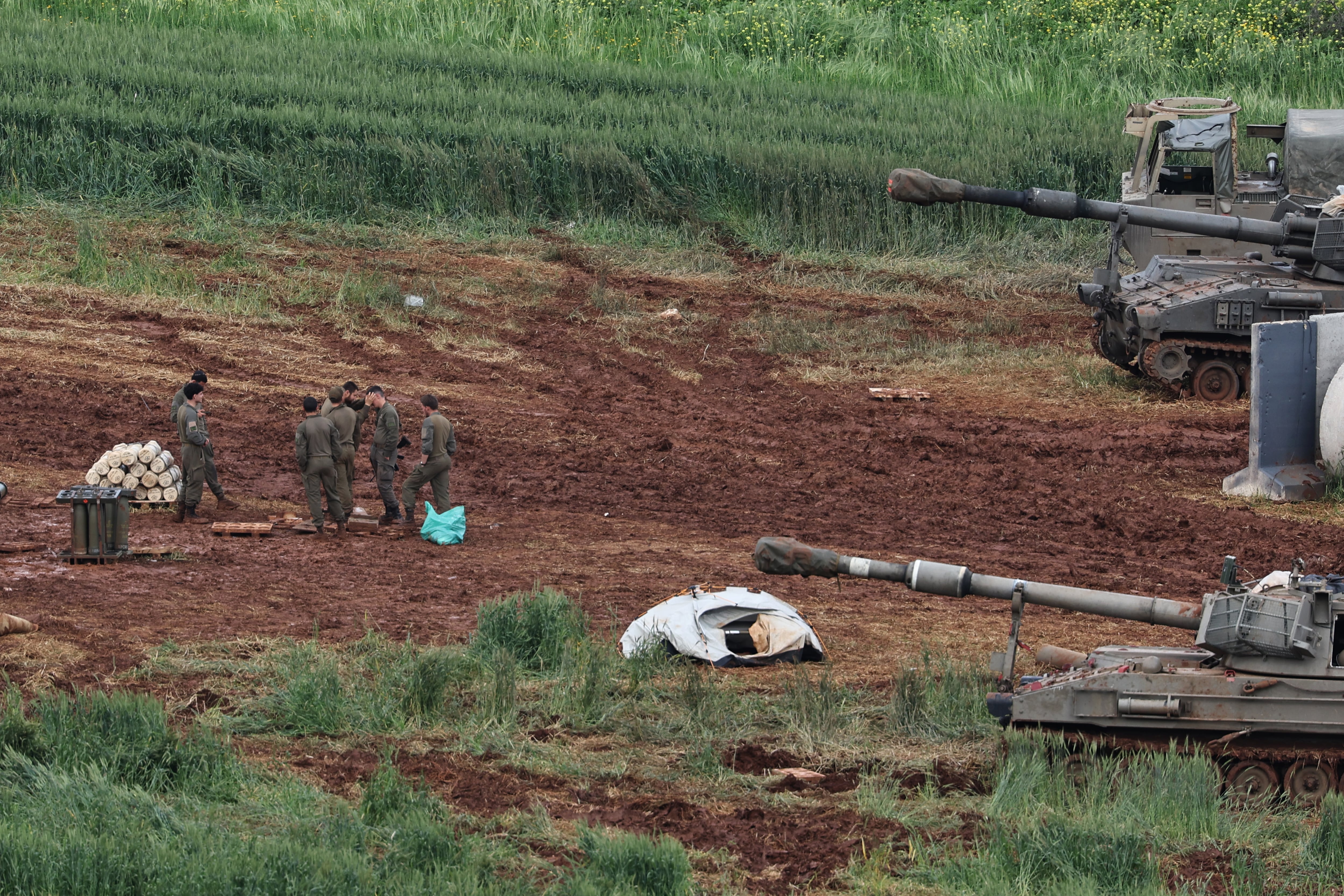
Almost the entire population has been limited to the 42% of the territory that remains in the hands of the Hamas Government. The Israeli army controls the other 58%: devastated and inhabited only by family clans that it protects. It is where the United States wants to focus reconstruction.
They are both sides of the “yellow line”. In theory, it is a temporary withdrawal divide, but Israel has begun to treat it as a new border de facto for the long term, and moved the milestones that mark it by hundreds of meters, increasing the general confusion about its limits.
The soldiers open fire on those who cross it, even if they are civilians eager to reach their houses (standing or in ruins) or in search of food and objects (plastics, wood, iron) to burn or prop up the fragile tents.
This is how the Abu Assi brothers died: Fadi, 10, and Yumaa, 12. At the end of November, they crossed into an old agricultural area in Bani Suheila to collect firewood. The absence of electricity and gas forces families to cook the old way: making a pyre and placing a salvaged pot on iron or bricks. Soldiers from a brigade with a long history of human rights violations saw them and sent a drone, which opened fire on them. According to the military statement, they had “carried out suspicious activities on the ground and had approached troops in a manner that posed an immediate threat to them.” The Air Force “eliminated the suspects to remove the threat.”
The mediators met this week to try to advance to the second phase of Trump’s plan, which received the endorsement of the UN Security Council last month. It would imply a new Israeli withdrawal, with the entry on the scene of an international organization in which former British Prime Minister Tony Blair will no longer be present and the deployment of an international force, which has been delayed again until next year and with prerogatives yet to be defined.
“Desperate circumstances”
In political and media times, the ceasefire has marked a turning point. But for Hossam Nasser, 35, the main difference is that he no longer spends his days wandering from one place to another nor does he buy sugar or flour at the most expensive prices in the world, as in the hardest months of the brutal Israeli siege. “We live in desperate circumstances,” laments Nasser. “Before (the truce), my children and I were displaced, living on farmland and sleeping in a horse stable on the sand, surrounded by bugs. Now, we are still in the same place.”
The UN estimates that there are 300,000 tents, mobile homes and caravans that the population needs and whose entry is blocked by Netanyahu’s Executive. Nasser lost several members of his family at the beginning of the war, in a bombing of his family building in northern Gaza. He was injured, but was rescued from the rubble.
Paradoxically, the death toll from the Israeli invasion (which more and more genocide experts define as such and for which there is an international arrest warrant against Netanyahu, for alleged war crimes and crimes against humanity) has exceeded 70,000 just during the ceasefire.
The figure continues to grow, on the one hand, because Israeli shootings or bombings leave bodies almost daily, despite the truce. The health authorities have reported this Saturday another six in the last 48 hours. Five of them (mostly children) in a bombing against a school transformed into a shelter for displaced people. Israel presents the attacks as actions to prevent Hamas from reorganizing.
On the other hand, there are hundreds of bodies recovered in previously inaccessible areas. Some even in buildings that had been in ruins since the first waves of bombings, in October 2023, following the Hamas attack. Without the necessary material (the Netanyahu government limits the entry of heavy machinery and fuel) but with many tons of debris to be removed, the pace is slow. Civil Defense rescue teams have so far accessed 641 lifeless bodies. These days, when it rains heavily, corpses are seen emerging from the ground, according to Gazan journalist Rami Abu Yabus.
The Integrated Phase Classification, the main analysis tool for food security and in which UN organizations participate, published a new report on Friday. The previous one, in August, was crucial, because it led the UN to declare famine among the 514,000 inhabitants of the capital region, while deaths from starvation and photos of skeletal babies continued. He had only done it with four others in the last 15 years: Somalia, in 2011; South Sudan, in 2017 and 2020; and Sudan, last year.
In this report, experts declare that there is no longer famine in Gaza, because the increase in food input has improved nutritional levels. However, they warn that the situation remains “critical”: no less than 1.6 million people (77% of the population) were still in a situation of acute food insecurity on the dates analyzed, between October 16 and November 30. Of them, 104,000 in the most serious category, category 5, considered catastrophic; and another 507,000 in the next, emergency call.
Not a single child in Gaza eats what they should and two thirds of them suffer from severe food poverty. If Israel were to completely stop the flow of food and resume the previous level of bombing, it could degenerate into a new declaration of famine by April 2026, they warn.
More goods are seen in the markets and prices have dropped since the ceasefire, but the majority of trucks correspond to the commercial circuit. That is why it is compatible to see the inauguration of a cafeteria on Instagram (generating images that the Israeli authorities exploit to relativize the extent of hunger), while many other Gazans continue to suffer daily to feed their own.
The UN Office of Humanitarian Affairs recalls, in fact, that the majority of families cannot afford the vegetables and fruits that are most present on the streets today. Also that they face the last weeks of 2025 with hardly any savings or assets. They already sold what they could to survive or pay the thousands of dollars that allowed them to cross into Egypt, before Israel took control of the border crossing in 2024.
For more updates, visit our homepage: NewsTimesWire