The script of the current Venezuelan political crisis is based on two central arguments, regularly invoked by the local opposition and the United States Government: the alleged link of the Chavista regime with terrorist groups and criminal networks, and the illegitimate nature of the presidency of Nicolás Maduro after accusations of fraud in the 2024 presidential elections. In recent days, Washington has put a third reason on the table. US President Donald Trump himself has openly alluded to the weight of Venezuelan oil and the alleged existence of liabilities and energy rights taken from US companies in previous litigation with the Venezuelan State. “Remember that they took away all our energy rights,” said Trump, referring to Chavismo and his dispute with the multinational Exxon Mobil, which led to the company’s departure from Venezuela in 2007. “We want it back,” the American warned.
Contrary to what some came to think, Venezuela’s vast natural resources are part of the subtext of this geopolitical crisis, which escalates new levels of tension daily. Aware of this, opposition leader María Corina Machado recently published a video titled Land of Gracein which he invites Venezuelans to imagine a republic capable of overcoming the bankruptcy of Chavismo and calls on investors to visualize the business opportunities and growth potential of the country based on its enormous natural resources.
The socioeconomic shipwreck of the last decade has forced a paradox: a country with abundant and coveted wealth, a still considerable infrastructure and an acceptable installed capacity, but mired in collapse. Abundance in an impoverished society has fueled a persistent legend—that of the “rich poor country”—that has become one of the great torments of the Venezuelan national project.
In addition to having the largest oil reserves in the world, Venezuela has enormous gas deposits—the sixth largest on a global scale; large gold reserves, the most important in Latin America; iron, ranked twelfth in the world; bauxite, in the fifteenth; and diamonds. Before the Chavista collapse, the country had made significant progress in the exploitation and export of several of these items, in particular oil, gas, iron ore, and transformed aluminum and steel products, pillars of contemporary Venezuela. Added to this is a relevant supply of the so-called “rare earths”, especially coltan and thorium: chemical elements with magnetic and conductivity properties essential for modern technology – mobile phones, electric vehicles, weapons and renewable energies. Riches embedded in a geography of high biodiversity, enormous water wealth and privileged access to the Caribbean Sea and the Atlantic Ocean.
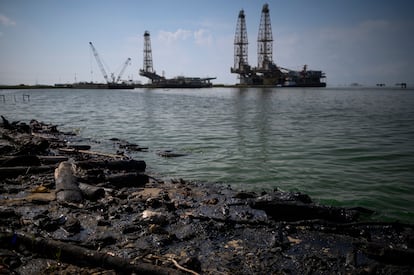
Between 2014 and 2015, when the oil industry hit rock bottom and the country suffered years of brutal food and medicine shortages, Chavismo leveraged mining resources south of the Orinoco River to survive. He did not do it by recovering the iron, bauxite, aluminum and steel companies, but during Chavismo they suffered the same fate as Petróleos de Venezuela, hit by lack of investment and poor management.
In 2016, Nicolás Maduro signed the decree creating the Orinoco Mining Arc, an area of some 112,000 square kilometers—equivalent to 12% of the national territory—located south of the Orinoco River, a strategic area for the exploitation of gold, mainly, in addition to diamonds, coltan, nickel and rare earths, in a context of favorable international prices. The Government has maintained that in the Mining Arc there are more than 8,000 tons of gold, which would place Venezuela among the countries with the largest reserves of the mineral. He has also talked about the possibility of exploiting up to one million carats of diamonds, 12,000 tons of nickel, 35,000 tons of coltan and significant copper deposits. A decade later, far from becoming a development pole, the Orinoco Mining Arc has been transformed into a dangerous hole of crime, political and military corruption and smuggling against the backdrop of a major environmental disaster. It is not large-scale mining, but rather chaotic and uncontrolled exploitation.

In the commercialization of gold, Chavismo has partnered with Türkiye and South Africa. In production, however, a network of “strategic alliances” operates with companies close to the ruling elite, under the tutelage of the Venezuelan Mining Corporation. These coexist with irregular actors such as the Colombian guerrilla of the National Liberation Army, FARC dissidents and criminal gangs such as the Tren de Aragua. Official projections from the government mining plan show that by 2025, 79 tons of gold should be produced in this region. The data, however, is opaque and difficult to verify. Multilateral organizations and journalistic investigations have documented that a good part of what is extracted is smuggled and only a fraction enters the national Treasury, with a high cost in violence, labor exploitation and trafficking in women. A report from Transparencia Venezuela estimated that in 2024 only 14% of the value of the extracted minerals reached the coffers of the Central Bank, while the rest was distributed between “strategic alliances”, the majority, and criminal groups.
In 2023, the Government declared cassiterite, nickel, rhodium, titanium and other minerals related to rare earths as strategic resources for the exploration, extraction and commercialization of this key raw material for the technology industry. The so-called black sands—a market largely dominated by China—emerge as another loot that the president of the United States aspires to take from his commercial rival with the pressure he has imposed on Venezuela’s resources. Research published in November by Amazon Underworld and the Venezuelan environment Armando.info revealed that, although there are official records of exports of rare earths through Venezuelan ports, a substantial part of what is extracted in Guyana is illegally sold to Colombia, where its origin is “laundered” before ending up in the hands of Chinese companies, the main global processors of the material.
For more updates, visit our homepage: NewsTimesWire