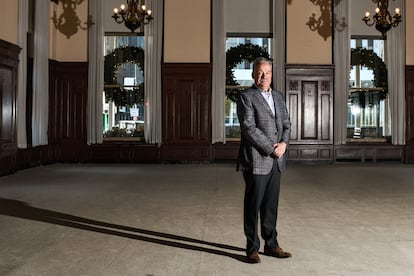
Fidel Castro boasted and bragged about that future in which history would absolve him. That story that many dictators construct in the midst of the most absolute denial of reality and a kind of psychopathy, poorly detected at the time and regretted too late. That past is today, in New York, in the movie hotel, with all the Christmas displays and the tea room packed to capacity. It is too paradoxical to talk about the redemption that “the commander” expected and that did arrive for Marcos Rodríguez (Cuba, 1962), in the middle of the capitalist heart of Fifth Avenue.
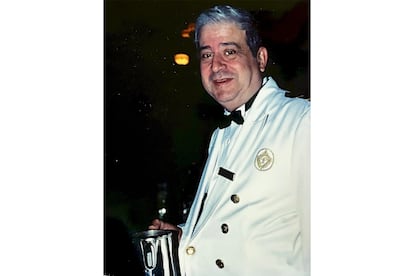
From the historic and emblematic Plaza Hotel in Manhattan, Rodríguez looks back on a life that in a way began here. It was in this luxury hotel where his family, exiled from Cuba, found a second chance after leaving the island in the sixties. His father worked as a waiter for more than 30 years in the building to support a family that lost everything in Castro’s Cuba. Almost six decades after migrating to the United States, Rodríguez is today the president and CEO of Palladium Equity Partners, a million-dollar private equity company that has been investing in the United States Hispanic market since its founding in 1997.
With a broken voice, Rodríguez recognizes what it is like to be an immigrant in the United States: “I became a citizen at the age of 18, the same day as my father. And although the United States is our home, the refugee mentality was a benefit for me, not a burden. It gave me motivation, discipline, and a deep sense of responsibility. My children did not have the same experience, but they have heard our story. One of them is even an immigration lawyer,” says the executive. “Today, at home, we continue to have that mentality: we make an effort, we work together and we take care of the family. My dad is 90 years old and five times a week, we have dinner with him. That is what he deserves: effort, unity and gratitude.”
Rodríguez is the great-grandson of Spaniards, who arrived in Cuba and began planting sugar cane. Later they bought several pieces of land and, over the years, they became a wealthy, middle-class family, something that did not last on the island. “When my father was about 17 years old, my grandfather and my uncles had, between them, properties and land more or less the size of Manhattan in the province of Oriente. My father studied finance and my mother was a doctor of pharmacy, also from the University of Havana. And Castro came, his Marxist revolution, and they expropriated everything from us: being able to work, all the land and too much dignity. I was 5 years old and I still remember the trip from Havana, to Madrid and from there, to the United States.”
This is how the Rodríguez family settled in New York, in the neighborhood of Queens, in a reality that had nothing to do with what they once had, but without time or money to regret. “My father arrived in this country when he was 34 years old, thin, with everything he had on, with my mother, my sisters and I. He had to start from scratch. My mother too, who always had to take care of the house. In Cuba they had been important, they had everything, but here they arrived with nothing and, as we say, eating cable,” he remembers.
Upon arriving in New York, his father “immediately” entered the Plaza Hotel and stayed there for more than three decades. “He was always happy: he came home with joy. Not all refugees had the same luck or attitude. And even so, he never showed resentment. Many Cubans who had been lawyers in Cuba could not practice here; those who had businesses there, here did not even have money to start with. Many doctors were not able to become doctors again, and like them, hundreds of thousands of exiles. That generated resentment in many, but my father never had it.”
The “worms”
When mass emigration from Cuba to the United States began, especially after 1961, all those who requested to leave the country, or sold their assets to try to do so, were publicly humiliated and even in some neighborhoods, acts of repudiation were organized against the families who were leaving. They were the “worms” and “parasites” that justified all the repression. “In my childhood and adolescence, here in New York, the news from Cuba was part of everyday life. There we were the worms and here, we had nothing. Cuban politics was not something we read: it was something we lived,” says Rodríguez.
“Being the son of a refugee made it very real and that mentality stays forever. We left the country where we were born, where my grandparents and great-grandparents are buried, and we have not been able to return. Or rather, I have not wanted to. Once, I thought about going, I told my father, but just by mentioning it, he started crying. There I decided that I could travel anywhere in the world, except Cuba,” he maintains.
In the United States, Rodríguez managed to obtain scholarships from the elite St. Regis school to Columbia University, where he studied mechanical engineering. He earned an MBA from the Wharton School, which he paid for while working, and a Master’s in International Studies from the University of Pennsylvania. “My entrepreneurial streak started early. When we arrived in this country, the first success was learning English. Then being the best in the class. Then entering high school, and then university. I worked hard, had scholarships, and started as an engineer in a small company. Then they signed me at General Electric and later, I started on Wall Street and there, I realized very quickly that being an entrepreneur means taking risks every day.”
After working at General Electric, where he worked in operations in the United States, Mexico and France, in 1997 he founded Palladium Equity Partners and has since been president and CEO of the firm.
“I think it is easier to start from scratch than to transform a 100-year-old business. Many entrepreneurs fail many times before succeeding. That is Schumpeter’s theory: that creative destruction leads to innovation. And I had that mentality because my parents started from scratch,” he explains. “When I started, my children were in public school and we didn’t have enough money; even so, I decided to risk two years of salary to try.”
Currently, Palladium consolidates more than 240 companies into 41 platforms, where it manages nearly $3.7 billion in assets and has nearly 19,000 employees. And since its inception, the firm has had the Hispanic community in the United States as its focus. “Most of our companies are oriented to the Latin market: food, insurance, distribution, products that our communities consume. We have not seen the Latino consumer retreat. If the price of beef goes up, they buy chicken or pork, but they keep going,” says the CEO.
If he is asked about the well-worn polarization in the United States and the policies of the country’s current president, Donald Trump, which have cornered the Latino community and migrants, with raids, arrests and mass deportations, he interrupts to give his opinion: “For me it is an exaggeration on both sides, of both parties, to scare people and make them paralyze.” He recognizes that “there are problems and injustices” and that “life is not easy or fair,” but he emphasizes: “The United States continues to be the country of opportunities, if you have a good heart and work hard. In the end, there is something very clear, and as we Cubans say, if you want to eat grated, you have to give it a try.”
As we finish this talk, at the hotel he talks to one waiter and another, and introduces himself as Rodríguez’s son, who served dishes and set the table for all the presidents of this country, from Richard Nixon to Trump. Although he has always preferred to keep a low profile: “Many ask me why I run away from fame. Neither I nor my ego need it. It doesn’t motivate me.”
“Thank God, my last name is common: Rodríguez. Nobody notices. And that’s what I want my children to see. A man who helped his people and who was able to improve his community. Someone who, through his money, was able to do many things like take care of those who cannot take care of themselves. The poorest. And that’s what I try to do every day: start at home, continue with my community and always be grateful for the sacrifice of my parents,” he says.
For more updates, visit our homepage: NewsTimesWire