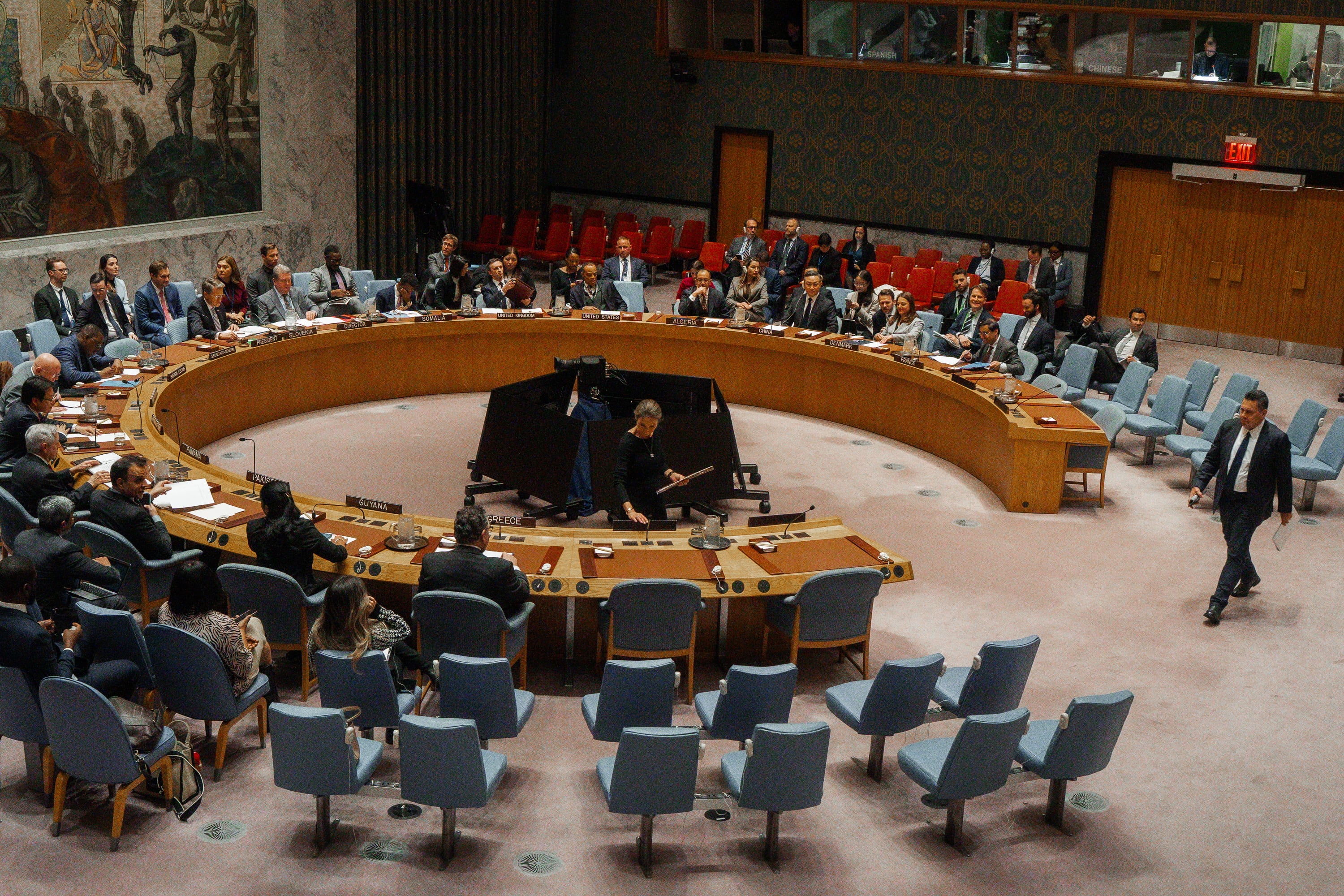
Mexico has raised its diplomatic position on the crisis in Venezuela to the United Nations (UN) Security Council. Héctor Vasconcelos, permanent representative of Mexico, called this Tuesday to find a “peaceful, democratic and negotiated” solution to the escalation of the United States military campaign against the regime of Nicolás Maduro. The intervention of the Mexican delegate has meant an extension of the position that the president, Claudia Sheinbaum, has been defending for the last week. Vasconcelos has invoked both the traditional mantra of Mexican foreign policy, “non-intervention and the peaceful resolution of disputes,” and the precepts of the UN Charter: “No difference between States should be resolved through the threat or use of force.” Mexico’s intervention in a Council briefing, at the request of Venezuela, also comes after the recent show of support for Maduro by China and Russia.
Mexico defended that “it is exclusively up to the Venezuelan people to determine their political future.” Regarding the role of the UN, Vasconcelos stressed that “the value of multilateralism” is being tested, which is why he urged the activation of the mechanisms provided for in Article 33 of the Charter, corresponding to conflict prevention and peaceful solutions to disputes. “When international peace is threatened,” added the Mexican delegate, “it is up to this Council to assume its responsibility and act, always in strict accordance with international law.”
President Sheinbaum already made Mexico’s position in the conflict clear during her last morning conferences. The president urged the UN to act to “avoid bloodshed,” in addition to even offering Mexican territory for a possible negotiation between the two parties. There are already more than 100 dead due to US attacks on alleged Venezuelan drug boats in the Caribbean. Maduro, along with a handful of senior officials in his Government, were included a month ago by the State Department on its list of international terrorists, being considered part of the so-called Cartel of the Suns.
Inclusion on that blacklist expands the margin for more sanctions against the Chavista regime, in addition to opening the door to undertaking military actions in its territory. Mexican cartels have also been classified as terrorist organizations by the White House. Something that, together with the recent designation of fentanyl as a “weapon of mass destruction”, are movements that are in line with a hypothetical military incursion. In this context, the Sheinbaum Government is taking advantage of the escalation against Venezuela to protect itself against the possibility of the attacks spreading to Mexico.
The crisis escalated another step last week, when Donald Trump explicitly set his sights on Caracas oil and ordered the “total blockade of sanctioned oil tankers” entering and leaving Venezuela. The seizure of two ships in recent days and the persecution of a third by US authorities, considered by the White House a war against “ghost ships”, has precipitated China’s entry onto the scene.
The Beijing government has accused the United States of “violating international law” for what it described as “an arbitrary seizure of another country’s ships.” China is the main destination for oil leaving Venezuela. Nearly 700,000 barrels per day of the 1.2 million that PDVSA is currently producing go to the Asian country. Russia has also begun to take positions. The Venezuelan Foreign Minister, Yván Gil, announced this Monday that his Russian counterpart “ratified his full support against the hostilities” of the United States and that “he will provide cooperation and support to Venezuela against the blockade, expressing full support for those undertaken within the UN Security Council.”
The intervention this Tuesday by the Mexican delegate has urged the Council to “guide and channel peace efforts in compliance with its mandate.” Vasconcelos has also asked the secretary general of the organization to “make use of his good offices to help de-escalate tensions, promote trust between the parties, facilitate dialogue and generate conditions that allow a peaceful, sustainable solution in accordance with international law.”
Mexico’s plea to the UN also comes the same day that a new US drone has been detected in Mexican aerial territory. It is a military aircraft dedicated to intelligence, surveillance and reconnaissance missions that flew over the Gulf of Mexico at dawn off the coast of Veracruz. During the first weeks of Trump’s mandate, American media detected at least 18 flights of this type of unmanned rums to spy, in theory, on drug trafficking mafias. The flights have not been limited to the border between the two countries, but were developed deep within Mexican territory.
For more updates, visit our homepage: NewsTimesWire