In the chaotic and eventful film of the declassification of Epstein’s papers, on Wednesday, a semi-festive day in Washington, came the penultimate twist of the script. It was thanks to the announcement that the Department of Justice, which is required by law to release all documents in its possession, had received around a million more files. The Government of Donald Trump had the obligation to have made public the totality of the materials before December 19, the day on which they only released a part, and his deputy attorney general, Todd Blanche, warned that the rest would take “a couple of weeks” to see the light. With the huge new batch of papers found, the Department of Justice is once again asking for more time.
These documents, the last to arrive and those that have been “on the table” of Attorney General Pam Bondi for months, come from the endless source of papers from the case of pedophile Jeffrey Epstein. All of them need to be reviewed before they can be made available to the victims, the politicians of both parties who have been demanding them for half a year, and public opinion; or, at least, from the part of public opinion that lives pending the gruesome story of the sexual predator, who died in 2019 in a maximum security cell. Epstein committed suicide, according to forensic experts, while waiting to be tried for setting up a sex trafficking network with hundreds of underage victims and supposedly with a long list of accomplices, rich and influential men, of his crimes.
“We have attorneys working tirelessly to review and make the legally required redactions to protect victims; we will release the documents as soon as possible. Due to the large volume of material, this process could take a few more weeks,” the Department of Justice clarified in a message on X.
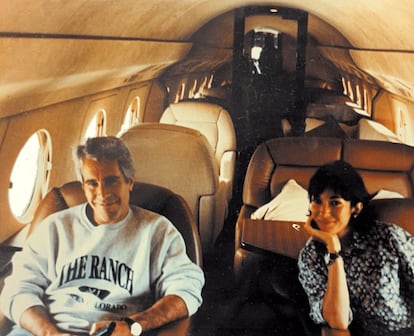
The obligation to sift through papers emanates from a law approved by an overwhelming majority of Congress last November. The first batch arrived last Friday. It had about 13,000 files, more than 100,000 pages, about 500 of them completely crossed out. As a whole, uploaded to a website created expressly by the authorities, they highlighted 4,000 images that once again served to prove that Epstein and his best friend and recruiter, the British Ghislaine Maxwell, sentenced to 20 years in prison as an accomplice, were extraordinarily well connected in society, finance, science and politics, not only in the United States.
A series of images of former President Bill Clinton, in which he is seen, for example, with a young woman with her face covered in a jacuzzi or in a swimming pool with Maxwell and another unidentified woman, was the one that generated the most stir. The first declassification received criticism as biased and excessively censored, both from Epstein’s victims and the drafters of the law.
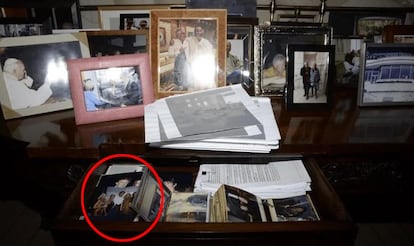
It also fueled suspicions that the Justice Department had started with materials that made Trump look good, practically absent from those files. One of the few documents in which there was a trace of the president of the United States, who was a friend of Epstein for 15 years, until 2004, was deleted and restored when the gesture threatened to lead to a crisis for the White House: it is a photo in which Trump is surrounded by women with his face unblacked out. Another key paper is a complaint filed by a woman named Maria Farmer to the FBI in 1996; It came to show that the authorities knew about Epstein’s crimes 10 years before his first arrest, and that they did nothing to follow up on that lead.
Second batch
The second large batch of declassified documents arrived on Monday at the stroke of midnight. And, again, his release was governed by chaos. The materials were published, which, this time, contained a good helping of Trump, and then they disappeared. Once they were back on the website, it was found that they were carrying a fake video, which supposedly captures the moment in which, according to the coroner’s ruling, the millionaire pedophile committed suicide. Also, a letter sent by him to doctor Larry Nassar, convicted of abusing dozens of athletes on the United States gymnastics team when they were minors, in which Epstein spoke of Trump’s “taste” “for young and attractive girls.”
The Department of Justice spent half a day to obtain the verdict from the FBI, which stated that the document is not real, and a lot more energy to respond on social networks to those who spread the alleged letter among pedophiles.
This new batch, which contains an email from an investigator who warns that Trump traveled several times on Epstein’s private plane “many more times” than was believed between 1993 and 1996, also revealed the sloppiness with which the officials in charge of the investigation have worked. cleaning of those papers. It turns out that when you copy and paste the content of some into a word processor, the deletions disappear and the censored information is visible. After an exhaustive study of those points in which the Justice Department’s censorship machine failed, it is not possible to conclude that there are any major developments.
And this Wednesday the mess got a little more tangled, after the announcement that the FBI and the Prosecutor’s Office for the Southern District of New York have discovered “more than a million additional documents, possibly related to the Jeffrey Epstein case.” The department pledged to review them and continue to “comply fully with federal law and President Trump’s order to release the files.”
The US Attorney for the Southern District of New York and the FBI have informed the Department of Justice that they have uncovered over a million more documents potentially related to the Jeffrey Epstein case. The DOJ has received these documents from SDNY and the FBI to review…
— US Department of Justice (@TheJusticeDept) December 24, 2025
Almost a week after the day on which all of Epstein’s papers should have seen the light of day, it is unclear what strategy is guiding Bondi; not even that it has anything other than pure improvisation. The attorney general said for months that the Trump Administration aimed to shed light on the case and then announce that it had no intention of publishing anything else, because the “Epstein list” did not exist, that list of rich and famous who could have participated in his crimes and that has given rise to all kinds of conspiracy theories and has tarnished the reputations of the usual suspects who appear in them.
The president of the United States, who appears on paper (which does not mean that he is guilty of any crime), usually reacts with impatience when journalists bring up the issue, which he would like to see disappear in one fell swoop. It does not seem that the clumsy and slow declassification that American society is witnessing, which renews the interest of the voracious news cycle about the Epstein caseis the best idea to fulfill Trump’s wish that the matter be resolved quickly and painlessly.
For more updates, visit our homepage: NewsTimesWire