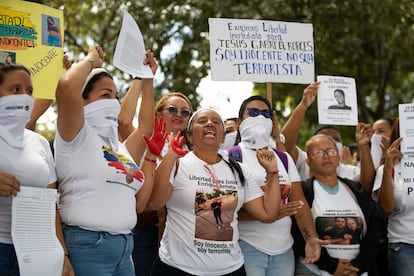
When the political and military tension with the United States is at its highest point, the Government of Nicolás Maduro decided to release 99 opposition political prisoners on Christmas Day, the highest number of political prisoners released in Venezuela in twelve months, according to the latest information from the Executive this Friday. The last measure of grace for arrested politicians and activists that Maduro took took place on August 2, when 13 prisoners were released from jail with alternative judicial measures. In December 2024, nearly 100 prisoners were released from Chavismo prisons, the vast majority of them for having participated in anti-government protests after the presidential elections.
The Chavista regime places on the table a studied gesture to try to decompress the pressure against it, without offering demonstrations of weakness or excessive magnanimity. 75 prisoners of the nearly 1,000 (according to the NGOs Provea y Justicia, Encuentro y Perdón) who remain behind bars return home.
The vast majority of them were also prosecuted after the protests that followed the presidential elections of July 28, 2025, considered fraudulent by the opposition and much of the international community. To date, there are no known front-line politicians or activists who have benefited from these alternative judicial measures, among the many who remain behind bars.
Not all the names of the people who benefited from the releases this Christmas Thursday have been reported yet. One of them would be professor Marggie Orozco, sentenced to 30 years in prison a few weeks ago for critical content against the Maduro government that she made on a WhatsApp chain. At least 65 men left the Tocorón prison, in the center-north of the country, and three women left the Las Crisálidas detention center. The list is completed by three teenagers detained at police checkpoints in the coastal state of Vargas, near Caracas.
The NGO Justicia Encuentro y Perdón issued a statement in which it recognizes the positive impact of the official measure on the accused, but affirms that it is “clearly insufficient, when compared to the 1,085 people deprived of liberty for political reasons that appear in our records.” The civil association comments that “the partial release of people arbitrarily detained does not correct the underlying illegality.” And he adds, later, that “the selective and discretionary nature of these releases confirms that deprivation of liberty has been used as an instrument of political persecution.”
The announced release of these political prisoners does not express, in any way, the development of an authentic policy of detente with the country’s political and social opposition, which at this moment is the majority in Venezuela and which is cornered like never before. Quite the contrary: the siege of Washington gives the Maduro Government arguments and inspiration to continue radicalizing the Bolivarian revolution, with the approval of new punitive laws, the profusion of arrests in confusing circumstances and the increase in censorship in the media.
During these weeks, the State security forces have toughened their procedures against political or civil dissidence, taking new opposition leaders to prison as the US siege of the Venezuelan coast increases. The latest arrested were the political scientist Nicmer Evans; union leaders José Elías Torres and William Lizardo; and the political activist Melquíades Pulido, member of the Vente Venezuela party.
Last week, in a case that produced enormous public impact, teenager Gabriel Rodríguez, a minor student, was sentenced to 10 years in prison for “terrorism” for his participation in the popular protests of August last year, after the presidential elections. The NGO Penal Forum estimates, for its part, that there are just over 800 political prisoners in the country.
In its statement, Justicia, Encuentro y Perdón finely recognizes “the human value of each release and the relief it represents for people and their families, especially on a date like Christmas.” At the same time, it considers that it is an incomplete measure, and makes a new call for a general amnesty for political prisoners, a slogan that is raised very frequently by social and human rights organizations. “Freedom cannot be granted as a prerogative, but earned as a right, and must be restored to all people who have been arbitrarily arrested,” the organization maintains.
For more updates, visit our homepage: NewsTimesWire