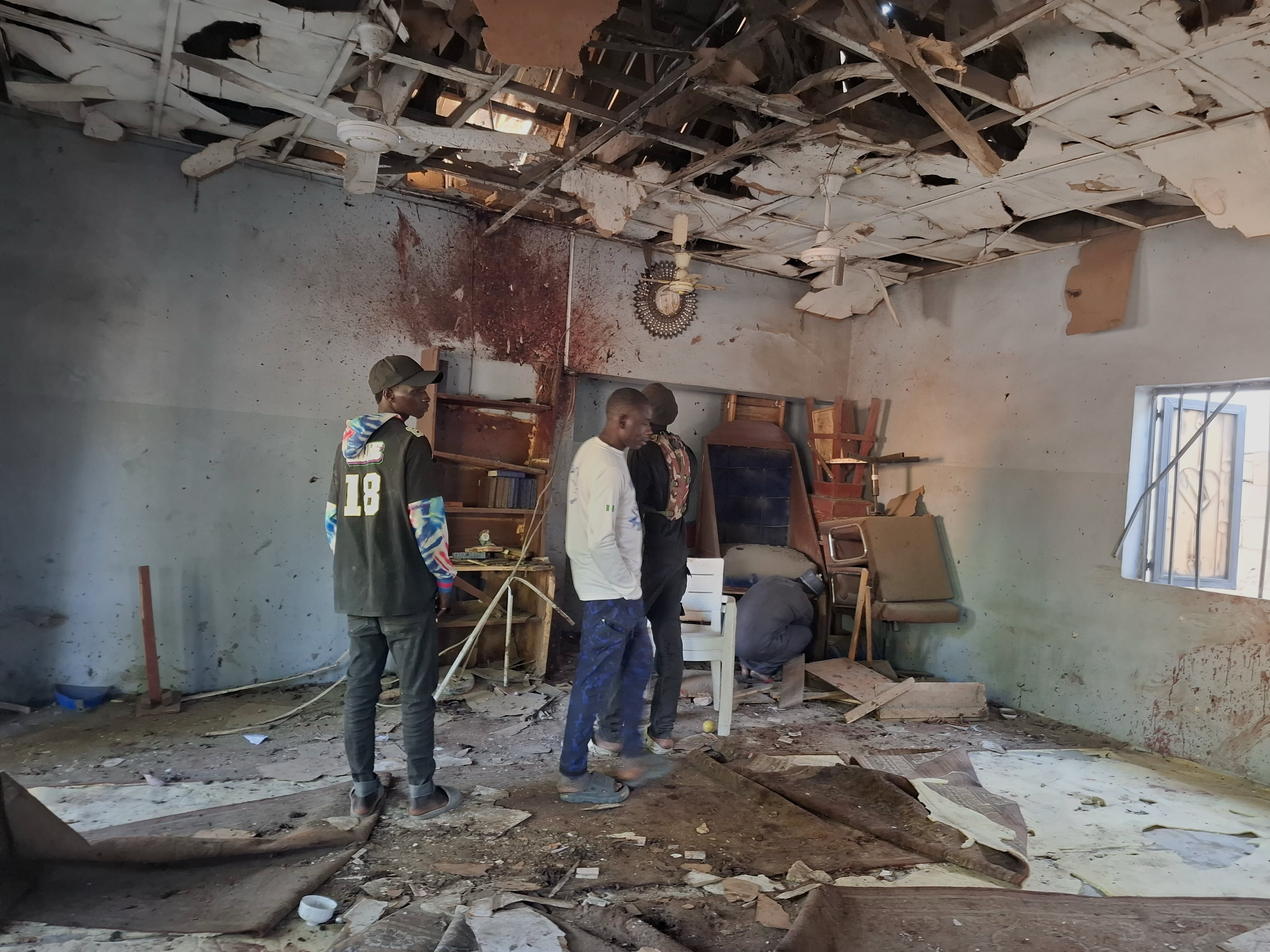
The president of the United States, Donald Trump, has used the “brutal murders” of “innocent Christians” as justification for attacking Islamic State (ISIS) targets in northwest Nigeria. But among the victims of jihadist violence in this African country there are members of different religious denominations, both Christians and Muslims, according to the Nigerian Government itself, which recognizes the high number of victims in this conflict, but rejects that it is a “genocide.” Both churches and mosques are attacked, as well as markets and other meeting places. “There is no systematic and intentional attempt, neither by the Government nor by any serious group, to attack a particular religion,” the Minister of Information, Mohamed Idris, assured a few weeks ago.
Nigeria, the most populous country in Africa – with some 235 million inhabitants – and one of its main economic drivers, has become one of the epicenters of jihadism on the continent in the last two decades. The most well-known terrorist groups are Boko Haram and the Islamic State West Africa Province (ISWAP), which operate primarily in the northeast and Lake Chad. But in recent years other radical groups have emerged in the northwest, particularly in Sokoto and Kebbi States, including Lakurawa, which maintains links to the Islamic State Sahel Province (ISSP), based in neighboring Mali and Niger. The United States announced this Thursday that it had bombed Islamic State (ISIS) camps in Sokoto.
These armed groups, which try to impose their radical vision of Islam, carry out attacks against the population, carry out kidnappings and mass murders, extort civilians and clash with security forces. In the northeast, in the States of Borno, Yobe and Adamaua, Boko Haram and ISWAP compete with each other for control of territory and have engaged in numerous clashes, while in the northwest Lakurawa fights against organized criminal gangs who also engage in looting, robbery and kidnapping. In fact, this last group emerged as a self-defense militia against bandits and was later radicalized under the influence of the ISIS branch in the Sahel. Its leader is Ameer Habib Tajje.
Added to this violence, which occurs especially in the north of the country, is the conflict between shepherds and farmers in the central regions, where attacks against entire communities have also been recorded.
Internal wear and tear of the president
As happened to his predecessors Goodluck Jonathan and Muhammadu Buhari, the current Nigerian president, Bola Tinubu, is suffering enormous internal wear and tear due to all this violence, which the Government has been unable to stop. In this context, Trump included Nigeria last October on the list of “countries of special concern” for its violations of religious freedom, and threatened “swift military action” if the massacres of Christians were not put to an end.
At the beginning of October, Republican Senator Ted Cruz stated in Trump also threatened to cut off all humanitarian aid to Nigeria, already greatly reduced after cuts to the North American agency USAID.
The Nigerian authorities reacted quickly and a round of talks was opened that has led to new agreements. Last Monday, Abuja declared the crisis closed. “The recent diplomatic dispute with the United States has been largely resolved through a firm and respectful commitment that culminated in a strengthened partnership” between both countries, said Minister Idris.
This Thursday, the Nigerian Ministry of Foreign Affairs was quick to point out through X that the US attacks against ISIS in the northwest had been carried out “within the framework of security cooperation with the US.”
Relations between the US and Nigeria are very strong. Washington is aware of the demographic and economic weight of this country, but also of its leadership in the western region of the continent. For Abuja, the North American giant, where a robust Nigerian diaspora lives, is not only its first trading partner, but also an important defense ally and its main aid donor.
For more updates, visit our homepage: NewsTimesWire