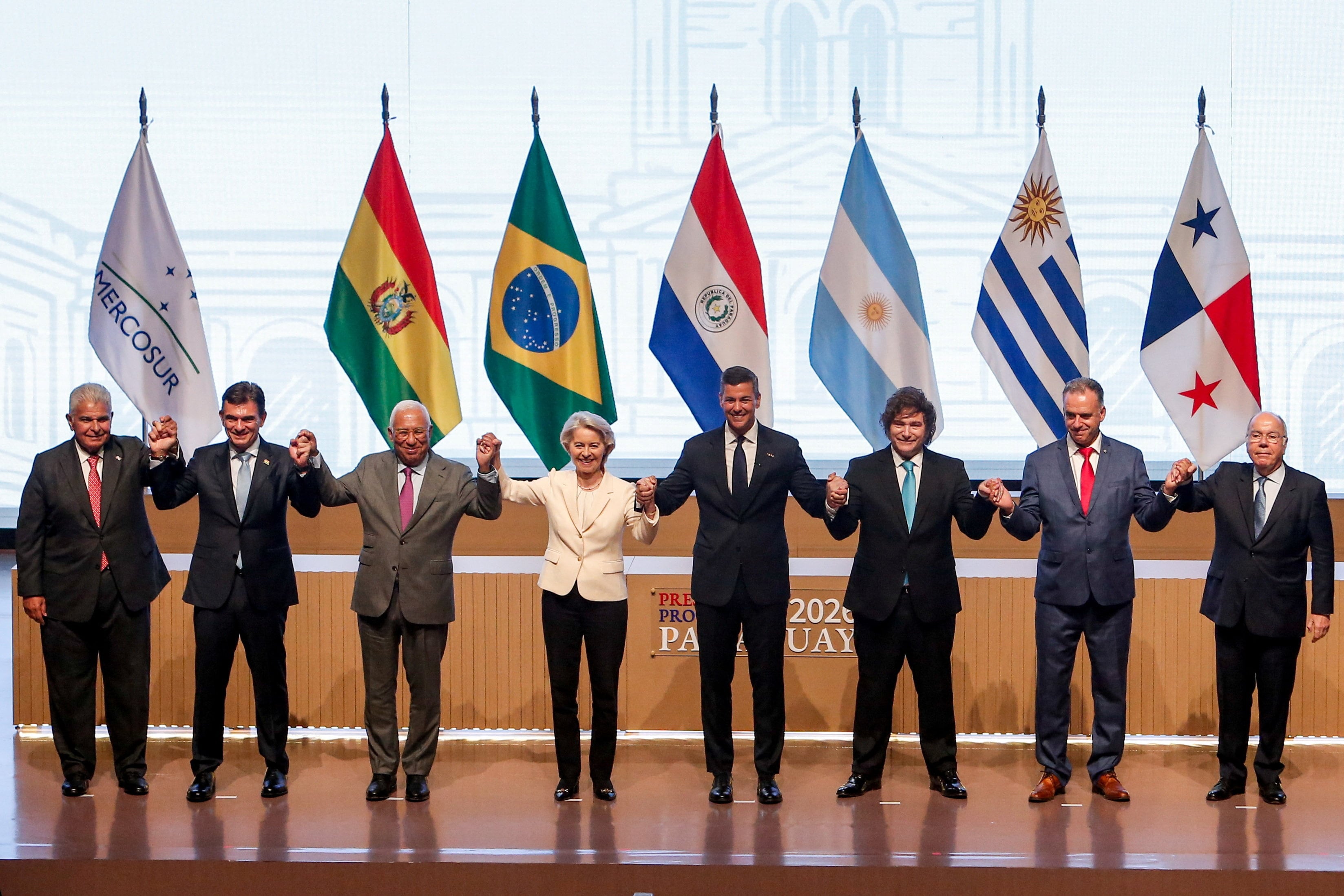
We celebrate the signing of the Interim Trade Agreement between the European Commission and Mercosur this Saturday. Is it good news? It certainly is. Could it have been better? Also. But in an international context marked by uncertainty, conflict and fragmentation, the fact that two regions decide to exercise leadership and commit to cooperation constitutes, in itself, a relevant and positive fact.
There are several reasons that support this optimism.
First of all, the agreement rescues the vision of a rules-based order. It will be a space for cooperation between two regions that share essential values: respect for international law, the peaceful resolution of disputes and the defense of an order based on rules, and not on the law of the strongest. In a world where trade is increasingly politicized and multilateralism is weakened, this understanding sends a significant signal, both externally and internally to both regions.
Secondly, the agreement has a clear geopolitical dimension. It reinforces the European presence in South America at a time of growing strategic competition between great powers and, at the same time, offers Mercosur a more balanced path to international insertion, avoiding excessive dependencies and expanding its margin of strategic autonomy. Trade data illustrate this need for correction: the participation of the European Union as a destination for Mercosur exports fell from 26% in the mid-nineties to just 14% in 2024, while its weight as a supplier fell from 28% to 18%. Europe cannot continue losing opportunities and it is in Mercosur’s interest to diversify and balance its external ties.
Third, the agreement will act as a powerful catalyst for regional integration. More than three decades after the Treaty of Asunción, Mercosur is still far from functioning as a fully consolidated customs union: it does not have an effective common external tariff, it lacks macroeconomic coordination and it maintains numerous internal barriers. The agreement with the European Union introduces concrete economic incentives that can promote true regional integration, more effectively than any isolated technical cooperation program.
Fourthly, it is worth emphasizing that Mercosur does not compete with European agriculture: it complements it and supplies it with strategic inputs. More than 70% of European imports of plant proteins – particularly soybeans and soybean meal – come from Mercosur and are essential to sustain European intensive livestock farming. Added to this is the supply of biodiesel, key agricultural inputs and the potential contribution in fertilizers such as urea and potash, as well as cotton, wood and cellulose, essential for the textile industry and agricultural packaging. In this sense, Mercosur is an irreplaceable partner for European farmers.
Finally, in relation to final agri-food products intended for consumption, the agreement does not pose structural risks for European agriculture. Market access is strictly limited by tariff quotas, gradual tariff reduction schedules and full compliance with demanding sanitary and phytosanitary standards. In the case of beef, poultry and pork, the volumes contemplated represent a minimal fraction of European consumption. In particular, the beef quota is equivalent, even in the full utilization scenario, to between 1% and 1.5% of annual EU consumption; Illustratively, the aggregate impact is equivalent to, at most, one hamburger per person per year. In poultry and pork, the effects are even more marginal, especially in a sector where the Union is a net exporter.
More arguments could be added, but there will be time for that. This story is just beginning and the ratification process in the European Parliament will be a key stage.
It is worth remembering, however, the old Chinese saying: “When you drink water, remember who dug the well.” In this spirit, we would like these lines to serve as a tribute to Spain for its unwavering support and to the remembered Spanish pro-European, Manuel Marín, a great friend, bold negotiator and visionary European commissioner, who knew how to defend, for thirty years, the possibility of this important interregional agreement.
For more updates, visit our homepage: NewsTimesWire