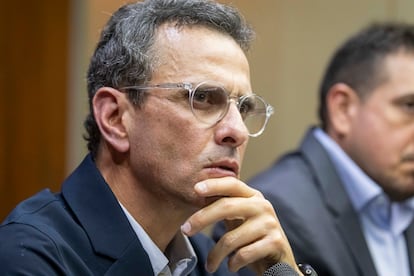
Henrique Capriles Radonski (Caracas, 53 years old) has regained strength on the Venezuelan political scene. Deputy of the National Assembly in a Venezuela without Nicolás Maduro, Capriles wants to talk. He pauses for several minutes on each response and sometimes returns to and develops the previous one. Although conciliatory, he reveals a persistent discomfort with a part of the opposition that, he says, has judged him harshly. Capriles, opposition leader, former mayor, former governor and former presidential candidate, is concerned that the “new political moment” that interim president Delcy Rodríguez has spoken of is only an oil transaction. And he insists: without reliable institutions and without freedoms, elections will not change anything.
Ask. After the early hours of January 3, what do you think happened and why did Trump opt for Delcy Rodríguez?
Answer. At some point we Venezuelans will debate why we got here, but there is a truth the size of a cathedral: everything that Maduro said would happen, did not happen. Neither Xi Jinping nor Putin, two of his most important allies, came out to defend him, which suggests a certain unanimity in the international community in seeing this as an opportunity, despite the implications in international law. Rather than stay with diagnoses, I would look at the difference with 2019: this is Trump’s second presidency and the question is what is the theory of change, because it has already been understood that removing Maduro does not mean recovering democracy in 24 hours.
Q. What type of transition does Venezuela need?
R. Changing this is not something that happens overnight. As people become poorer, it is more difficult to recover democracy, because you become more dependent on the government. That is why, when I hear Secretary (of State) Marco Rubio talk about stabilization, recovery and transition, I see a change: there is awareness that the country must first be economically stabilized. Venezuela is on the verge of collapse, it is a paralyzed country, with a black market that almost tripled the official one and inflation that has skyrocketed in recent days.
Q. And after?
R. Then comes re-institutionalization, although Delcy Rodríguez does not like the word. A new political moment is not just about changing a law or voting, it is about starting to seriously discuss institutions. This second step is what allows us to reach elections. And that’s what I would say even to (the presidents of Brazil and Colombia) Lula or Gustavo Petro: a new election is the end of this movie, not the beginning. That is where I see the change in United States policy towards Venezuela.
Q. What deadlines do you see possible?
R. That’s the big question: how long? I wouldn’t set a fixed deadline. It is evident that the government is clinging to the thesis that Maduro is a prisoner. And with that the Constitutional Chamber creates continuity and a mandate without entering into the times established by the Constitution, which would force it to declare absolute failure and call elections in 30 days. The debate can take place, but not now, because calling elections today would be like taking a 360-degree turn and returning to the same point. The real question is how quickly the Venezuelan economy can be stabilized. My concern is that the president of the United States only talks about how many millions of barrels have arrived. In Venezuela we have to ask ourselves if the institutions serve the country. Who trusts the Supreme Court, the Prosecutor’s Office or the CNE? We will be able to talk about a new political moment when we sit down to negotiate what the re-institutionalization process will be like and when the opposition is represented so that there is balance.
Q. Should María Corina Machado have a relevant role?
R. More than once I have recognized, privately and publicly, the effort and strength of María Corina. I thought she was not going to stay in the electoral race and she stayed, even though she was disqualified, and I think that the Nobel is recognition for having stayed there. For me, the candidate should be her, because she won the primaries and had the greatest support. And she has to have the right to compete in elections; If we deprive her or any other political actor, we are not opening doors to democracy. That said, I think that in the current situation we have to depersonalize things.
Q. Have you spoken to her recently?
R. I haven’t talked to her in a while.
Q. How long?
R. I don’t know, I only have that account with my wife.
Q. What role will you have in this entire process?
R. My aspiration is not Miraflores. I’m not obsessed with coming to power. What I want is for Venezuela to change. My role is to open channels of democracy and be where key issues are discussed, as is the case today with the hydrocarbon law. It is important to be there: it will always be better for the opposition to have a voice, even if it is in a corner, than to have none at all.
Q. You abstained from voting on that law.
R. We are going to give the background discussion on the oil issue and the government knows it. And it’s not just about talking about royalties or taxes. The problem with PDVSA (the state company Petróleos de Venezuela SA) is not the law: it is that the industry was looted and destroyed and became the great center of corruption of the so-called Bolivarian revolution. All the last presidents of PDVSA have ended up in prison, and while they were talking about the oil strike or sanctions, no one mentioned scandals such as the one of more than 20,000 million dollars (about 17,000 million euros) stolen in a single year.
Q. Is there more room for the opposition in Venezuela without Maduro?
R. I don’t feel that way. And I don’t think we’re in a transition either.
Q. Why is the opposition still so divided?
R. We have all been co-responsible for the good and bad moments. It is a lie that the opposition has not made mistakes, and some have been very costly, but I do not see the possibility of a future if there is no reunion of the democratic sector. The differences have reached unacceptable extremes, such as attacking journalists for not following a line of opinion, and that is incompatible with a democratic opposition.
Q. And what have been your mistakes?
R. I have made many mistakes and I will continue to make them, but the important thing is to learn. Abstention was always a mistake: I was there, I learned and I didn’t return. I also think it was a mistake to have accompanied the interim government (of Juan Guaidó).
Q. What is happening in Miraflores? Is unity believed between the Rodríguez brothers and Diosdado Cabello?
R. Whether they get along well or badly with each other, I don’t care. The big question is whether anything has really changed, and the answer is that so far it hasn’t. When is the repressive apparatus going to be dismantled? When is the law against hate, used to persecute people for tweeting, going to be eliminated?
Q. Is there not then a new political moment?
R. The new political moment is to have a free press, to return the signals of international channels and for the releases of prisoners to be full freedoms. Hopefully it’s just a matter of time. If not, it’s just an accommodation so that nothing changes. After so many abuses, Venezuelans are not going to settle for that. That is Delcy Rodríguez’s challenge and how she wants history to remember her. After what happened on January 3, in the way it happened, it can happen again.
Q. What is happening in the barracks? How do you re-institutionalize weapons in a country where thousands of civilians act as militiamen?
R. The issue of security does not seem to be on the agenda right now. But re-institutionalization requires the Armed Forces to once again comply with the Constitution. Maduro used it to stay in power, but that changed today. The question is whether he will continue to defend a political party or return to his constitutional role.
Q. What is the role of Vladimir Padrino? Under other circumstances, wouldn’t a Defense Minister who suffers such an attack have resigned?
R. The Government will never recognize a weakness or a failure. It seems that in the United States election what mattered was not who has the military strength, but who has the strength in terms of the functioning of the government, but from the economic point of view. And that is Delcy Rodríguez.
Q. Do you believe that the United States protects Venezuela?
R. That word, tutelary, sounds to me like they were talking to me about my mother. There I believe that María Corina has an important role: beyond her legitimate aspirations, she has to prevent those three steps of Rubio’s plan from remaining only in the first when economic aspirations begin to be satisfied. I am not going to go into the internal differences of the opposition. The truth is that when María Corina herself opens the possibility of a new election, you see that there has been a turn. They accused us of being normalizers and we never turned the page; We said that that 2024 election was not charged. But I’m not going to stay in that discussion, because it never ends.
Q. Are there direct channels with Delcy or Jorge Rodríguez?
R. No.
Q. Can the cause of political prisoners reunify the opposition?
R. That is everyone’s cause. We are all asking for the freedom of political prisoners. If we take it to partisan confrontation, the government closes and it is in our interest that they leave as soon as possible. There is common cause, but we must be very careful that no one tries to capitalize on the freedom of a political prisoner.
For more updates, visit our homepage: NewsTimesWire