A conflict in the Balkans is rarely resolved by the action of a single person. But Kosovo Prime Minister Albin Kurti is now in a prime position to influence the stability of a historically troubled region. His party, Vetëvendosje (Self-Determination), obtained 51.11% of the votes in the legislative elections on December 28, a result that exceeded even the most optimistic forecasts. It is unclear, however, what use Kurti will make of that comfortable majority. His critics define him as intransigent and stubborn, a supporter of “all or nothing” when he sits down to negotiate with Serbia. His defenders believe, however, that Albin Kurti, 50, is loyal to his principles and relentless against corruption.
A former student activist, electrical engineer by training, nationalist and progressive, Kurti made headlines in the international press in October 2015 when, as leader of the opposition, he threw tear gas canisters into the Kosovo Parliament. Several deputies needed medical attention. On previous occasions, their legislators whistled inside the Assembly, threw bottles of water and even eggs at the ministers.
Kurti was opposed, above all, to an agreement promoted in 2013 by the European Union, which would create the Association of Serbian Majority Municipalities, with important autonomous concessions. The then opposition leader said that this would mean “the Bosnianization of Kosovo”, as if a State within the State would be created, similar to the Republika Srpska in Bosnia.
Kosovo unilaterally proclaimed its independence from Serbia in 2008, a status that five European Union countries still do not recognize: Cyprus, Romania, Slovakia, Greece and Spain. After the secession from Serbia, some 90,000 Kosovo Serbs remained among Kosovo’s 1.8 million inhabitants. The figure is approximate because many citizens refuse to participate in the census. The relationship between the Kurti Government and that minority is the one that concentrates the main focus of tension in the country, with recurring episodes of violence. In northern Kosovo, where there are four municipalities with a total of 50,000 Kosovo Serbs, some 4,500 KFOR soldiers remain deployed, the NATO mission that acts as a security cushion between the Kosovo police and the Kosovo Serb population.
Albin Kurti began his first term as prime minister in February 2020, but his government fell just four months later, following a motion of no confidence promoted by his coalition partner in the middle of the pandemic. He returned to power in 2021 and headed until 2025 the first Executive since the country’s independence that managed to complete a four-year term. In the February 2025 elections, he won with 42% of the votes, but he failed to form a Government, the legislative paralysis was almost total and he ended up calling early elections for December 28.
Until now, Kurti, with more than five years of experience in power and dozens of official trips abroad, has continued to oppose offering more autonomy for the 90,000 Kosovo Serbs. And that has created tensions with Kosovo’s traditional partners, the European Union and the United States. Richard Grenell, Donald Trump’s former special envoy for the Balkans (2019-2021), has called him in several interviews a “radical” or “leftist” who “prefers to be right than to have peace.”
Kurti arrived with his party at the December 28 legislative elections entrenched in their positions and under pressure inside and outside the country. Inside, because the opposition had been under an institutional blockade for 10 months, alleging that because of its “stubbornness” the country was breaking bridges with the United States and the EU and being left alone against Serbia. And outside, because Brussels continued and continues to pressure through the so-called “punitive measures” (which translates into the freezing of funds) for the lack of tangible concessions to the municipalities with a Kosovo Serb majority, located for the most part in the north of Kosovo, bordering Serbia.
Journalist Eraldin Fazliu, from the Kosovo network Kohavision-KTV, points out through an exchange of messages that the “overwhelming” victory of Self-Determination is explained, among other reasons, by the massive mobilization of the Kosovo diaspora. The elections were called on December 28 to favor the arrival of Kosovars residing in Germany, Switzerland and other Western European countries.
The result, explains Fazliu, allows Kurti will govern alone, although he will depend on the votes of the opposition to address constitutional reforms and international agreements, which require a reinforced majority. Among the first pending decisions is the ratification of the EU Growth Plan, which provides some 900 million euros for Kosovo. At the end of last December, the EU began to lift some of its punitive measures and released an initial €216 million. The rest of the blocked money will depend on the negotiating will that Kurti shows regarding the Serbian minority.
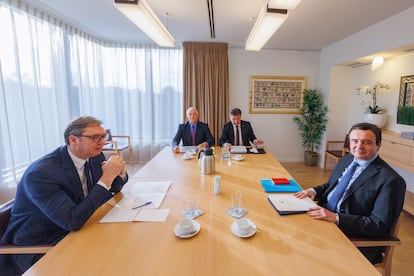
The prime minister’s main internal challenge, according to Fazliu, will be to contain inflation, which ended December at 5.3%. And abroad, the biggest challenge will be responding to pressure to reach agreements with Serbia. Both countries are candidates to join the European Union. But neither Belgrade wants to recognize Kosovo as a State nor does Pristina intend to promote the Association of Serbian Majority Municipalities as long as Belgrade does not recognize the independence of Kosovo.
The weekly The Economist warns: “Both countries resemble an separated and unhappy couple, unable to agree on the terms of divorce: Serbia refuses to grant it, and until it does, Kosovo cannot prosper. Shaking his fist against Serbia may help Kurti win elections, but to bring prosperity to his country he will need a more cordial relationship.”
Kurti made the fight against corruption his banner, and in Transparency International’s corruption perception index Kosovo went from 104th in 2020 to 73rd in 2025. Sébastien Gricourt, co-director of the Balkan Observatory of the Jean Jaurès Foundation, believes that what has allowed Kurti to be re-elected, in addition to his fight against corruption, is the combination of “policies of economic reactivation and social redistribution, in particular in favor of the emancipation and employment of women and young people.”
Gricourt prefers to talk about coherence in the face of those who call him stubborn. “His intransigence in not deviating from his principles makes Kurti a unique leader in the Balkans and, in my opinion, even a European model,” he underlines. Gricourt believes that there is “excessive” use of the word “nationalist” associated with the prime minister. Instead, he believes that “sovereignty” should be used, since, as he points out, the prime minister has acted in the north of the country exercising a sovereignty “that two decades of international presence never dared to initiate or even conceive.”
However, the previous High Representative of EU Foreign Policy, Josep Borrell, came to openly criticize Kurti in 2022, in the face of a conflict between Belgrade and Pristina: “I must say, for the sake of transparency, that we presented a proposal… President Aleksandar Vucic (Serbian leader) accepted it, but unfortunately Prime Minister Kurti did not.”
Borrell’s successor, Kaja Kallas, congratulated Kurti on December 29 through a joint statement with the office of Marta Kos, Commissioner for Enlargement. The carrot of congratulations did not hide the stick of warning: “The normalization of relations between Kosovo and Serbia remains the only path. We hope that all obligations of the Agreement on the Path to Normalization and past agreements of the Dialogue will be implemented without further delays or preconditions.” The implicit message is clear: if Kurti does not comply, Brussels will keep the almost 700 million euros pending from the EU Growth Plan under lock and key.
Now it will be the leader of Self-determination who chooses his path. The international context is no longer for tear gas canisters. And Brussels has made clear that Kosovo’s progress towards the European Union will depend on its ability to close uncomfortable agreements. The former activist must decide whether his legacy will be that of a leader who maintained the purity of his principles or that of the statesman who risked his political capital to ensure Kosovo’s definitive fit into Europe.
For more updates, visit our homepage: NewsTimesWire