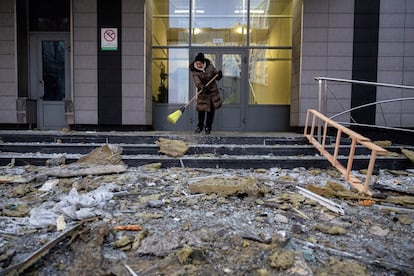
The thermometer read -20ºC when at 00:24 in the morning the air raid sirens cleared the inhabitants of kyiv from doubting whether the one-week energy truce announced by Donald Trump five days earlier was still on. The explosions that began to be heard half an hour later and lasted throughout the early morning confirmed that Russia was launching another major attack against the country this Tuesday, on the coldest night of the worst winter of the war, which is approaching its fifth year. Around 10:00 in the morning, the alarms went off again.
In addition to the capital, explosions were reported in energy infrastructure and homes in Kharkiv, Sumi, Odessa, Dnipro, Vinnitsa and other regions. Moscow used 521 aerial projectiles, 450 attack drones and 71 ballistic and cruise missiles, according to President Volodymyr Zelensky, who reported nine injuries so far. “Taking advantage of the coldest days of winter to terrorize people is more important for Russia than resorting to diplomacy,” the leader denounced on social networks.
“Putin waited for temperatures to drop and stockpiled drones and missiles to continue his genocidal attacks against the Ukrainian people,” said Foreign Minister Andrii Sibiga.
The Ukrainian Air Force has specified that among the projectiles launched by Moscow, there were explosive drones of different types, along with 32 Iskander-M/S-300 ballistic missiles; four Zircon, which are hypersonic anti-ship missiles that it has already used before against land targets, and 35 cruise projectiles. The defense systems intercepted 450 projectiles.
DTEK, the country’s largest energy company, reported at 8 a.m. that the attack had damaged thermal power plants. This is the ninth large-scale attack on these facilities since October 2025. Since the beginning of the invasion, these plants have suffered more than 220 attacks.
In the capital, local authorities reported that 1,170 residential buildings were without heat as a result of the attack and emergency power outages were made in two districts. In Kharkiv, 820 residential complexes have been left in the same situation.
US President Donald Trump said last Thursday that his Russian counterpart, Vladimir Putin, had committed not to attack Ukrainian energy infrastructure for a week. Moscow later confirmed that conversation, but pointed to Sunday, February 1 as the deadline. That is, four days and not a week.
The coldest days of the polar vortex that hits the northern hemisphere were expected from that Sunday to Thursday. The population survives the extreme temperatures of this winter with water, electricity and gas cuts that in some cases last for weeks. Moscow has systematically battered Ukrainian energy infrastructure since the beginning of the large-scale invasion in 2022.
As the fourth anniversary of the start of the war approaches, the facilities are in critical condition. The mood of the Ukrainians, too. As they heard the explosions, many wondered how many more days without water, electricity or heating the new attack was going to leave them. Hundreds of residential buildings in the capital had not yet recovered from the last one, on January 24, and a massive blackout on Saturday.
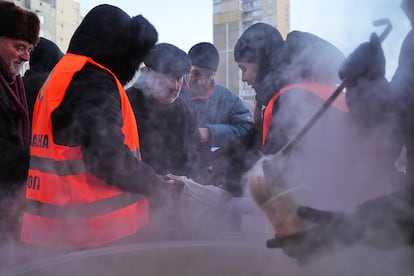
In Ukraine they interpreted Moscow’s promise of a truce as a simple pause to prepare for a new attack, without being clear how long it would last. kyiv pledged not to fire on the Russian energy sector either. On Monday, Zelensky reported that in the last 24 hours, there had been attacks on energy facilities in towns along the front lines and on the border with Russia, but that there had been no missile or drone bomb attacks on energy infrastructure. A day earlier, on Sunday, Russia attacked a bus carrying DTEK miners, the country’s largest energy company, with drones, killing 12 of its occupants. If there were any doubts about whether the truce had ended, Moscow cleared them up a few hours later.
kyiv hoped for a de-escalation to support diplomatic efforts to end the conflict. This Tuesday’s attack occurred while the Ukrainian delegation was traveling to Abu Dhabi to hold a new round of trilateral talks with the United States and Russia this Wednesday and Thursday. Also, hours before the arrival in kyiv of NATO Secretary General Mark Rutte, when Ukraine cries out to the allies for more anti-aircraft defenses.
In his tweet after the attack, the Foreign Minister called for increasing pressure on Moscow. “The world has the necessary tools,” he said, and pointed to several concrete measures: “Depriving the Russian war machine of energy revenues and access to technology. Isolating the Russian regime. Detaining and confiscating Russia’s illegal oil tankers.”
For more updates, visit our homepage: NewsTimesWire