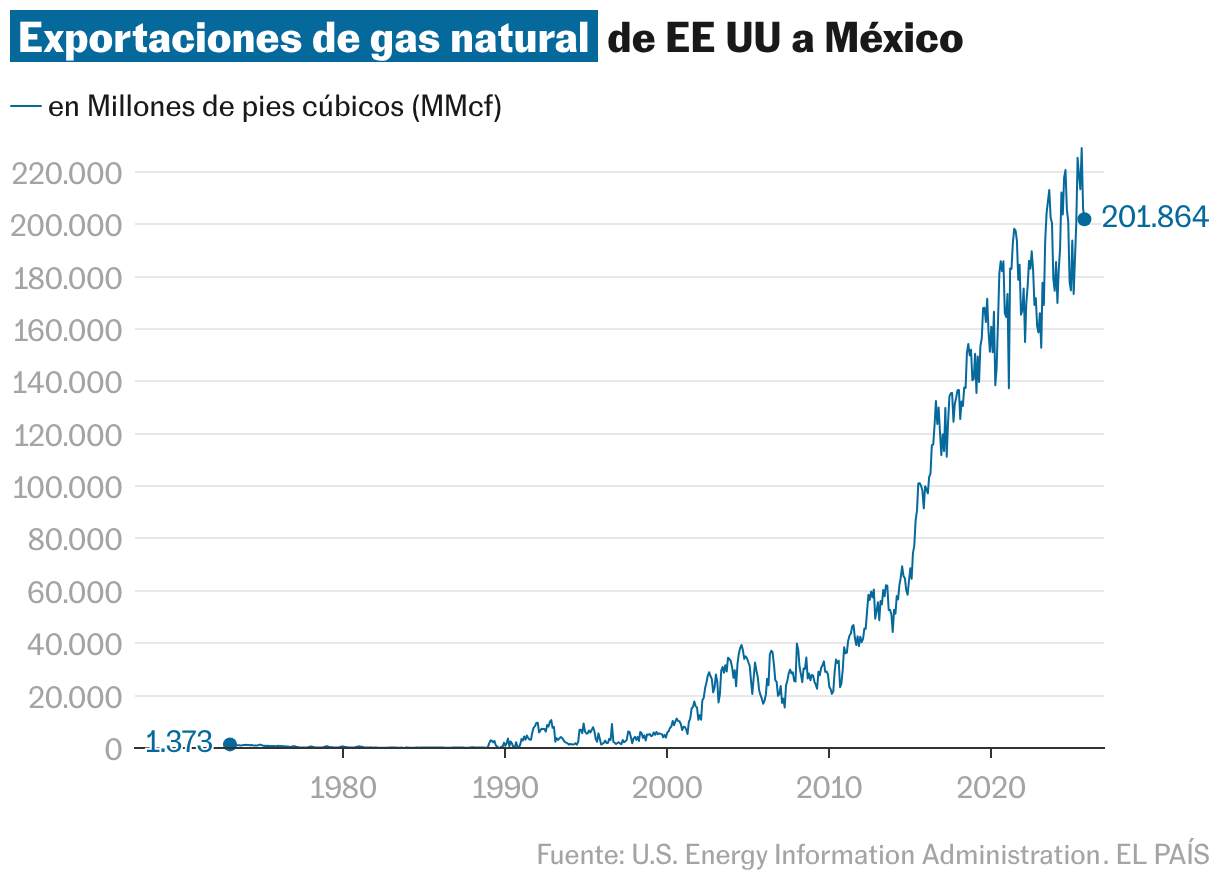
Mexico’s energy engine is located on the other side of the Rio Grande. The second largest economy in Latin America depends more than 70% on imports of natural gas from the United States, a key input in industrial activity and electricity generation. Mexico is highly deficient in natural gas and to supply its needs, it depends on US imports. During October 2025, the latest figure available, the country imported 6.5 billion cubic feet of this raw material per day, according to data from the Energy Information Administration (EIA). Official figures show that Mexico doubled its purchases of energy from the United States, becoming the main buyer of natural gas from the United States, surpassing Canada, the Netherlands and France. Faced with this dependency, the Government of Claudia Sheinbaum evaluates several alternatives, among which is the fracking or hydraulic fracturing, to increase Pemex’s local production of this energy. If in 2024 the state oil company extracted about 3,800 million cubic feet per day, the goal is to raise this figure to 5,000 million in 2030.
The low prices of natural gas in the United States, which are currently around three to four dollars per million thermal units (BTUs), encouraged imports; however, in the long term, this dependence poses a risk for Mexico and its productive sector, at the mercy of Washington’s production and prices. Faced with an increase in national consumption of natural gas, which is already around 9,600 million cubic feet per day, this Government has opened the door to using the exploitation of the so-called unconventional fields in Coahuila, Tamaulipas and Veracruz to increase local production. A project, still in the making, that will involve the association of Pemex with other private companies, as well as a complex debate between opponents of this technique due to the intensive consumption of water and the environmental impact.
Natural gas is considered a “transition fuel” because it is an intermediate fuel between the dirtiest fossil fuels such as coal, gasoline, diesel, fuel oil and green energy sources such as wind or photovoltaic energy. Although Pemex produces 35% of the demand, when discounting its own consumption to supply its own plants, it leaves approximately 15% in the national market.
Last May, Mexico reached the peak of imports of this raw material by purchasing 7.5 billion cubic feet per day, the largest amount recorded in history. The EIA attributed this milestone to the increase in demand for natural gas “in the electricity sector.” Mexico is used to generate more than 60% of the country’s electrical energy. State utility CFE is building and commissioning combined cycle gas turbine plants across the country.
These imports enter Mexico through the main corridors of Texas, Arizona and California. The EIA warns in a report that among the factors limiting US natural gas exports to Mexico are restrictions on Mexico’s pipeline infrastructure, including the construction of new pipelines and delays in permitting, as well as limited storage capacity. The high dependence of energy on US purchases increases the risk that the country is at the mercy of US climate contingencies and price swings.
Javier Estrada, director of the consulting firm Analítico Energética, explains that for more than 20 years attempts have been made to launch natural gas projects, however, Pemex prioritized oil projects as it is a higher value input. On the contrary, while local production of natural gas was rejected, the Federal Electricity Commission (CFE) began to build combined cycle plants based on natural gas, also taking advantage of the low energy prices. “Combined cycle plants were installed in almost the entire country, but many old plants were also maintained throughout the country. Today we are also paying that price, for not having changed them to better technology and the CFE is still burdened with a good number of plants that are not efficient and that increase the price of electricity,” he says.
In the past, adds Estrada, Pemex used the fracking, but The projects foundered due to deficiencies in the contracts, in the business scheme, in the type of companies involved and in the supervision of the oil company. Now, the specialist affirms that it is viable to resume these plans if these failures are corrected and appropriate technologies are adopted that mitigate the impact on the environment. “Hydraulic fracturing is intrinsic to oil activity. Now other technologies have been discovered, the chemicals that were mixed are not the same today and others could be used, definitely less polluting. The fracking It would have to be done only where there is actually an abundance of water and with responsible use of all waste. So, yes it should be done, but the finance and production scheme has to change a lot,” he concluded.
The urgency of increasing national production of natural gas seeks to reduce the risk of supply interruptions due to contingencies in the United States, as already happened in 2021, when a storm in that country paralyzed its energy industry and skyrocketed the prices of the input and, therefore, of electricity in Mexico. Experts warn that in the face of forecast growth in electricity demand, it is crucial to ensure energy supply.
For more updates, visit our homepage: NewsTimesWire