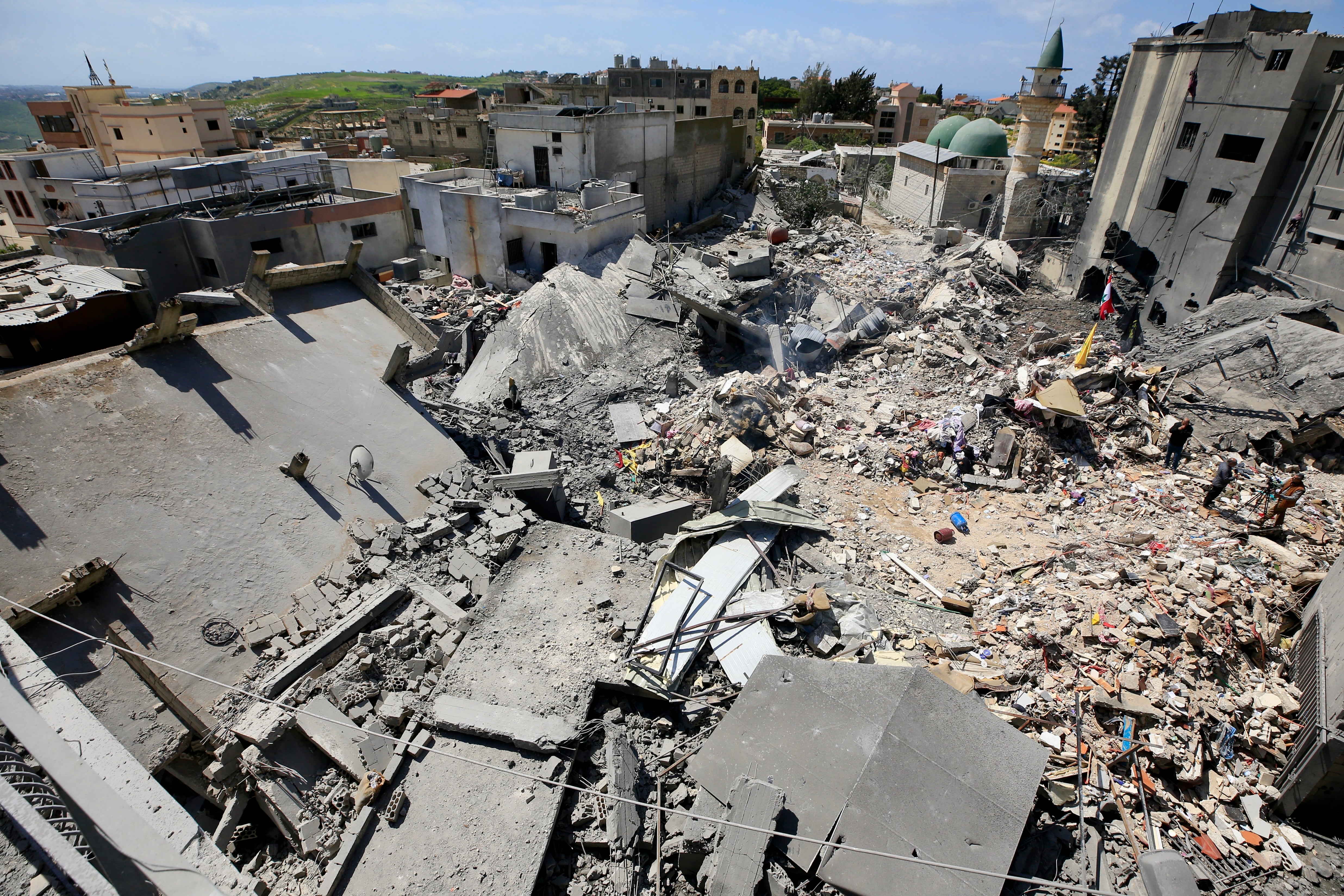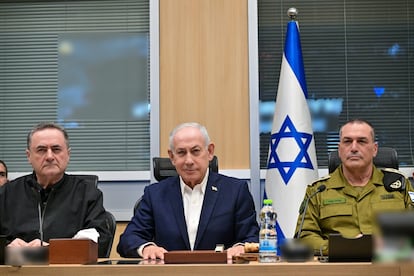
Israel is the country that has most endangered the ceasefire that the United States and Iran sealed on Tuesday at the last minute and that has given birth to the negotiations this Saturday in Islamabad. The truce got off to a bad start on Wednesday, after a few first hours of optimism; Not only because the Government of Benjamin Netanyahu agreed to apply it in Iran (it did not want to, but had no alternative) but excluded Lebanon, but because it chose precisely the first day of the truce to launch its largest wave of bombings of the war in the neighboring country.
Israeli military aircraft released 160 explosions in 10 minutes, causing more than 300 deaths and generating the question that the newspaper’s military affairs correspondent HaaretzAmos Harel, asked rhetorically on Friday: “Was this a final explosion of anger or is Netanyahu trying to undermine the regional agreement?”
Netanyahu’s obsession with attacking Iran is no secret kept under lock and key. He himself explained it this way after launching the offensive a month and a half ago together with the United States: “This coalition of forces allows us to do what I have longed for for 40 years: completely annihilate the terrorist regime.” No other president (not even Trump in his first term, between 2017 and 2021) had undertaken such a task, for fear of the potential global repercussions that it has ended up having.
Netanyahu personally convinced Trump on February 11, two weeks before the attack and despite the skepticism of US military and intelligence commanders, according to the recreation of that meeting published last Tuesday by the newspaper The New York Times based on “extensive interviews conducted under condition of anonymity” with sources familiar with the meeting. That day, the Israeli prime minister vehemently defended in the White House that a joint mission would end the regime born in 1979.
His delegation even showed the American president a short video with a montage of possible new leaders, among them Reza Pahlevi, the son of the last shah who ruled the country with an iron fist and who supported Israel and the United States until he was overthrown, precisely, by the Islamic Revolution.
Netanyahu’s team sold Trump an almost certain victory that time has proven wrong: Iran, the Israeli leader maintained (always according to the American newspaper), would see its ballistic missile program destroyed in a few weeks, would be so weakened that it would not be able to block the Strait of Hormuz and would hardly choose to attack American interests in the Middle East.
Israel’s secret services abroad, the Mossad, predicted street protests that could overthrow the Iranian regime, added to the riots and rebellion promoted by Israeli espionage and the opening of a front in the northwest by Iranian Kurdish fighters who would cross the border from Iraq.
The next day, the story of The New York Timesthe director of the CIA, John Ratcliffe, defined this regime change plan as “ridiculous”, and the chief of the General Staff, Dan Caine, alluded to the “usual procedure of the Israelis”: “They promise a lot and their plans are not always well prepared. They know they need us, and that is why they insist so much on convincing us.”
Trump, however, ended up giving the green light. The rest is history and, that is why now, in the dialogue in Pakistan, the Iranian delegation distrusts Israel’s role even more. “If we negotiate in Islamabad with representatives of ‘America First’, it is likely to reach an agreement that is beneficial for both parties and for the world,” Iranian First Vice President Mohamad Reza Aref wrote this Saturday, referring to Trump’s isolationist slogan. But he added: “If we face representatives of ‘Israel first’, there will be no agreement.”
Analyst Harel emphasizes that “Netanyahu is clearly pressuring Trump to attack Iran again, eight months after both declared that the threat had disappeared, partly for political-personal reasons.” “The continuation of the war benefits him. It creates a permanent state of emergency in the country, hinders the activity of the opposition and protests, delays his trial and diverts the debate from (the errors that allowed) the massacre of October 7 (2023, by Hamas),” he adds.
“A misunderstanding”
Trump, for now, has sided with Netanyahu regarding his operation against Lebanon, despite the risk of throwing the truce with Iran overboard. At first, in the early hours of Wednesday, he limited himself to announcing the ceasefire agreement. Shortly afterwards, Shehbaz Sharif, the Prime Minister of Pakistan, specified that this truce had to be applied “everywhere” and added: “Including Lebanon.”
With the greatest humility, I am pleased to announce that the Islamic Republic of Iran and the United States of America, along with their allies, have agreed to an immediate ceasefire everywhere including Lebanon and elsewhere, EFFECTIVE IMMEDIATELY.
I warmly welcome the…— Shehbaz Sharif (@CMShehbaz) April 7, 2026
Diplomatic sources cited by CBS assure that Trump was clear that it applied to the entire Middle East. Israel then said no to Lebanon, and the two leaders spoke by phone. Hours later they asked Trump, and he assured that the Israeli bombings in Lebanon “are part of the agreement” and that “everyone knows” that this is a “separate skirmish.”
It was a “misunderstanding,” according to Vice President JD Vance, who represents the United States at the talks in Pakistan. “I think the Iranians thought the ceasefire included Lebanon, but it didn’t. We never made that promise,” he declared.
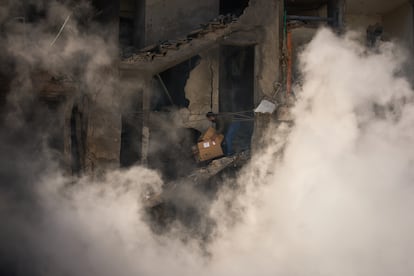
The issue is key for Netanyahu domestically in the midst of an election year, as the polls published on Friday recall. The general conclusion is that the unfulfilled promises of the war adventure in Iran are taking away votes. No poll gives the parties in his coalition a better vote estimate than before the war, and his party, Likud, loses seats. The one from the newspaper Maariv In fact, it predicts a narrow victory for the Jewish opposition formations, with 61 of the 120 parliamentarians. Those of the coalition obtain 49 (15 less than now) and the Arab formations, 10.
To the question: “Do you think the United States and Israel won the war against Iran, did they not win it or is it too early to know?”, only 22% of Israeli respondents respond that their country has emerged victorious. 46% believe not, and 32% see it as premature to speak out. 63% are also “very” or “fairly” dissatisfied with the results of the war.
The same consensus in Israel that suggests that the war campaign in Iran is not going as sold exists around the idea of continuing to bomb Lebanon despite the ceasefire. 77% consider that it should continue “until the objectives are met,” and only 12% advocate stopping the offensive. So far, the campaign against Hezbollah has involved occupying more territory in the south of the neighboring country, demolishing entire villages and forcibly displacing more than a million people.
At Trump’s request, however, Israel is not attacking Beirut now and will enter into the first “direct negotiations” with the Beirut government on Tuesday. The prime minister had to announce it by surprise on Thursday. He had been rejecting it for weeks, until Trump called him on the phone. He twisted the language to sell it as a response to “Lebanon’s repeated requests,” but it fooled few in Israel. It was Trump’s way of making a concession to Tehran without having to impose on his ally a ceasefire in Lebanon that would crush him politically. Netanyahu is already under fire for having promised a great victory in Iran and ending up agreeing to a ceasefire conceived behind his back.
Preconditions
Once again, however, the Israeli prime minister is putting obstacles in the way of a dialogue that he does not want, neither with Lebanon nor with Iran. This Saturday he indicated that the talks, which are scheduled to begin this Tuesday in Washington, have two objectives: “to dismantle Hezbollah” and sign “a real peace agreement” with Beirut that will stand the test of time. That is, the recognition of Israel without paying the historic toll of the end of the military occupation and the creation of a Palestinian State, as Morocco, Bahrain and the United Arab Emirates did in 2020, each with its counterparts. What he “did not agree to,” however, is to address a ceasefire with Hezbollah.
Israel has also vetoed the presence in the dialogue of France, guarantor along with the United States of the 2024 ceasefire that put an end to more than two months of war between Israel and Hezbollah, according to the newspaper. The Jerusalem Post. He considers him an “unfair mediator” for his positions in the last year. Its Foreign Minister, Jean-Noël Barrot, declared on Thursday that, although “Hezbollah must be compulsorily disarmed,” Lebanon “cannot become the scapegoat of a government upset because a ceasefire has been reached between the United States and Iran.”
For more updates, visit our homepage: NewsTimesWire