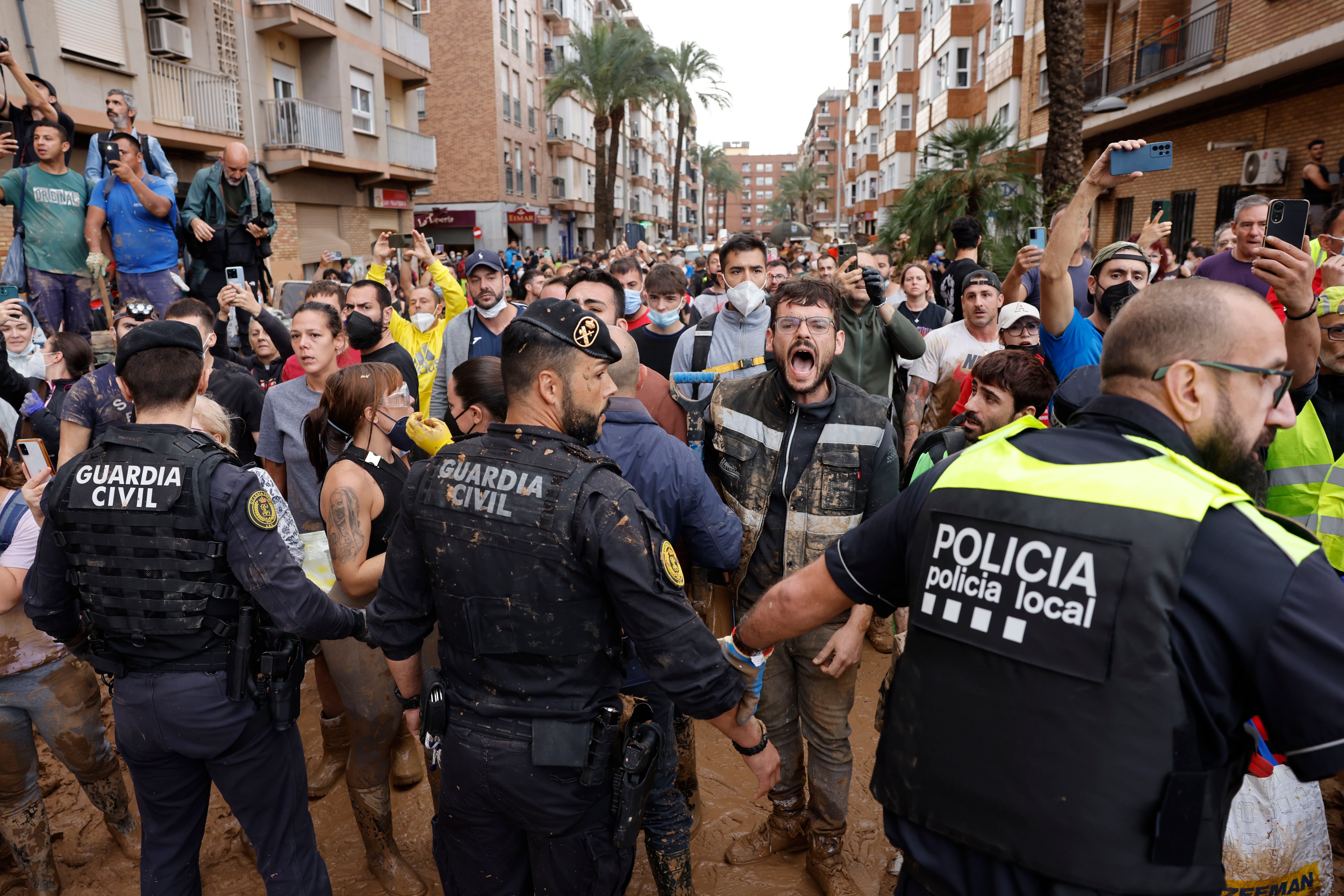
Emergency specialized experts, José María Gil and Alberto Aguilar, have agreed this Friday to point to the judge of Catarroja (Valencia) investigating the Dana, Nuria Ruiz Tobarra, the responsibility of the president of the Generalitat, Carlos Mazón, of the PP, in the management of the catastrophe that left 228 dead last October. And they have reproached the magistrate that the popular baron did not assume the command during the Aciaga Day, according to sources present in their statements.
Experts are the authors of a report in charge of disappeared SOS, the association that represents more fatalities of the flood (it brings together 170 relatives of 70 dead). Its president, Joaquín Amills, requested the resignation of Mazón last March at a meeting with the popular president at the Palau de Manises, headquarters of the Generalitat. The entity exercises one of the particular accusations in the case.
The two experts have also criticized the delay in the call of the Cecopi – the Emergency Center of the Generalitat that coordinated the crisis and whose meeting started at 5:00 p.m. in 290— and the delay in sending the mass message to mobile phones. The letter, sent through the system is alert, reached the phones at 8:11 pm, when there were already dozens of deaths, missing and people trapped in low floors and garages.
Before these appearances he has declared for four hours before the judge, also as an expert, Francisco Vallés, engineer and hydraulic professor at the Polytechnic University of Valencia (UPV). The expert has lamented that the authorities disregard the previous notices issued by the State Meteorology Agency (Aemet) about the DANA that last October left 228 dead and a trail of destruction in Valencia.
“The Aemet stuck (the prediction),” said this researcher at the Institute of Water and Environment Engineering (IIAMA) of the UPV, which has developed a hydraulic system to locate disappeared in catastrophes such as the cold drop of October.
The expert recalled that the state agency warned eight days before the DANA of the thrombus risk. And the same day of the tragedy, at 7.35, issued a red notice, the maximum of the scale. “The October 29 was the first red risk of the year. The degree of reliability was very high. It means that in an hour the 90 liters per square meter were exceeded,” he said.
“Aemet predictions had to have taken into account. The technicians know that the Poyo ravine is problematic,” he said in allusion to the infrastructure that unleashed the lethal flood when he overflows as he passes through populations such as Paiporta or Catarroja, where 45 and 25 people died, respectively. “You have to take Aemet seriously, who played a great role, warning from previous days,” he insisted. “The previous afternoon (to the Dana), my daughter, she already received notice of not going to the University of Valencia, and that was for the rains, the orange level.”
The UV suspended the classes on the eve of the flood. The decision was called “exaggerated” by the President Carlos Mazón, who, on the day of the tragedy in the morning, came to say that the storm was moving towards the Serranía de Cuenca and that around six in the afternoon its intensity in the rest of the autonomy would decrease.
Asked if the tragedy was avoidable, the specialist has replied: “It is difficult to answer. With another emergency management, the film would have been another. I am convinced. But the stage was the one we had: in the lean river was the prey of Foraata, and in the ravine of the poyo there was no infrastructure.” Vallés recalled that, in the poyo, the Dana took the flow meter.
The role of the Forata dam
The specialist has highlighted the “important role” played by the Forata dam to reduce the lethal impact of the thrombus. The former emergency director of the Generalitat Valenciana, the accused Emilio Argüeso, has already explained that the breakage of this infrastructure could have caused 20,000 dead. “Foraata gates were open from the beginning, because it is the general norm from Tous”, in reference to the swampy which in 1982 left eight dead and 330,000 victims. “(The Forata dam) played an important role, what happens is that it was a lot, and there comes a time when you have no control. If it is fills more, it could have poured by coronation, and that is always dangerous,” said Vallés. “The input flow (from the dam) was 2,000 cubic meters per second and the exit, 1,000,” he said.
The coach spent the cold drop day in the Valencian population of Buñol, where the flood discharged more than 200 liters per square meter. And, the eve, in Valencia. “I got on the Internet and I saw what was happening in Almeria and Malaga. Photos of people with an egg in one hand and a hail stone in another. Then I consulted the Aemet page, its evolution model. (La Dana) came from Andalusia, it got into the Valencian Community.