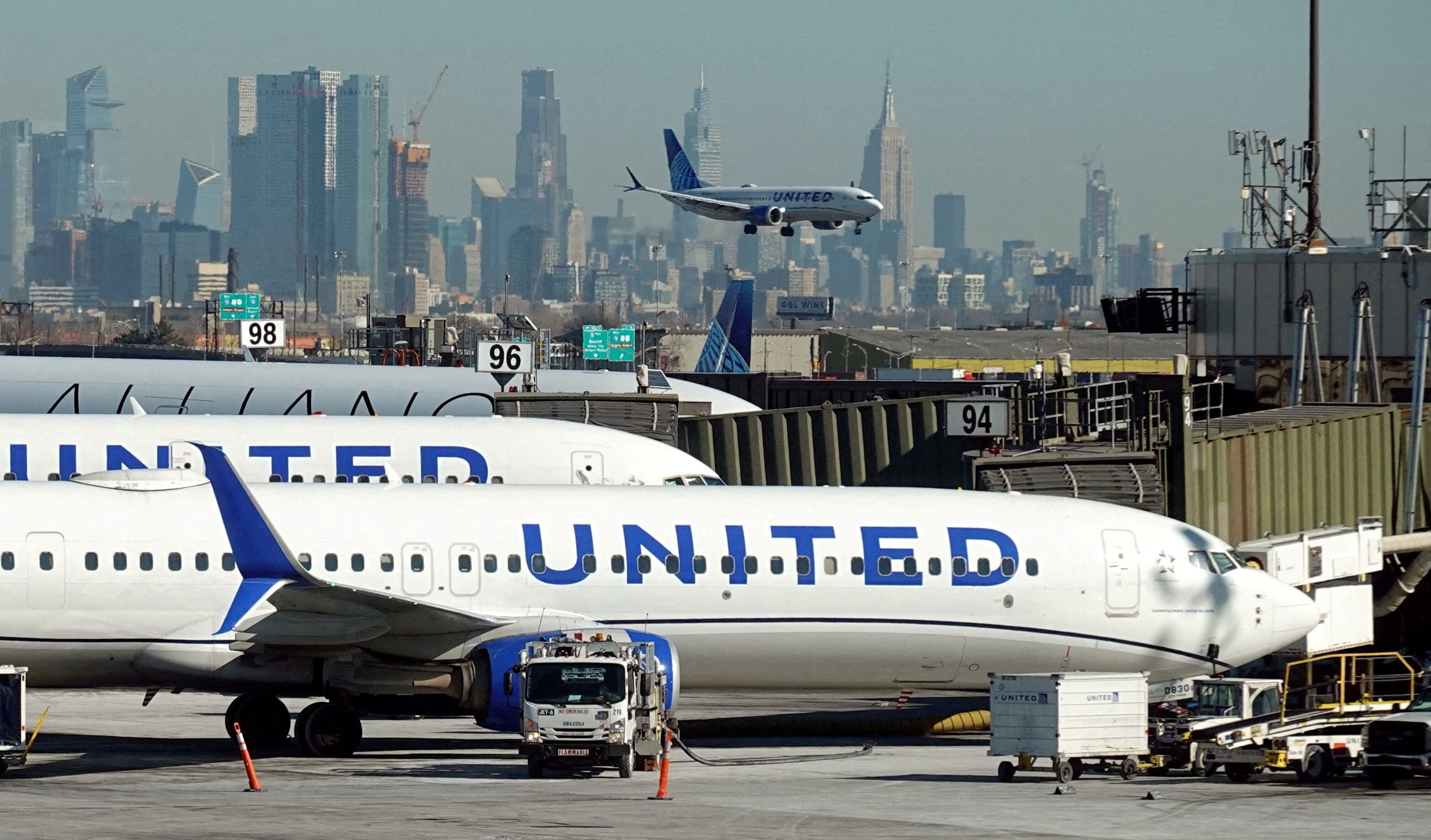
For years, the shortage of aerial controllers in the United States has caused delays and deviations in continuous flights and headaches to travelers, but what happens for almost two weeks at the Newark airport, which functions as the third in New York for its proximity to the Big Apple, is something else. The chaos in which the Newark Liberty International is plunged, located in the homonymous town of New Jersey, has caused significant delays for at least ten days in a row and raised many questions about safety in air transport, which in recent months accumulates incidents: the accident of the Potomac River in Washington, that of a tourist helicopter in New York and those of several medical planes.
The Federal Aviation Administration (FAA, in its English acronym) accounted for delays up to four hours on average on Sunday night. This Tuesday, 377 flights arrived or left late, while 150 were canceled, according to the FlightAware air traffic website, with an average delay that was approaching at six hours.
The delays are due to several factors: in addition to the shortage of aerial controllers throughout the country, a strike by Newark last week; The closure of a track until mid -June for “rehabilitation works”, and technological failures caused by obsolete teams, according to the Secretary of Transportation, Sean Duffy.
The Newark traffic control center has been “chronically lacking personnel for years,” according to United Airlines CEO, Scott Kirby. FAA attributes to the lack of personnel the cause of delays, a deficit that the agency tried to alleviate months ago with the transfer of the controllers responsible for the approaches and outputs of Newark from facilities in Long Island to Philadelphia. This transfer caused some critical moments, such as the loss of radar signals and radio frequencies in the Newark control tower, some of whose workers caused stress drop.
A stone shooting in New York, and well communicated by train to the center of Manhattan, Newark is usually a bustling airport, classified as the most traveled 14 of the country in 2024, according to the Office of Statistics of the Department of Transportation. It is also one of the United Airlines operations centers, one of the most affected companies, which on Sunday operated 232 flights and canceled another 35, according to FlightAwareleaving passengers the option to reschedule their trip on new flights that in turn dragged the effects of mass slowdown.
Airport problems are also due to technological failures. In a press conference held last Friday, the Secretary of Transportation attributed the failures to an outdated system used in all air traffic control facilities. Duffy promised to implement a new “avant -garde” system that will be the “envy of the world”, but the substitution could take three to four years. The employee currently to order air traffic on Newark, lamented Duffy, “is incredibly old.” “We use disks. We use copper cables. The system we use is not effective in controlling the traffic we have today,” he added, although he reassured travelers, ensuring that it is a safe system, and that its antiquity is only reflected in the delays and cancellation of operations. This Friday, the radars failed again and caused 68 cancellations and more than 400 delays.
The Federal Agency adopted measures on Wednesday to update technology and alleviate other functional failures that are contributing to feed chaos.
3,000 new professionals
At the end of January, after the clash of a commercial plane and a military helicopter on the Washington Potomac River, which cost the life of 67 people, President Donald Trump blamed the incident to his sinister to his Democratic predecessors, Barack Obama and Joe Biden, supposedly imposing quotas for minorities in the controllers, but what was really clear Personnel: A controller was doing the work of two when the incident occurred.
This time the Republican president seems to have been more cautious, by limiting himself to giving his right to transport and his plan to replace the outdated systems, in addition to asking the congress to “the necessary resources” to update technology. “We can do it, we are the United States, but it will take some time,” is the Government’s message. But as far as infrastructure, the superpower leaves much to be desired: bridges that fall, vestusta facilities in tunnels such as those of the bypass Manhattan-Nueva Jersey, or roads with countless potholes and remit on, even in large cities.
The head of United Airlines has encrypted in “more than 20%” the deficit of drivers in Newark. In total, the US would need to add 3,000 new professionals to operate without delays, according to the branch union, which represents 10,800 workers. If that missing 20% is not supplied, Kirby added, “Newark airport will not be able to handle the number of airplanes that are expected to operate there in the coming weeks and months.” To the calls for airlines and controllers, the Association of CWA flight assistants, which represents 55,000 professionals, representing the airlines that operate in Newark have been added to reduce the number of flights planned due to the shortage of personnel.
Nick Daniels, president of the Controllers Union, declared before Congress in March that the provision of human resources throughout the country is at its lowest point in almost 30 years and the most recent FAA data show that, in all airport towers and approximation facilities in the country, only around 70% of the personnel objectives were covered by fully approved controllers – the access requirements are very strict – in September 2023. If the 2023 They are in the formation period, the figure rises to 79%. From the remaining 20% hole it seems that fortune is only occupied.