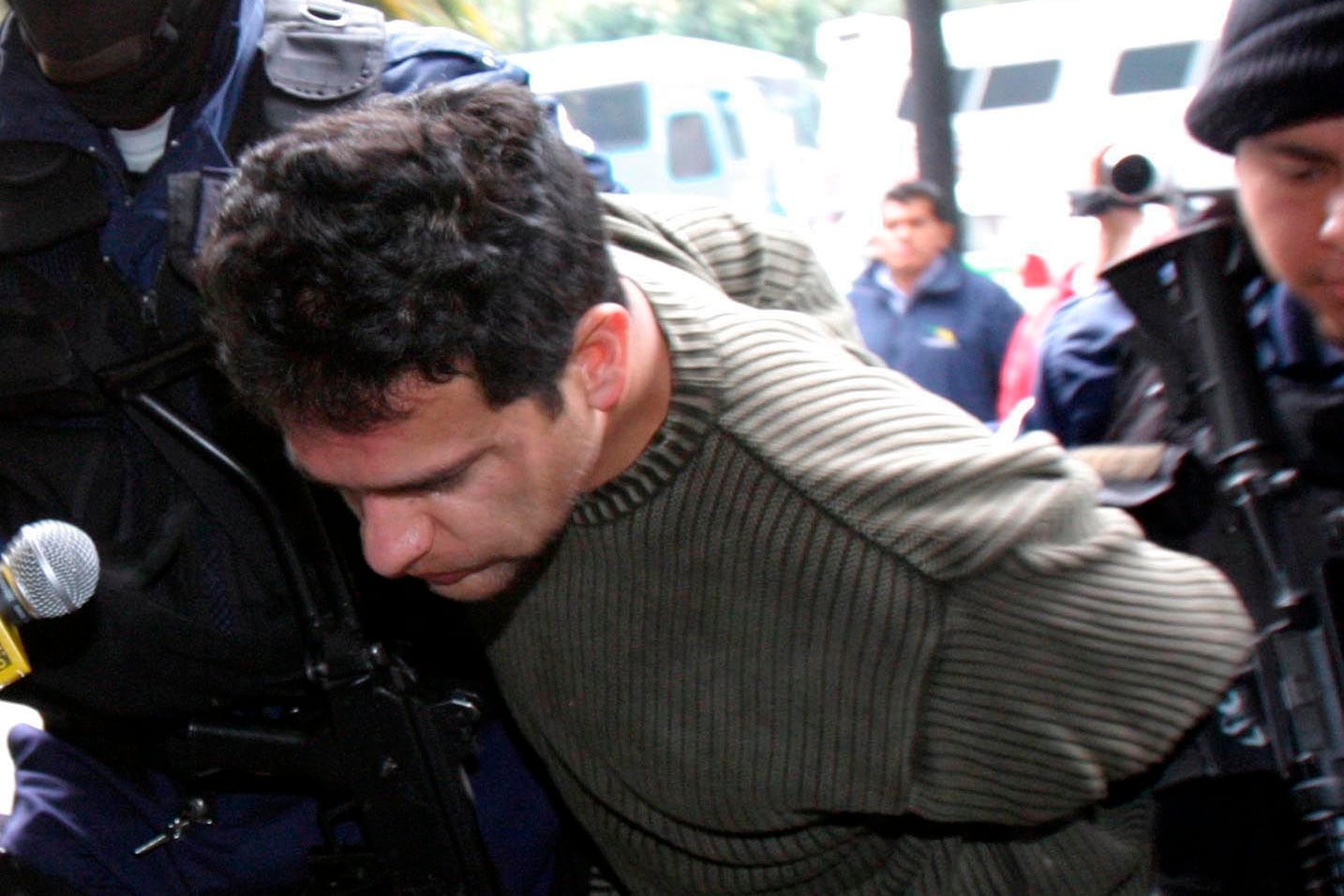
A window has opened for Israel Vallarta, after 19 years and seven months in jail without sentence. A Collegiate Court of Appeal has ordered that it be reviewed whether to continue in pretrial detention or if you can change your precautionary measure, as your family, your defense, at the Federal Institute of Public Defensoría – and even the UN. This resolution implies that the judge of the case, Marina Vieyra, must cite a review hearing to analyze it, if the Attorney General’s Office (FGR) does not oppose and resort to the decision before.
The judicial case of Israel Vallarta is a maze. The Public Defensoría (IFDP) has been requesting for years to change its precautionary measure, since its health worsens day by day in the Maximum Security prison Almoloya de Juárez, in the State of Mexico. They had not succeeded because the judicial instances consider that if Vallarta still does not have a sentence, it is because of their right to defense. “The procedural activity of the interested party is the trigger for the culmination of the process and that the behavior of the authorities has been diligent in the conduct of the matter,” said the last time, ignoring that, for example, Vallarta only managed to force the FGR to close the case instruction phase by means of a judicial protection.
To this flagrant situation are added the provisional measures that the UN Committee (CAT) of the UN granted to Vallarta. The first time was in August 2023 and the second, already extended, in September 2024. In these measures, the United Nations demanded that the Government of Mexico “guarantee adequate and immediate psychological care required by their health status” and “apply without delay alternative measures to the deprivation of liberty, such as house arrest, in order to prevent the author’s health from continuing to get worse.” Based on this resolution of the CAT – which is binding, according to the latest failures of the Supreme Court of Justice of the Nation (SCJN) -, the Ombudsman returned at the beginning of the year to file an indirect protection.
“The need for the application of alternative measures to the deprivation of liberty,” argued Arturo Roblesferia, Vallarta’s lawyer: “The affectation in her health is degenerative, which implies that over time it has aggravated, becoming incompatible with the physical well -being with the precautionary measure that resents,”. The clinical picture of Vallarta includes osteoarthritis, deafness, blood pressure, migraine, a vertebral lesion, anxious disorder, insomnia, bronchitis and habitual gastroenteritis, venous insufficiency. All as a consequence of some torture never rehabilitated and almost 20 years of survival in prison (where he has suffered aggressions of dogs and also other inmates). The last thing, his wife Mary Sainz told, it was a strong ocular spill due to stress and anxiety.
The National Code of Criminal Procedures indicates that when there is an objective change of condition of the accused, the judge must re -assess whether the preventive detention remains justified. “The health of Israel Vallarta is a sign of this change, together with the resolution of the CAT, which is the expert in torture, that the preventive detention has to be valued by the judge,” explains Sofia de Robina, a technical secretary to fight the torture of the Federal Public Defender.
Last week, the Collegiate Court of Appeal of the Thirteenth Circuit proved them right. The magistrates have granted the amparo to Vallarta and have ordered the third district judge in criminal matters, based in Toluca, which cites the parties to an audience. For De Robina, this opens the opportunity to review what has never been reviewed and that Marina Vieyra judge pronounces, for the first time, in the fact that Israel Vallarta has almost two decades in pretrial detention. “She could set a different criteria and resolve the change of precautionary measure,” says the lawyer.
Among this scenario and Vallarta is the same obstacle as 20 years ago: the Attorney General’s Office. That is the concern now of the Public Defensoría, which has asked the FGR to “not hinder this path to justice and refrain from challenging this resolution that is part of the highest national and international standards in human rights.”
Meanwhile, Vallarta’s criminal process is already in its final stage: on January 31 the hearing was held that implies that they are now waiting for a final sentence of their case to be issued. Vallarta was Israel Vallarta was arrested, together with Florence Cassez, on December 8, 2005 by the Federal Research Agency, the agency commanded by Genaro García Luna and Luis Cárdenas Palomino (sentenced today for organized crime and torture, respectively). The agents had retained for almost a day – in which Vallarta was brutally tortured – until they were presented in the largest television assembly of the Mexican Police. This allowed the Supreme Court to grant an amparo to free Cassez in 2013, because all these elements had prevented him from having a fair trial. Since then another 12 years have passed, where the case of Vallarta has barely advanced small steps. “Justice cannot continue waiting,” concludes the Ombudsman.
For more updates, visit our homepage: NewsTimesWire
https://elpais.com/mexico/2025-07-16/una-ventana-para-israel-vallarta-despues-de-19-anos-un-tribunal-ordena-que-se-revise-su-prision-preventiva.html