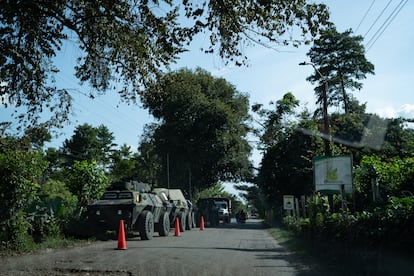
President Gustavo Petro’s bet to concentrate tens 45 days of guerrillas of the 33rd Front, who are part of the dissent of the “Block Staff and Front” (EMBF) in the Catatumbo, was not fulfilled. Although the plan was for the guerrillas to reach a “temporary location zone” in Tibú on July 7, near the Venezuelan border, there are suspicions that around the area and by a path that leads to those properties there are mines. Until the government does not know with certainty if you have to decline anymore, the guerrilla walks there was postponed and it is not clear to when.
The concentration of 33, which looks difficult beyond the mines, is not only key for the government to show any result to the country against its totally new peace policy by just over a year after the end of its mandate. It is also because the expectation of the Commissioner of the Peace, Otty Patiño, is that “once the dynamics of the Fronts of the Catatumbo, those of Caquetá and Guaviare will be installed,” he told El País in April, referring to the other units of the EMBF in the Colombian Amazon, in charge of Alias “Calarcá”.
The logic of the Government is that if the 33rd Front in the Catatumbo goes well, it can be the mirror to show the rest of the units of that dissent that is worth walking with their rifles to a georeferencing area in which they do not use them and take forward “territorial transformations”. This is the same model that they have already applied with other groups, such as South community members, a dissent from the ELN in the department of Nariño, to the south of the country, and that they expect to also be replicated with the “National Coordinator Bolivarian Army”, another dissent in Putumayo and Nariño.
The problem is that “Calarcá” has never been reflected in that mirror. It has been clear that their units are not going to concentrate, nor to sign an agreement with this government, and that the maximum they see from here to August 2026 is to leave “something well advanced in terms of transformation, of reforms,” he said at the end of last year, when the negotiating table seemed firm. This year, on the other hand, it has been beaten: the Government decided not to extend the bilateral ceasefire to put pressure on them, men of “Calarcá” killed seven military in Guaviare in the middle of a questioned military operation, the army attacked them in Caquetá and just this week there were also fighting on the Puerto Flores de Guaviare sidewalk.
By prioritizing the concentration of 33 in Catatumbo, the president made it clear that this was the north that traced for the other EMBF units in Antioquia and Amazonia. Camilo González Posso, who resigned in June as a negotiator head with this group, saw another north. “The experience of community members and the 33rd Front probably made the president think that this was the way, but the rhythms in the Amazon are different,” he told this newspaper. “I did not agree with his decision not to continue bilateral cessation and not prioritize territorial advances, but I see a light with what he said in San José,” he added, referring to a message that Petro threw him to “Calarcá” a few weeks ago from a coliseum in the capital of Guaviare: if they want to follow the table they have to commit to “revitalize the jungle and help the jungle He said, implying that peasants must have autonomy to decide how to reforest without armed pressure.
Concentrate that north that Petro expects with the Jorge Suárez Briceño block of “Calarcá” – which has become the de facto environmental authority in the areas that controls in Guaviare, Meta and Caquetá – is now in the hands of the government’s negotiator, Gloria Quinco, who was behind the filigree of the eventual concentration of 33.
She is looking to resume the dialogue with “Calarcá” and hopes to meet him soon. “The table has not broken. We are going to a meeting with all the provision in the revitalization of the jungle, in advance in conditions that allow us georeferencing or in some territorial figure that helps us, and we have seen them to do it,” he told El País. Two sources that have direct contact with the “Calarcá” table confirmed to this newspaper that they know about that meeting, although there is still no clear date.
Unlike Catatumbo, where one of the main problems is the mines, in the Amazon the most urgent knots are others.
The knots
If the dissent of “Calarcá” and the government sit down, they will do so in the midst of the military confrontation and the insistence of some social and peasant organizations of Guaviare to resume the cessation, something that has not happened and that the group has also demanded while facing death with the dissent of “bite.” But the line of Commissioner Patiño is that the time of the cessation is over and that has opened the door to the Minister of Defense, Pedro Sánchez, to bet on a military attack against “Calarcá”, which although for now it has not been so strong, would put the parties to negotiate in the middle of that pressure. However, the application of some agreements and protocols signed so far with this dissent are tied to cease. If they insist on this, the risk is that discussions become entangled in that when time plays against them.
If “Calarcá” agrees to sit with the government without cessation, they have on the table a road map that came out of an extraordinary meeting in March in La Macarena, goal. There they agreed points as a plan to revitalize the jungle “without weapons” and even spoke – without being in writing – that the army, communities and dissent could make reforestation plans together, something unpublished. It was also that key state institutions for environmental issues such as natural parks or the National Land Agency, can enter the areas they control, as dissent has restricted access and converted deforestation into a business and a pressure mechanism at the table.
The challenge will be to put the accelerator to that roadmap and get it to translate into a reality, taking into account the visions of the peasant organizations and the communal action boards and avoid pressures of the dissent. For example, the country revealed that in Cartagena del Chairá, Caquetá, several leaders have denounced that the dissent of “Calarcá” forced them to suspend a project to reforest 12,000 hectares of jungle to appropriate and present it as their own at the negotiating table. For these types of pressures and threats to several communal leaders, in their speech of Guaviare, Petro insisted that “the resources that arrive for that (recovering the jungle) are not used by the armed group, but the community freely.”
On the table, the creation of peasant reserve areas is also under discussion, a figure that in theory would give more autonomy to peasant communities because they can make their own development plans, formulate agrosostable projects and, above all, limit the amount of land that a family can have within them. That with the complexity that, if approved, they would be overlapping with interference and social control areas of the “EMBF”. “With or without a table, we want to carry out those areas and here the armed actor anyway will always press,” a farmer from the Macarena, a finish line, told El País, who did not want to be summoned by his safety.
Perhaps the greatest challenge is that when using the concentration in the Catatumbo as a mirror for the rest of the dissent, if the arrival of the guerrillas to that area is still delayed by the antipersonnel mines on the road, and in the time that remains there are no concrete transformations, the government can give even more wings to the “Calarcá” speech that weapons are the guarantee for development.
For more updates, visit our homepage: NewsTimesWire
https://elpais.com/america-colombia/2025-07-19/las-minas-antipersonales-del-catatumbo-se-atraviesan-en-la-paz-que-busca-petro-con-calarca-en-el-amazonas.html