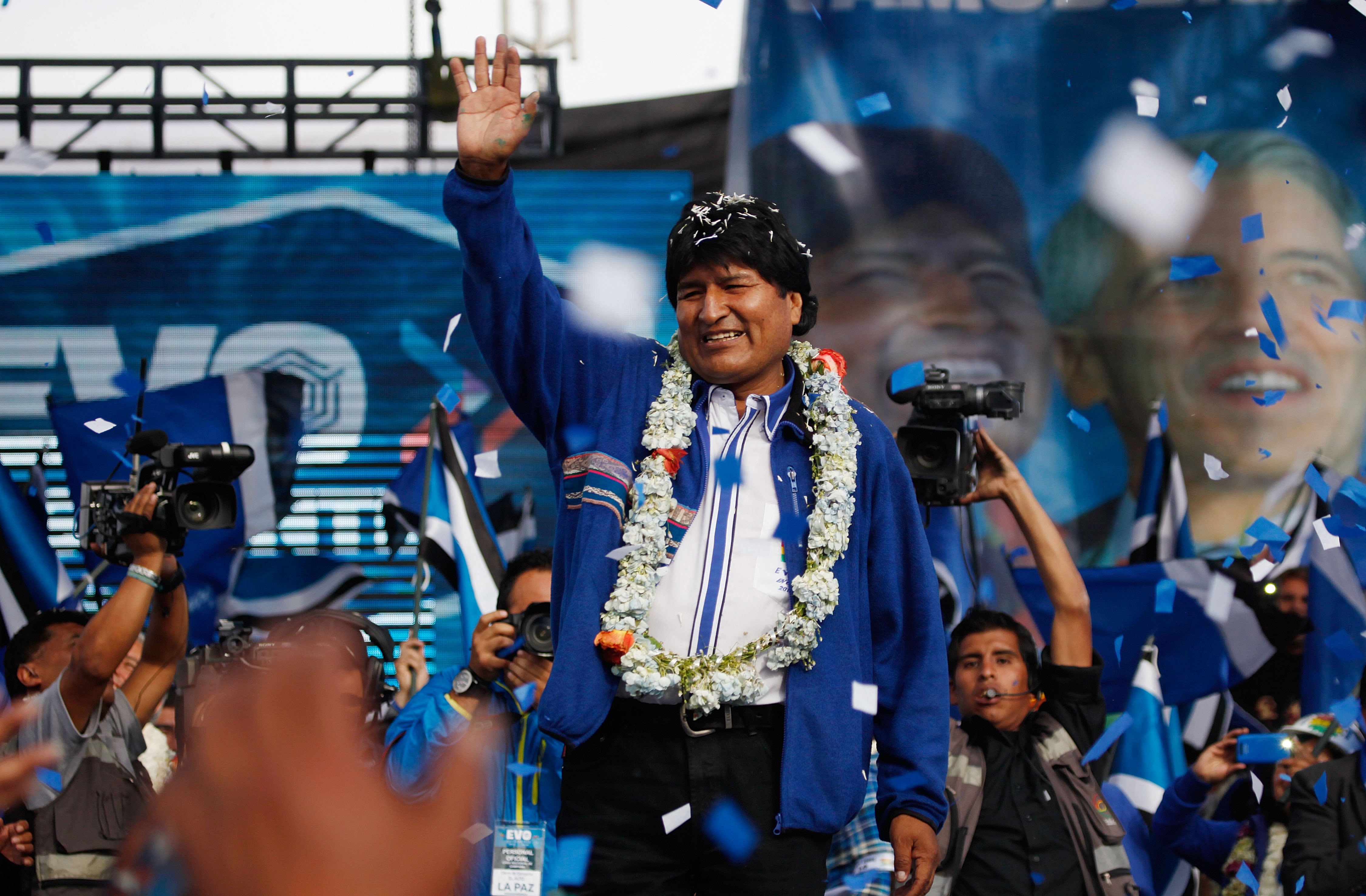
In mid -August there will be presidential elections in Bolivia. There is at this time a candidate who is outlined as the clear winner of this election, which will most likely lead to the realization of a second round in October of this year. However, one thing is clear: it is the end of an era, since 20 years of almost uninterrupted government of the Socialism Movement (MAS) will end, the party that would re -found in 1997 the cocalero leader of origin Aimara, Evo Morales.
Recall that the most won the presidential elections of 2005, 2009 and 2014. In all of them, the most won without the need to go to a second round because Evo obtained 54%, 64% and 61% of the votes, respectively. In the questioned presidential elections of 2019, Evo allegedly obtained 47% of the votes in the first round. However, Evo was forced to resign and leave the country in the midst of mass protests for electoral results. The 2019 elections were then annulled and a new presidential election was convened by 2020. In this new electoral process the most triumphed with this time as a candidate for Luis Arce, who obtained 55% of the votes in the first round. Arce’s management will end at the end of the year, which will be completed almost 20 years in the power of the MAS, only interrupted by the brief internship of Jeanine Añez between 2019 and 2020.
Surveys prior to the election reveal a drastic change in the electoral preferences of the Bolivians with respect to the 2020 elections. Now, according to the most recent survey, the preferences are headed by three center-right candidates. He leads the preferences Samuel Doria Medina, a well -known Bolivian cement and political businessman who has been presidential candidate several times and is known for being a critical iron of the most interventionist policies.
Samuel Doria is a 66 -year -old economist with titles by Arizona State University and London School of Economics. Doria was Minister of Planning and Coordination between 1991 and 1993 during the government of Jaime Paz Zamora and is a long -standing public character that has survived a 45 -day kidnapping of the Tupac Amaru revolutionary movement (MRTA) in 1995, to the fall of a Cessna plane in 2005 and a bladder cancer. Doria was a candidate for the vice presidency in Bolivia in 1997 as a partner of former president Paz Zamora and has been presidential candidate three times (2005, 2009 and 2014). He also intended to contend for vice president in 2019 accompanying former President Jeanine Añez, but both ended up withdrawing from the process. Doria is defined as a social-democrat and is vice president of the Socialist International for Latin America and the Caribbean. However, its political position in this campaign is based on a hard criticism of the economic conduction of the MAS and frequently reiterates that the socialisms of the 21st century in Latin America have failed and have no future.
The second place in the electoral preferences is Jorge “Tuto” Quiroga, 65, who was president of Bolivia for almost a year between 2001 and 2002. Quiroga was vice president during the management of Hugo Banzer, between 1997 and 2001, and it happened in the presidency when he resigned. Quiroga was also the leader of the Conservative Nationalist Democratic Action (DNA), which was founded by Banzer, just after he left power for the first time in 1978 (obtained through a coup d’etat).
Jorge Quiroga was presidential candidate in 2005 and 2014 and on both occasions he was defeated by Evo Morales. Subsequently, in 2020 he announced his candidacy to the presidency, but ended up withdrawing from the contest. Now in 2025 “Tuto” Quiroga is the candidate of a coalition entitled “Free” (Libertad and Republic), formed by the Revolutionary Front of the Left and the Social Democratic Movement.
Among the two leading candidates, Doria and Quiroga, more than 50% of the vote preferences of those who express their electoral intention, so the second round will be settled between them two. Interestingly, Tuto Quiroga and Samuel Doria agreed in the government of Jaime Paz Zamora, where the first served as Minister of Finance and the second planning and coordination. Between the two there are five failed presidential candidates and both have been systematic critics of the economic policy of the MAS.
In a distant fourth place of the preferences is Andrononic Rodríguez, president of the Senate in Bolivia, a young cocalero leader who was at some point identified as a possible successor of Evo Morales. In the seventh place of the preferences, Carlos del Castillo is located, the candidate of the MAS for these elections, but that does not even reach 2% of voting intention.
What is behind this drastic change of political perspective in Bolivia? It is possible that a part of the abandonment of the voters of the MAS is the reflection of the political crisis and the internal division that occurred after the departure of Evo Morales in 2019. However, we must remember that even after that episode, the most won the 2020 elections overwhelmingly, since Luis Arce won with 55% of the vote. Therefore, there must be other factors at stake. In addition to the sour dispute between Arce and Morales, a crucial factor in the change in electoral preferences seems to be based on the current discontent with the economic situation of Bolivia. These elements should serve as a lesson for other governments of Latin America. We will return on this subject.
For more updates, visit our homepage: NewsTimesWire
https://elpais.com/mexico/opinion/2025-07-20/terminan-20-anos-del-mas-en-bolivia.html