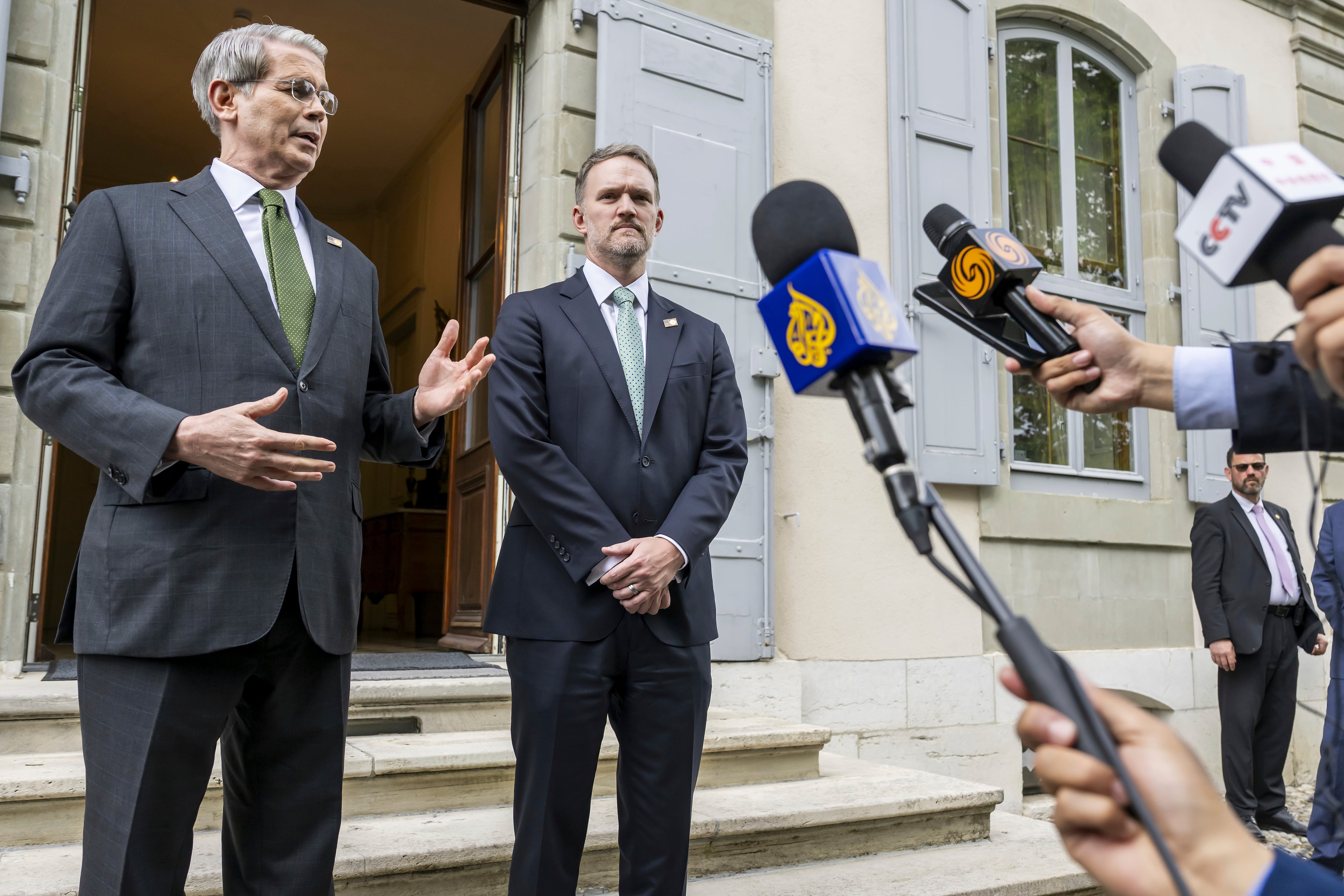
“Productive.” Thus, the Treasury Secretary, Scott Besent, defined this Sunday, the conversations held between China and the United States this weekend to talk about reciprocal punitive tariffs with which both powers are punished since Donald Trump launched his global commercial war. “We will give more details tomorrow,” Besent promised on an alleged pact achieved in Geneva (Switzerland). The Treasury Secretary spoke to the media at the end of the second day of a meeting at the highest level, the first one that the two countries have since Trump unleashed their tariff fury. “I am pleased to inform you that we have made substantial progress,” he said.
The other main negotiator of the United States, Jamieson Gerer, International Trade Representative of the Trump Administration, implied that both parties had reached an agreement. “The President (Trump) declared a national emergency to impose his tariffs, and now we are confident that the pact that we have torn to our Chinese partners will help us work to resolve that national emergency,” Greer argued.
During the weekend, both teams spoke surrounded by secrecy in the fenced enclosure of the American ambassador residence in Switzerland. Trump posted a message on his social network, Truth, on Saturday night, Washington time, in which he said: “Very good today’s meeting with China in Switzerland. Many issues were discussed and many agreements were reached. A great progress !!! ”, wrote.
Trump did not offer evidence of those “many agreements.” Nor did it reveal if theirs had arrived in Geneva with the offer under the arm of reducing tariffs imposed by the United States to China to 80%, a figure that remains high and slid in another message on his social network on Friday. It was the first time that he gave symptoms of loosening in his commercial war with Beijing.
The confrontation between the two capitals has climbed the rates with which the United States gravels to China to 145%, which does not apply to a series of technological products, crucial for the survival of Silicon Valley, whose magnates have approximate Trump positions during the campaign and the first bars of its second presidency.
At the end of this Sunday in China, their authorities had not added anything to their brief announcement of the previous day, which just certified that the conversations had begun, which, given the hostility between the two countries, it was already a triumph. Beijing taxed Washington with a 125%reciprocal tariff, a figure that was reached at the end of the escalation in which both capitals engaged after Trump announced on April 2 a battery of taxes to tens of their commercial partners. Then, in view of the effects of the sole promise of these measures for the economy, the US president raised those tariffs and left a universal 10% for all countries, except China.
An editorial of the official agency Xinhua, published on Saturday night and replicated by the Diario del Pueblo, Official propaganda body of the Chinese Communist Party, did not offer clues about the content of the appointment. Xinhua’s article implied that Beijing does not expect large ads. “Switzerland’s conversations are a crucial step towards solving the problem,” says the text. “However, its definitive resolution requires sufficient strategic patience and perseverance, as well as the firm support of the international community to justice.”
On the table in Switzerland was the reduction of those tariffs that, in the case of taxes by China to the United States, are lower, because at 125% reciprocal Washington adds 20% of the so -called “Fentanyl tariff”, which Trump also fell in Mexico and Canada. The White House holds those three countries of the international traffic for that powerful opioid.
Besent and Greer came to the American side. The Chinese team led him for the second day the vice -first minister He Lifeng, Tsar of Beijing’s commercial relations. Besent did not arrive with the idea of achieving “a great commercial agreement”; He formed in the previous days to “reduce tensions,” as he said in an interview with Fox News.
Another member of the Cabinet, Howard Lutnick, Secretary of Economics, also an architect of Trump’s aggressive and volatile commercial policy, insisted on that idea in one of the political interview programs that serve in Washington to feed the incessant news cycle on Sunday morning, when the news is usually scarce.
Achieve a decala
“The objective (of the conversations with China) is to achieve a decalled. Those numbers, 145%and 125%, are figures that basically prevent trade between countries. We need to put the conversation accountant to zero,” said Lutnick, who on Friday in another interview in Fox News ventured that the taxes could remain at the end of the negotiation around 34% announced on April 2.
To appease the spirits, the Xinhua editorial only saw one option: that the Trump administration first reverses and reduces the tariff barrage. “If Washington is really determined to solve commercial frictions through dialogue, it must first face the damage that its policies have inflicted not only to the world commercial system, but also its own economy and its citizens.”
The punishment levies have already havoc disturbing global supply chains. American companies look for products beyond their Chinese suppliers, while in Beijing they explain new ways to evade US tariffs and increase their exports to Southeast Asia. In the United States, factories discuss how far prices can increase to counteract these new tariffs. Inflation, at the time controlled, is one of the indicators that follow more these days in Washington, where the risk of a recession floats in the environment.
According to Chinese authorities, their exports to the United States fell in April 21%, due to tariffs, which are already causing a rearrangement of their trade to Southeast Asia, Latin America, Europe and Africa. In March, the worst data from the pandemic were recorded.
Commercial exchanges between the two largest powers amounted to 660,000 million dollars last year (about 533 billion euros). It is an unbalanced balance: China sells three times more to the United States, hence, in Trump’s negotiating logic, its solution seems easy, since in theory it is the opposite that has to lose the most with current tariffs.
It remains to be seen, once their details are known, “the substantial progress” announced by Besent will be enough for the US president to sign up or not in that “art of negotiation” that he presumes much and that served to hold his first book of memoirs.
For more updates, visit our homepage: NewsTimesWire