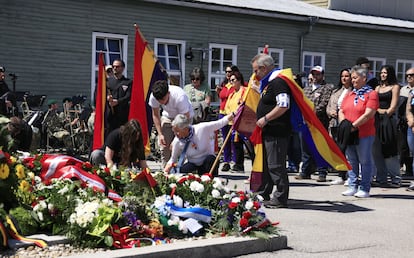
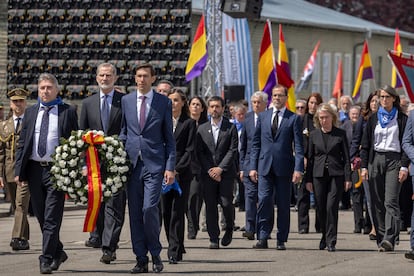
The image of this Sunday in Mauthausen was powerful: the kings of Spain, for the first time and between a sea of flags, also of republican Spain, paying tribute to the Spanish Republicans who died, and some survived, in this field of concentration released 80 years ago.
It is an image that, at the same time, is uncomfortable for a part of the relatives of those who were persecuted or abandoned to their fate then by Franco’s Spain; uncomfortable for those who keep the flame of the Republic alive and that in some cases they said this Sunday that the gesture of the monarchy was late.
The image, in short, affects the political complaints about memory and history, and underlines a message that resonates in times of ascent of the extreme right and revisionism: every country has its heroes and republicans of Mauthausen and other fields in Austria are central to the identity and values of Spain of 2025.
“That the memory of the crimes committed here and the memory of our compatriots remain intact to preserve their dignity. And to never forget the horror,” the kings wrote in the Book of Visits of the field located in the high Austria. “80 years later,” they added, “we reaffirm our collective and personal commitment to democracy and the defense of human rights.”
“Long live the Republic!” Said someone, while Felipe VI, Queen Letizia and the Austrian President, Alexander Van Der Bellen, paraded with dozens of delegations and thousands of attendees for the call Appellatzwhere the prisoners had to form for the daily count. Someone was heard replicating: “A little respect, please!”
Beyond these moments, it was a day of serenity and reflection. But politics are gestures. And the choreography that over five hours in the field deployed the kings and relatives of the deportees – the misgivings and dialogue; The flags, constitutional and republican, at times in tension and others in harmony – was first -order policy. An image of Spain very tragic and very real at the same time; Hopeful: Mauthausen is a Spanish monument.
The Kings talked upon entering the countryside with Juan Manuel Calvo and Concha Díaz, president and vice president of the Association in Memory of the amical deportees of Mauthausen. They greeted Dolors Pont, daughter of Josep Pont, republican soldier born in 1903, hospitalized at the end of the Civil War in the French countryside of Agde and deported to Mauthausen and the neighbor Gustan in 1941, where he died on November 7 of the same year.
After the conversation with the king, Calvo explained: “For us it was important that, for the first time, the head of state visited Mauthausen. He has shown us that he knows perfectly what the deportation of the Republicans was.”
The president of the AMICAL added: “What is missing is the institutional declaration, by the State – I do not know if it corresponds to the Royal House or the Government – of the responsibility of the Spanish State, which has continuity, in short, with the Francoist State, because the states do not disappear. The State must apologize and assume responsibility for the complicity between the Francoist government, the Petain government (the leader of the France of the French collaboration) and the Nazi regime. ”
Queen Letizia carried in her hand, during the parade, a handkerchief with the “s” of “Spanier“(Spanish) in a blue triangle, which just given him those responsible for the amical of Mauthause. The triangle with the S is the symbol that identified in the field”Rotpanier“,” Red Spaniards “, as the Spanish Republicans called Nazi propaganda.
Felipe VI deposited four crowns of flowers. One in the cenotapio in the Appelllazwhere it reads in Latin: “It serves as a lesson to the living the fate of the dead.” Another on the old plaque in memory of the Republicans dead in this field. And two others in the Spanish monument, flanked by the constitutional and republican flags, and in the French memorial. Applause at the end.
“A representative of the Spanish monarchy in these celebrations is a strong institutional symbol, but it should have a low profile,” said Ana Saint-Dizier. His maternal grandfather, Bartomeu Martí Escandell, was exiled to France at the end of the war, and since that country in 1941 he was deported to Mauthausen. He left in 1945. As a child, she asked her grandfather: “How did you do it, to survive?” The grandfather replied: “There was no strategy. Those of us who left had a little more luck.”
It is not the first time that the kings pay tribute to the Spanish Republicans. In 1978, during a visit by Juan Carlos I to Vienna, emissaries from the Royal House moved to Mauthausen to inaugurate the plaque that said: “Spain to their fallen children in Mauthausen.”
The recognition of Felipe VI, on the throne since 2014, to Republican Spain have been numerous, since the soldiers of La Nine, which in August 1944 released Paris into exile in Mexico. In 2020 and last January, the king participated in the commemorations for the release of the Auschwitz extermination field.
But Mauthausen had never visited, “the field that swallowed more Spanish Republicans,” as Montserrat Roig wrote in his pioneer work Els Catalans Als Camps Nazis. Mauthausen. There were more than 7,000 who passed through this field between 1941 and 1945 and other adjacent ones, of which more than 4,000 died (in total, 190,000 deportees passed through Mauthausen and 90,000 died from diseases, torture, exhaustion, gas, trying to evade or in medical experiments).
Dolores Delgado, the Spanish Prosecutor for Human Rights and Democratic Memory, who attended the commemoration, raised the questions of the investigation that has initiated for crimes against Spaniards in the Nazis fields and the role of the Franco regime: “Was there connivance? Was there a possibility of avoiding these deaths? Could they have returned to Spain?”
Representatives of the State Institutions, and the Government of Pedro Sánchez. Among them, the Minister of Social Rights, Consumption and Agenda 2030, Pablo Bustinduy and the State Attorney General, Álvaro García Ortiz.
The 80th anniversary of liberation culminates a sequence of commemorations of the end of World War II, marked by the disappearance of the survivors. They are less and less. The Republicans of the Nazi fields have all died. His voice resonates in the books or in the texts and poems that have been read this weekend in Mauthausen and in Gustan.
“Everything is cold in the environment of the yellow garden / cold that rises from the earth / blue cold that falls, between the red clouds / cold that comes from the blood clots … The sunflowers have trembled so much silence.” They were verses of a poem about the Mauthausen sunflowers that Joaquim Amat Piniella (1913-1974), survivor of Buchenwald and author of the novel KL Reich. He read them, together with the baked of Gustan, the Professor of History Pep Castilla to the students of the Institute of Manresa, the city of Amat Piniella.
For these teenagers, memory moves away. They can no longer learn from history for those who lived it. They will learn from books, movies, parents, teachers.
For more updates, visit our homepage: NewsTimesWire