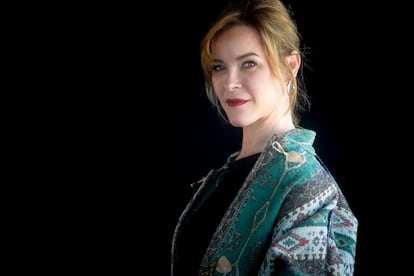
María Esteve cannot deny that she is the daughter of her father and her mother. Up, at 50, the face of the firstborn of Antonio Gades and Pepa Flores, who jumped to fame as an actress two decades ago for his role in the film The other side of the bedit is a mixture of the sweetness of the features of the legendary flowers and the angles and determination of those of the mythical Gades. She knows, of course. But he has been fighting for herself and not for her lineage. We agree to keep this interview with the journalistic hanger of the premiere in Madrid of Carmen, from Gades and Saura, The flamenco ballet conceived by both geniuses, coinciding with the 150th anniversary of the Bizet opera. Esteve, president of the Gades Foundation, the entity that manages the artistic legacy of its parent, is so extremely educated when speaking of the artist as reserved as soon as you try to go something beyond its work.
How much does the immaterial inheritance of their parents carry on the shoulders?
It is a very difficult question. It is a material and immaterial heritage. It is not only the fact of being born in a family with a, well, two, characters as powerful as my parents, but, in addition, when my father dies, 21 years ago, I fall into my hands a historical legacy that, in reality, does not belong to me only to me, but to everyone. Sometimes it is a heavy heritage to carry, yes, but necessary. I would not understand my life without fighting for her.
Your father died at age 67, when you were 30. How was it to lose it so young?
Well, I suddenly became. You are young, everything works, no misfortune has happened to you, and, suddenly, your childhood and your youth are leaving. For me, my father was a reference and a very big pillar, and more dedicating myself to this. It was hard, I imagine that as for everyone. But I keep in touch with him every day. There is a part that does not just go. I am used to working with your clothes, with your things, with your memory every day.
And does the absence of the absence regret when you least expect?
At work, I try to separate the father from the father. For a long time, I have called him “gades” at work and “dad” at home. But if. When you see something you did not count, for example. One day, I found a briefcase where his entire project and his sketches were about how the National Ballet of Spain had to be, of which he was creator. Or it has also happened to me that I see my father through the movement of the dancers, I notice present. The first time it happened to me put my hair to tip. But not only happens to me, there are many people who feel things to see them, an inexplicable emotion, a very strong bond. My father invented unique language.
Also outside Spain? The show ‘Carmen, by Gades and Saura’, comes from filling theaters throughout Europe.
Outside, more. The public’s reaction is the same, because the emotions they cause are universal. But, in Spain, it seems that a newly created show is needed every year, there is no culture of heritage conservation, and, sometimes, I feel that teachers are disregarded. However, outside, my father is recognized as a classic. Entertainment is necessary, but there are teachers who unite entertainment and culture. And my father, and Carlos Saura, of course, are creators who tell the history of our country and who we are through their art.
And that without being able to study, because his father began working at 11 as a waiter in a photography study. Was it a natural talent?
My father was a reader and a voracious observer. He read to the prospects of the medicines. But talent is, above all, work. You see the work of Gades and see painting, literature, music, dance. He was a total artist, a child in constant learning. I remember that, as a child, I destroyed the dolls to see how they worked and my father, instead of fighting me, encouraged me because, deep down, that is what he did with everything: wanting to know, want to understand and then be able to express himself.
He tells me about Gades, but how was Dad?
I have a hard time talking about that. There is a part of my life that I never count, because it is not only mine, it affects other people. And when those people, in addition to such great, have been so discreet with their lives, it costs me.
In 2020, you and your sisters picked up the Goya de Honor on behalf of your mother, Pepa Flores and you said: “This is for you, Pepita.” Do you also call her by name, and not “mom”?
Well, Pepita comes from Pepa. They are our things, and I do not want them to be counted.
Well, I ask you only, how do you remember your father as a child?
I have always had an impressive worship. I have been a father of dad since childhood. I loved everything of him. Listen to him. See him dance. See him coming from fishing, when we lived in Altea. But I didn’t realize where I was born until I was older.
When was that?
When I started working on my own. For me it was normal to get up and see my mother singing with Aute, Oa Paco de Lucía Guisar something with my father in the kitchen. Or that Cristina Hoyos, the dancer, took me by the waist and made me make dance steps with three years in the house. I didn’t know that other children did not do those things. When I start working, to become aware, to separate your parents from what they have done, I begin to realize the magnitude of who they are and that the situations that you have passed in your life are not normal.
Is talent inherited?
Well, I think there is something that one is born with, but being born with a capacity does not mean arriving. Work is fundamental, without work there is nothing. I can say that I have had the personal privilege, not as a thing to show the world, but for my feeling and my emotion, of having been able to breastfeed, learn the art of my parents and their surroundings of artists at home, like those children who learn languages at home without realizing it. I have learned respect, listen to everyone, to discuss, to question things, to contrast. All that I have inherited. And I am very proud.
He could also have given the mother to ‘kill’ the mother in adolescence. Did you never have that rebellion?
Well, I had a complicated childhood out of the doors outside. The day I was born there were magazines with my birth on the cover. I have grown with that. In adolescence I was very envious of the freedom of my friends, who could do what they wanted without fearing to go out in a magazine. So, when I started working, I insisted on calling me María Esteve, in being as brunette I could, so that my name was not associated with that of my father, nor my appearance with that of my mother. I wanted to develop my own personality. Because my vocation of being an actress was not a whim. It was a total expressive need, I don’t know how to do otherwise. So, there I needed my space, where the protagonist of my life was me and only me. There I was very rebellious. I fell to send curricula, make all the photocopies of the world and leave them in the producers. I remember having left the last 25 pesetas I had in photocopies that nobody was going to see.
Didn’t your parents do economic injections if you needed it?
Never, at all in the world. It was the worst that could have happened in life, because then I would not have known who I was. I needed to know my limits and evolve as an individual person and not as part of the phenomenon he had at home. In addition, in that my father also educated us. I have worked buzoneando, of cash, whatever it was. All life have taught us to look for life, real life is not a cotton, if you leave real life, the punch is brutal.
You became famous with a whole generation of actors in ‘The other side of the bed’ And now, 21 years later, they are going to release ‘all sides of the bed’. What happened to them since then?
Well, we’ve become older. Now, in the movie, we go to our children’s weddings. But the truth is that there are fellow men who are still working and their partner is 25 years old and, vice versa, it does not happen, of course. Mature women begin to be more visible, but there are still papers of our age. There is a time when female physical change is not easy and we still demand beauty and it seems that you are 30 years old when you are 50. But I also tell you that I begin to take off so much nonsense. In many ways. Before, I went to the premieres with the model and the heel, and now I realize that my friends cannot buy those dresses, this is me, I am 50 years old, my back hurts, I have health and, if I have to choose between an aesthetic treatment or hit a trip to dive with turtles in Oman as I just did, I have it very clear.
To return to his legacy. His father declared communist until his death. In times of polarization, do you think this significance has taken its toll when valuing your work or selling tickets?
Notice that not especially. You have to place things in its historical context. The political dimension of my father’s work is evident, but he is not a pamphlet author. When in Carmen Talk about women’s freedom, or in Fuenteovejuna It tells the history of solidarity of a people, it is culture and not a pamphlet. Being honest, I have not noticed that. We have made exhibitions with very significant letters, of its time to support the Cuba regime, and people from all political colors have come to the inauguration. My father’s work is universal cultural heritage. That is why it seems to me that there are permanent foreign musicals in the Gran Vía, and yet its Carmen Try more outside than inside. We could better take more care of our culture.
For more updates, visit our homepage: NewsTimesWire