The country offers in the open America section for its daily and global informative contribution to sustainable development. If you want to support our journalism, subscribe here.
Almost fifty years from the beginning of the bloody Argentine dictatorship that has set the history of the country over fire, the Grandmothers’ Organization of Plaza de Mayo began working with artificial intelligence for the identification of the almost 300 sons and daughters of disappeared who have not yet achieved the restitution of their true identity. The work has been built together with the University of Buenos Aires and with a company specialized in data analysis and aims to digitize the enormous archive that the agency has collected since its foundation in 1977. Thus, they want to automate research that until now were carried out in an artisanal way and distinguish priority cases that allow the identification of the grandchildren that need to find.
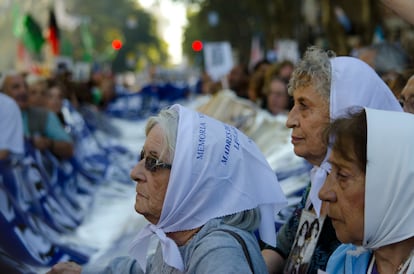
“Grandmothers are always at the forefront,” summarizes Carolina Villella, coordinator of the Legal Team of the Agency. For the lawyer, it is not strange that a group of women who exceed 90 years see artificial intelligence as an ally, since they have always woven society with science, technology and innovation. Since their origins, they have achieved the restitution of 139 grandchildren and granddaughters. The last one was Paula Inama, last January. This is the daughter of Daniel Inama and Noemí Beatriz Macedo, leftist militants kidnapped in November 1977.
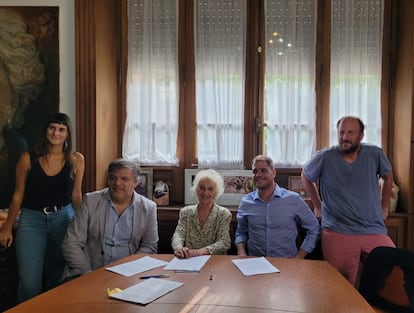
On February, the agreement with the Faculty of Exact Sciences, under the University of Buenos Aires, and the Quantit company, specialized in artificial intelligence solutions, the president of Grandmothers, Estela de Carlotto, stressed the importance of working with new generations in the defense of human rights because “oblivion is dangerous”.
The first step is to digitize the thousands of documents, evidence, testimonies and judicial investigations that the organization has. Then, they will use the artificial intelligence system to identify and extract data that can be relevant, according to Villella. In addition, they will use data science to define the priority of cases according to the probability of success.
Science to restore identity
The automation systems and modules will be developed by Quantit together with members of the applied artificial intelligence laboratory, by Juan Kamiekowski. Likewise, students, teachers and researchers of the National Council for Scientific Research (CONICET) and the National University of San Martín will work.
Guillermo Durán, dean of the Faculty of Natural Sciences, details that the idea is to cross all the information that is processed “by eye” and is more prone to errors, although there will always be human supervision. The last instance, as always, will be the genetic analysis to compare and confirm identities. “We must take advantage of science, technology and computing in a humanitarian theme such as the search for grandchildren,” he says.
For Villella, it is important to re -analyze the information that has been generated in the 1970s and 1980s. With this, says new perspectives and search hypotheses with creative tours: a task that has been complex for grandmothers, since it is dispersed documentation and preserved in multiple formats. Among the documents available are from more than 10,000 newspaper and magazine cuts, to oral testimonies, audiovisual and judicial material. “It is a lot of documentation for the number of cases we address. Between those resolved and those we are still looking for, in total there are approximately 500. These volumes become unmanageable,” says the lawyer.
The objective is to make new cross -linking and deepen information that can be valuable, from addresses to names, ages or even data on baptisms and birth certificates that have been forged. At the moment, you will not work with images and it is ruled out to use artificial intelligence to recreate the possible face of the grandchildren sought. However, Durán points out that elements of facial recognition could be used for data processing.
Human Rights
Throughout their history, the grandmothers of Plaza de Mayo have gone to the avant -garde of the hand of science and technology. In 1982, the geneticist Víctor Penchaszadeh, exiled in the United States during the dictatorship, contacted their American colleague Mary Claire King, who together with a group of scientists developed the “grandparent index.” It is a mechanism that allows establishing the degree of kinship between a grandson and its grandparents precisely, based on the analysis of genetic material, even when there are no blood samples of the sons and daughters. That method was first used in 1984, when it allowed the restitution of the identity of Paula Logares, a girl who had been kidnapped with her parents. Since then, it has allowed the recovery of more than a hundred grandchildren and granddaughters.
Years later, in 1987, also thanks to the impulse of grandmothers, the National Genetic Data Bank was created, where since then the biological samples of the relatives of kidnapped and disappeared during the dictatorship are stored.
For Villella, grandmothers always sought to innovate for the need and the impetus to find the grandchildren. “The way to organize work is always using the guides that marked along their way, thinking outside of the ordinary and wondering how new tools can be used to review what already exists, to know where the grandchildren are, where they were delivered,” he says.
Hurry hugs
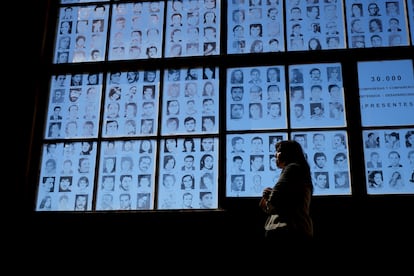
“You have to hurry the search to be as quickly as possible. The grandchildren are already gentlemen and ladies with between 45 and 50 years, and the grandmothers, (they have) more than 90. For obvious reasons, you have to try not to continue spending much more time,” says Durán, who is excited that artificial intelligence tools help “go a little faster.” They must also achieve it in an adverse context: since its arrival in power in 2023, the government of Javier Milei has eliminated economic support to Grandmothers of Plaza de Mayo, has questioned the claim of human rights organizations and systematically denies the figure of 30,000 missing and the horror that has produced the dictatorship that operated between 1976 and 1983.
Villella says that daily works urgently. “Almost 40 years ago all cases should be resolved and grandmothers are getting bigger, they are very little and it is necessary that grandchildren and granddaughters can meet their families. It has to be soon. The kidnappings and appropriations occurred many years ago,” he reflects.
For grandmothers, it is essential that civil society gets involved in the grandchildren’s search process. Villella says it must be a “collective work” for the complex task: look for 300 people in a time range that covers four million births. And it finishes: “There is not a single grandson or granddaughter who has appeared because she was looking for a single person, it is a community work, with the commitment of many people who point to the same thing: that we find them.”
For more updates, visit our homepage: NewsTimesWire