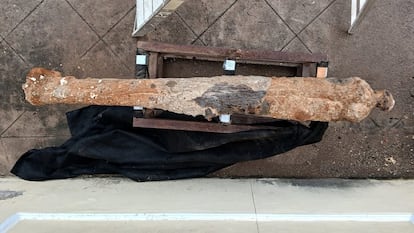
Veracruz unpublished centuries of history while the local government works in the remodeling of drainage and electrical wiring in the streets that make up its historic center. Among excavating machines and lots of rubble, the port of the Gulf of Mexico, a strategic point of transport and transatlantic trade from the conquest, rediscovers buried objects under the asphalt. The last finding presented by the National Institute of Anthropology and History (INAH) in this regard gives an account of two iron cannons dating from the 18th century, which could have been used in the defense of the port during the French intervention of 1838 and the occupation of Veracruz after the US invasion of 1847.
The first cannon, found in early June, measures two meters long and weighs 750 kilos. While their characteristics respond to the naval artillery that accompanied the mailboats, some modifications found in their base make the specialists who adapted to shoot from the ground. The second cannon, found in July, measures 2.82 meters long and weighs more than one ton. Both objects, oxidized and covered mostly by sand remains, were found on Independence Street, a few meters from the Zocalo, an animated area with hotels, coffees, banks and historical buildings that two centuries ago led to the door of Mexico, one of the counted terrestrial accesses to the port, which due to its commercial importance for the consolidation of the new Spain and the constant siege of pirates, remained walled between the viceroy and the nineteenth century.
The findings, product of an archaeological rescue program of the National Institute of Anthropology and History (INAH) that started in parallel to the works, reveal unpublished details of the transformations that the port has crossed, the protagonist of the national history for at least five centuries. The city of about 600,000 inhabitants was the first settlement of New Spain founded by Cortés in 1519 and the First City Council of America. In Veracruz also landed Maximiliano de Habsburg and Carlota, called to lead the second Mexican empire in 1864. The port was also witnessed from the escape to the exile of Porfirio Díaz in 1911, the dictator who ruled with iron fist the country during the last three decades of the nineteenth century and whose fall marked the beginning of the revolution.
Although the state of conservation of both cannons prevents obtaining details of its manufacturing, its form coincides with those used between the end of the 18th century and the beginning of the nineteenth century. Hence, Judith Hernández, a specialist at INAH in charge of the project, does not rule out that both artillery pieces could have triggered projectiles both in the cake war, a passage from the first French intervention in Mexico in 1838, as in the US invasion of 1847. Ditches dug to bury them and level the streets above, ”Hernández explains in a statement.
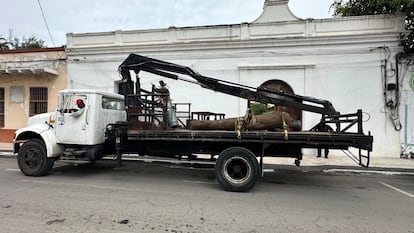
Veracruz’s current face began to take shape at the end of the 19th century, with the demolition of the wall that guarded access to the port and the line of new roads that departed from the center of the city. In addition to the cannons, during the works, remains of ceramics, glass, animal bones that were used as construction elements and the remains of barracks and a military prison that functioned as a building attached to the wall.
For more updates, visit our homepage: NewsTimesWire