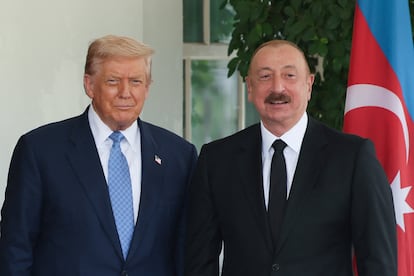
Donald Trump has received this Friday at the Oval Office to the leaders of Armenia and Azerbaijan for the signing of a pre -agreement of peace in which Washington has interceded. It is a document that the White House ensures that it will end a thorny territorial conflict, dragged for almost four decades of armed tensions and clashes between the two enemies in the Caucasus. The president of the United States, who hopes to increase the influence of his country in the region, does not hide his hopes of adding points, with this meeting to three, in his ambitions to achieve the Nobel Peace Prize.
Armenian Prime Minister Nikol Pashinián has described the joint declaration of “revolutionary result” announcing a new chapter “of peace, prosperity, security and economic cooperation in the southern Caucasus.” Pahsinián has cited the passage of the Bible “Blessed are pacifiers” to praise Trump. Even more emphatic in his praise to the US president has been his counterpart from Azerbaijan, Ilham Alíyev. “If it weren’t for President Trump and his team, Armenia and Azerbaijan would probably be again immersed in this endless negotiation process,” said Alíyev. “President Trump brings peace to the Caucasus.”
Pashinián and Alíyev, who as he has pointed out the second, will jointly nominate Trump for the Nobel, have also signed economic bilateral agreements in respective meetings separately with the Republican, prior to the ceremony. “It will be a historic day for Armenia, Azerbaijan, the United States and the world,” said the Republican on Thursday night in a publication in Truth, his social network. “Many leaders have tried to end this war, without success, so far, thanks to ‘Trump’,” he wrote.
A high position of its administration under anonymity has described the pre -agreement as “the first statement of peace signed by the two countries after the end of the Cold War.” In fact, Trump has referred to the declaration of Armenia and Azerbaijan as if it were a closed peace agreement. “Thirty -five years of death and hate, and now it will be love and success together,” he said, at the Ceremony in the White House. After posing for photographers with a three -band handshake, the leaders have signed two copies of the peace pre -agreement.
But many questions still hit how the agreement will be developed and the effective thing that will result on the ground. What the firm in Washington does reveal is the erosion of the influence of Russia, the former mediator, on these former Soviet republics in the Caucasus.
One of the key points that the pre -agreement tries to solve between Baku and Ereván is the establishment of a corridor – known so far as “Zangezur runner” – by Armenian territory to connect Azerbaijan with his najicheván enclave, located between Armenia and Turkey. As the White House has revealed, the agreement establishes the creation of a “Trump route for international peace and prosperity” (Tripp), which will have 43 kilometers long, will connect Azerbaijan and its autonomous territory through Armenian soil and where the United States will enjoy rights for the economic development of the area. In that hall, Armenia would maintain legal control of that territory.
Until now, the control of the corridor, the possible routes and even their denomination had been the subject of dispute. Even neighbors Russia and Iran had expressed concern that this corridor was constituted. But the aforementioned position of US administration has indicated that Trump “changed the language” and “eliminated politics in negotiations”, which has allowed a solution that will make “commercial prosperity guarantee peace.” The White House presents Tripp as a commercial, non -military or security project.
“This is not only about Armenia. It does not only go on Azerbaijan. It goes over the entire Caucasus region, and they know that this meeting will be safer and more prosperous under President Trump,” he said the high position of the Republican Administration.
The White House deputy spokeswoman, Anna Kelly, said that the solution will allow “connectivity without obstacles” between the Azerbaijan territories “while Armenian, its sovereignty, its territorial integrity and its people and its people. Over the next months, working groups will begin working to launch the details of the agreement.
As part of the understanding, the two faced countries will sign a joint letter to withdraw from the Minsk group from the Organization for Security and Cooperation in Europe (OSCE), the mediation instrument co -chaired by Russia, France and the United States that had tried to resolve the conflict around the Karabaj Nagorno enclave since 1997.
Between 1988, when the Soviet Union entered the end of the Cold War, and 1994, the Christian Armenia and the Muslim Azerbaijan faced themselves in skirmishes and two wars by Nagorno Karabaj, an internationally recognized territory as part of Azerbaijan, but where more than 100,000 people of Ethnician Armenia lived.
Russia loses influence
Russia headed mediation efforts between the two neighbors and enemies, without ever reaching a definitive solution to a conflict that has cost more than 40,000 people. In 2020 both took arms again, after an offensive from Azerbaijan, in a confrontation that resulted in the deployment of almost 2,000 Russian soldiers to guarantee peace.
But the Russian invasion of Ukraine and war in that country distracted Moscow’s attention. In 2023 Azerbaijan launched a new offensive to take control of all Nagorno Karabaj and expel Armenian residents. The Russian contingent began its withdrawal in April last year, while Baku has been taking steps to settle in the enclave.
For the United States, the agreement represents an important diplomatic triumph, which allows it to increase its influence in the south of the Caucasus and develop and strengthen commercial routes that avoid Russia and Iran. The White House also considers that a peace pact could give way to negotiations for the entry of Azerbaijan in Abraham’s agreements for the normalization of relations between Muslim countries and Israel, although Baku already maintains excellent strategic ties, in the military, energy and commercial sector, with that country, where he opened an embassy in 2023.
La Paz between Armenia and Azerbaijan could also give a boost, as Washington expects, to the process of normalization between Turkey and Armenia, including the possible reopening of the border that they share and that is closed to Cal and sing from the nineties.
But, despite the Optimism of the White House, there are still important obstacles to peace. Bakú demands that Ereván withdraw from his constitution all language that can be perceived as a territorial claim of Nagorno Karabaj. Armenia claims the release of his prisoners in the neighbor’s territory: Azerbaijan keeps at least 23 Armenians, including eight high political and military positions of Nagorno Karabaj. And the parties have not yet agreed on the official demarcation of their borders.
For more updates, visit our homepage: NewsTimesWire