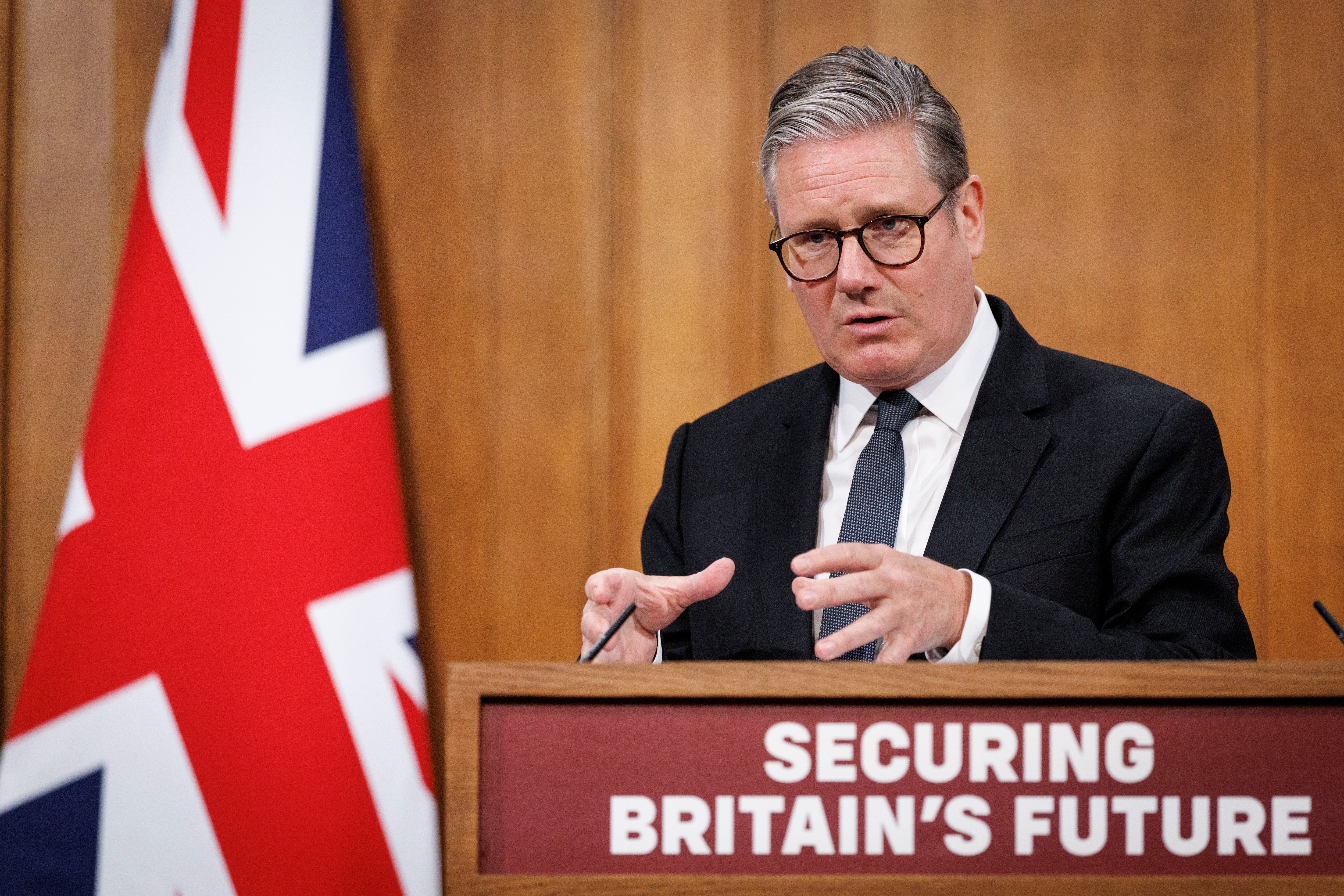
Keir Starmer has decided to even more harden the immigration standards of the United Kingdom, just two weeks after the populist right of Nigel Farage Vapuleara to Labor and Conservatives in the local elections of England, on the back of a xenophobic and nationalist discourse. But the prime minister, as on previous occasions, wanted to present such a drastic turn, that mimics the speech of his political rivals, such as the “correct” left of the left, necessary to “straighten the chaos” left in the country by the previous conservative governments, “who lost control of the borders.” Among the main measures are to increase the time of stay five to 10 years to acquire permanent residence in the United Kingdom, increase the minimum level of qualified foreigners who can be hired and greater control of visas for students.
“I do it because I think it’s the right thing, and because it is something I believe. I think we need to significantly reduce immigration,” Starmer said in defense of his new measures, essential, according to him, so that Great Britain does not end up becoming “an island of outsiders.”
Starmer has appropriated the idea previously driven by governments Torso by Boris Johnson or Rishi Sunak, according to which the restriction of the conditions to obtain a work visa will end up forcing British companies, accustomed for years to an unqualified foreign workforce that was cheap, to form and hire national workers. The British Prime Minister, who arrived at Downing Street with the promise of economic growth, refuses to link the largest number of immigrants with greater economic activity.
From June 2023 to June 2024, according to the latest data published by the National Statistics Office, the number of people who entered the United Kingdom was 728,000. A year earlier, the figure touched the million: 906,000. Practically the quadruple that the average recorded five years before. The vast majority of them came from countries outside the EU. Brexit braked into the arrival of community citizens to British soil, but did not prevent the increase in immigration at all).
“The damage this has done to our country is incalculable. Public services and public housing have been subjected to too much pressure. Our economy has been distorted by perverse incentives to import workers instead of investing in our own skills. In sectors such as engineering, learning scholarships have been reduced to half and work visas have doubled,” said Starmer.
The Labor Government does not want to fall into the trap in which its predecessors fell, by putting concrete numbers to the immigrant reduction objective. Starmer would be tied in that way to the figure, if it was very high, or crossed out of little ambitious if it were very low.
In any case, the British prime minister has committed to the net immigrants figure to reduce, year after year, until the end of his first mandate, predictably in 2029.
And he wanted to reaffirm that will with the promise of greater hardening, if he considers it necessary: ”If we need to go further, if necessary to do more to relieve pressure in housing or public services, pay me attention, we will do it,” he emphasized.
Ten years for residence
One of the main measures announced by the British government will be to duplicate, from five to 10 years, the time necessary for an immigrant to acquire its permanent residence or nationality.
“For a long time, the principle has been sustained that residence or citizenship in the United Kingdom is a privilege, and not a right. We are creating a (new) system that will benefit people who respect the rules and make a contribution to the United Kingdom, while taking measures against those who do not,” says the official work document, the call White Paperin which the Starmer government details its new immigration standards.
In this way, the door opens to maintain the reduced term of five years for those who “make real and durable contributions to the British economy and society”, such as the payment in time and form of their taxes, participation in volunteering tasks or the performance of highly qualified works in key sectors.
The British Interior Ministry, in charge of preparing the new proposals, wanted to focus especially on three areas: the labor market, the university scope and the social care sector and the dependency (where more qualified foreign labor has been incorporated in recent years).
The degree of training of qualified foreign workers who can be hired today by British companies will increase. The school graduate will be required. The annual minimum wage of these hired will also rise, which was currently almost 30,000 euros for the lowest level.
The new short root plan to grant new work visas for the dependency sector, although it opens a transition period until 2028 to extend the visas currently granted.
Finally, the new measures promise a more thorough control of the visas for students. The Starmer government has bought the idea that universities, which need the enrollment of foreign students – triple faces than those of nationals – for their financing, are very little rigorous when selecting newcomers. Many abandon their studies, but remain in the country, or take advantage of the work period that allows the visa, once graduated, to join work activities that have nothing to do with the completed studies.
Finally, the Starmer government also appropriates ideas already rehearsed by previous conservative executives, such as demanding a higher level of English to newcomers and further hardening the criteria of family regrouping of immigrants.
“I think that the Labor Party has as one of its fundamental principles the idea that immigration must be controlled and selective. We must be able to choose who we want, and attract the best talents to our country, in a fair way,” Starmer defended, aware that the fear installed among his deputies after the recent victory of Farage’s populism and his reform uk party in the local elections will make a few more authoritative drift in politics in politics Migratory
For more updates, visit our homepage: NewsTimesWire