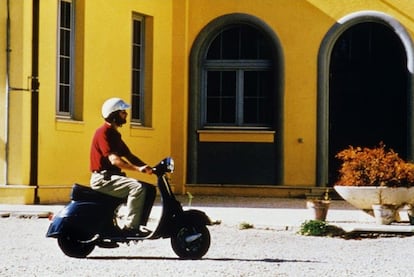
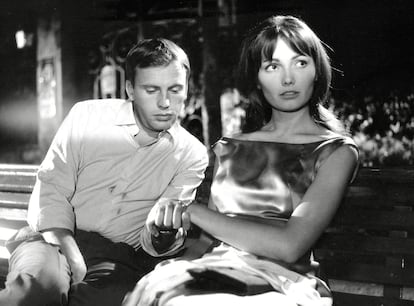
The first scene of Daily expensive (1993), the most celebrated film by Nanni Moretti, presents its protagonist, who is the director himself, walking in Vespa through a deserted Rome. There are barely traffic or pedestrians, empty buildings monopolize the planes and Moretti talks that, in their city, during the summer, cinemas close or project what they would never exhibit during the rest of the year (Italian porn or cinema). Daily expensive Start during the Ferragostoa party of pagan origin that is celebrated in Italy every August 15. That day, and those that surround it, many of the inhabitants of the big cities move to the beach or the mountain and the streets of Rome or Milan that are usually stuck in solitary decorations. Many other films, such as Ile sorpasso (An summer adventure co -written and directed by Dino Risi in 1962), they have collected that moment during which, according to the topic, a whole country goes on vacation in a synchronized way.
In Spain, August 15 is also a national festive and verbenas are organized in hundreds of towns and cities. Catholics celebrate the assumption of the Virgin, but it is not necessary to be a believer to notice that something special happens: if a well -known poem by Roberto Juarroz affirms that “in the center of the party there is another party”, the bridge of the “Virgin of August” is almost a summer in the center of summer. It is possible that in our country the urban exodus during these dates is not as incorporated into popular culture as in Italy, but summer myths such as that of Rodríguez They include the idea that something exceptional happens in cities while the others truthfully away from them. In fact, The Virgin of August From Jonah Trueba (2019), he also explores – although in a very different way from those of the Spanish – the intuition that staying in Madrid in August produces a special mood and generates unusual encounters, as if chance was the main ingredient of a summer in the city.
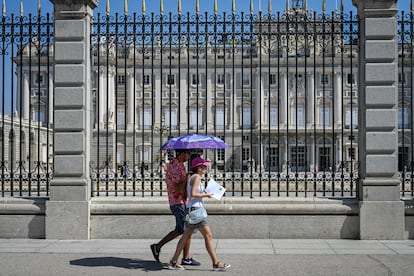
But not all urban summers are happy or full of discoveries, even in fiction. Baden-Baden birds It is a story by Ignacio Aldecoa written in 1965. In the story, Elisa must end her thesis in a desert Madrid. The doctor feels alone, he longs for the sea and, in the moments of greatest despair, believes to see it from the terrace on the Paseo de Rosales where she usually installed to write and drink warm beer. Of course, arguments like this and scenes such as those of Italian films require that urban activity has been stopped almost completely and that everything has “closed by vacation”, and it is possible that this is no longer happening. Now, that collective time that the sirens of the factories sound or that pushed the masses towards the “output operation” has broken and the teleworkors, tourists and self -employed live under very different schedules and calendars with each other. In an increasingly synchronized world, it is worth asking if the interior cities continue to be emptied during August. And if so, at least in part: is there any truth from the city that is revealed, precisely when it is empty? Do exceptional relationships or summer loves arise among lonely found? Do they form, who stay, a kind of resistance?
The void goes through neighborhoods
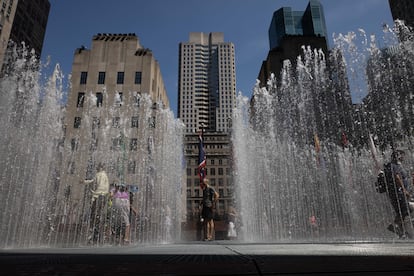
From year to year, the Madrid City Council confirms that August 15 is the day that the least traffic records the M30. In general, during this month traffic in the capital drops around 33% (or one third compared to the average). In the city of Murcia, no municipal data is necessary to verify something obvious: such as the closest beaches (those of the Mar Menor or Torre de la Horadada) are about fifty kilometers or forty minutes by car, during the summer there is plenty of parking and, in the Ferragosto They barely move through some streets RIDERS exhausted and those who keep minimal services such as ambulances. Also people in street situations, who resist heat thanks to a few sources. The class issue, again, is essential to understand what happens in cities, also during these days. “It is true that there are certain neighborhoods that are emptied in August. The class difference is very much noticeable here, because if you go through Argüelles, Chamberí or the Salamanca neighborhood you see many parking spaces. But if you go by Carabanchel, for delights or by Lavapiés, the void is not so large,” says journalist Paloma Rando from Madrid. “It happens to me that, as I have to work, because it is not that I am on vacation in the city, but that I leave later, because I notice the scarcity of certain public services. Those services decrease because there are fewer people during the summer, but they do not apply that difference in areas,” he continues.
In 2017, the filmmaker and architect Emilio Tomé directed Summer Symphony: Portrait of a citya film that wanted to be “a poetic look, like hallucinated” on the summer in the center of a large city and that premiered during the Veno Festival of the Villa of that year. I took recalls that its material was a city that “when the heat arrived, it was emptied, with the inhabitants that were in it having to resist adverse and hard conditions of heat and sopor, of difficulty in the movement of the bodies, of enclosures, of the search of the shadow.” For Tomé, those who remain in summer in any large city without coast live “a kind of desertification of the real, something that triggers a kind of state of semiconscience.” “Somehow, the city transforms because those who stay do it with a kind of fault: there is a state of exception in their lives,” says the filmmaker. But not everything that reflects the film is negative. Again in Tomé’s words: “As nothing can be done during the day, times change so the desire of the extraordinary appears later.” If the sequence of the summer naps formed almost a nightmare full of “sweat, bugs, fans and strange noises”, then, when the sun fell “there was a release, with the people going out and looking for the encounters.” “Our film was inevitably a portrait of public spaces, and there we find class issues: people who do not have an urbanization with a pool or a chalet, in the end they are thrown into the street, to that weather, looking for water, the shadows, the encounter with the others, looking for the laughs, that the nights are extended and that time is nonsense,” says the filmmaker.
Romantize it or not
The journalist Lucía Tolosa published a year ago a tweet in which he said that “there are only two types of individuals who pass August in Madrid: who idealize and romanticize their situation, as if they were protagonists of a film by Jonah Trueba; and those who want to hit a shot in the foot knowing that they are in a soporific oven and abject.” “I believe that the city really does not change, that this idea of the special openness is very cinematographic, but also a myth. What does change is the look of the people: it depends on your vital moment, on whether you are more receptive or more cheerful; it also depends on your character, if you are to romantize or more realistic … all that influences more than the city itself; because Jonah Trueb Tolosa comments today.
But the enthusiasm for a city where the activity and the party are concentrated in a few popular neighborhoods and verbenas is not new. The tardo It is a novel written by Ramón Gómez de la Serna in 1930 whose protagonist, a woman with a “porcelain, furniture, pots and clothes” on the trail, lives his last passionate summer. In the novel, the threat of a kite that is about to crash against Earth makes the holidays be held with more intensity and excitement than ever. Precisely because of that, The tardo It is a work that the poet Irene Domínguez always rereads for these dates, and it seems that it is “quite representative of that hedonism that you practice when you know that everything falls into pieces.”
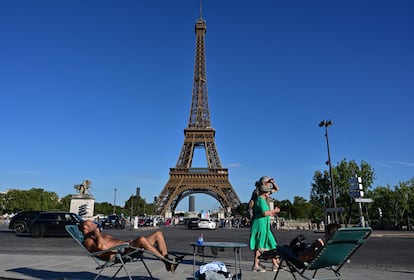
Dominguez herself has lived several intense agos in the city of Madrid, as she recalls: “I am from a town in Toledo as well as my four grandparents, and we have no apartment on the beach or know family outside. Most of summer my only option to spend a long season is the deep spot, where it does the same or more heat and there are fewer plans, so I have lived in Madrid in Madrid. “Now there is a lot of debate with whether it is right or badly romantizing every thing you do,” continues the writer. “In this case it seems good to me to romantize that your life is based on being with the conditioned air (if you have) inside the house in a heat wave, or in a parties up to beer and with the fan. I prefer to do it and say that time passes slower because it is easier to reach everywhere, because it is half empty, and because there are not so many tourists it seems that the people here live in a more relaxed way and it is easier Madrid and that are easier to maintain. ” And what about the myth of summer love? Can also appear far from the sea? “Among my single friends we have a bit of the coña that if any loving idyll begins in August it is because it is a summer love, it hardly comes to more when the frantic September begins to return to the works in person and the people everywhere,” says Dominguez.
Of course, like all phenomena, that of summer in the big city (in the case of Madrid, with its verbenas), it is also susceptible to becoming fashionable or suffering a gentrification process. Domínguez believes that something like that would be happening and that what was previously almost one last resort for those who were in need of entertainment and company, is becoming the first plan of many people: “This year the rush of people has been seen in the verbenas for that crisis of the tourism they speak of, and the friends that we usually stay in August every year we even have as a kind of jealousy to see that they suddenly see that they suddenly see that they suddenly see that they suddenly see that they suddenly see.
In any case, so many films and novels cannot be wrong. There is still some summer exceptionality in large cities, both for good and for worse. As Emilio concludes, I took: “In that drift of going out to the streets it seems to me that there is a very beautiful portrait of a possible life that only appears when the conditions seem to go against. There is something in the summer that transforms the city into town and that brings a beautiful connection with childhood and its sensations.” Not all indoor summers have to be like that of Neighborhood (1998), that film by Fernando León de Aranoa whose poster (a motorcycle of water hooked to a lamppost) became an icon.
For more updates, visit our homepage: NewsTimesWire