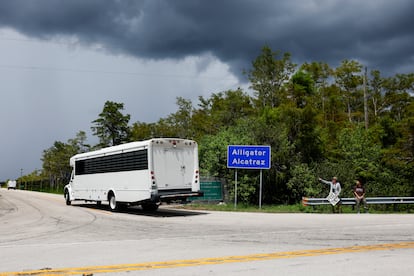
When some tourists entered the Licatraz Aligator T -shirts to the Crafts Store of the Indigenous Miccosukee of Florida, Troy Sanders, a 35 -year -old tribe who works as a guide of the museum, felt anger. “There are people next to the road selling t -shirts that Aligator Alcatraz say. And others enter the store thinking that there is nothing wrong, greeting, being friendly. They have a huge disconnection of what all this means to us. The Everglades (the vast swamp ecosystem located west of Miami) are intended for our tribes, to protect life, to protect it. Not to stop it, ”says Sanders.
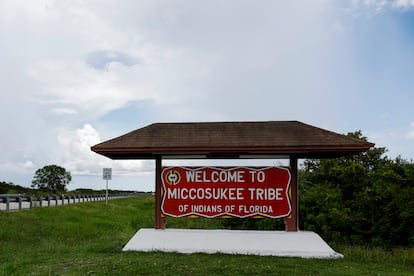
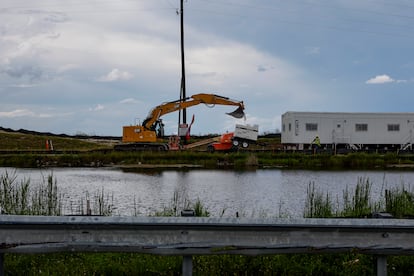
The Aligator Alcatraz Immigrator Detention Center, already famous for the terrible conditions in which the detainees are kept, was erected in just eight days at the end of June to just over 20 kilometers from the Miccosukee town on the Tamiami Trail road, the only way that connects Miami, on the east coast, with Tampa, in the west, crossing just the heart of the heart Everglades. So the Miccosukee joined in mid -July a demand from environmental groups against national and local governments that alleged that the center would cause irreparable damage to the fragile wetland ecosystem that is their home. There they have lived for hundreds of years and have with that wet land and inclement a connection that transcends idiosyncrasy, is a original, vital and sacred roots. The Federal Court in which the claim was filed finally ordered the authorities to dismantle the site in 60 days.
The governor of Florida, Ron Desantis, said Friday that he will defend the permanence of the detention center despite the order of the judge to close it. “A judge tried to disrupt everything related to our deportation and arrest processing center in southern Florida,” he said at a press conference in which he crossed out the judge of “activist who tries to do politics from the stand.” Whatever the legal future that gives Aligator Alcatraz, the Miccosukee proudly celebrate one more instance of their long history of defense of their territory.
Naturally dates back to the origins of the country of which they are now part. Before and after the independence of the 13 original colonies that would end up expanding and becoming the 50 stars of the flag, it is estimated that hundreds of thousands of North American indigenous people died as a result of the consolidation of the US nation. The survivors were displaced to reserves and forced to assimilate another culture.
For a good part of the nineteenth century, the villages of Florida fought to avoid being relocated. “All the natives southeast of the Mississippi had to be deported and taken from their homes to be taken to the Indian territory, which was Oklahoma. This included the Miccosukee and the seminols. Abiaka, a very old Miccosukee boss, knew we were not going to win this war against the Americans. He took 100 of his own, Miccosukee and seminols. In the Everglades, ”says Sanders.
The swamps were their salvation. “It was very difficult for the United States Army to operate logistically in the Everglades, transfer their men, artillery and supplies.” “That’s why we are still here, because if not, we would have been taken to Fort Brooke, which is now called Tampa, uploaded to a ship, crossed the Gulf to New Orleans, and forced to meet with the rest of the natives in the so -called trail of tears, sneaked as cattle to Oklahoma,” Sanders summarizes.
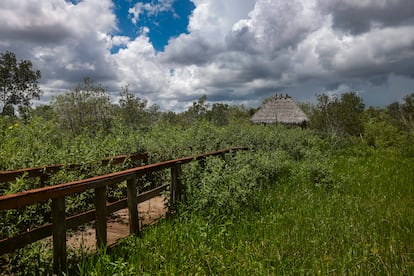
Before having to establish themselves in the Everglades forever, the Miccosukee already knew the wetland inhospitics very well, as they had been their hunting territory for millennia. In the most intricate of the grass river that is lost sight of the horizon plane, each family or clan settled on a “trees island”, where the land was high enough to live. There they installed the Chickee To cook, a kind of hut open on the sides and with palm roof, where they maintained a perpetual fire. “Every family here, each clan, can more or less track their lineage for hundreds of years to a tree island,” says Sanders. Today, although they do not live there, the trees islands remain the place of traditional ceremonies and are treated by each family.
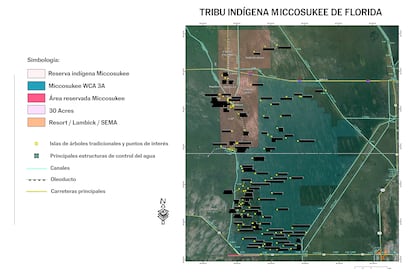
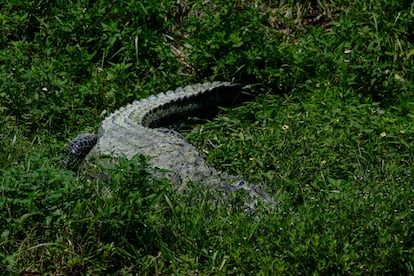
A map with the trees islands is part of the evidence presented in the courts against Aligator Alcatraz. Witnesses warned that the detention center directly threatens 80% of homes, two schools and the tribal government building, according to court documents. It also indicates that wastewater could contaminate wetlands and affect the water supply of the region, as well as endangered species such as Florida panther, and that noise, traffic and lights disturb the fauna and cut access to traditional hunting and collection sites. The ruling of federal magistrate Kathleen Williams, proves them right and emphasizes that any deterioration in the habitat constitutes direct damage to the tribe, whose identity is linked to the Everglades.
“This place is not simply a showcase, it is to live,” Sanders stands out. “It is not to put humans on display.” In his opinion, the Immigrant prison was “an advertising trick” with political background. “They put people in cages, in tents, and then place a poster on the road with this name so ingenious, fun and stupid. Then people arrive, taking photos as if it were Disneyland,” he says, and rage is re -looked between his words.
But the Miccosukee do not oppose the detention center just because it is “a showcase of cruelty.” For decades, the tribe has been in the center of several legal disputes that have sat on how the US courts interpret tribal sovereignty, environmental legislation and the taxation of the original peoples. In 1982, for example, the tribe demanded the state of Florida for illegal land appropriations, which resulted in Florida Indian Land Claims Settlement Act, a law that extinguished territorial claims in exchange for thousands of acres in trust. In 2004, they challenged the pumping of wastewater from Miami to the Everglades, a case that highlighted the role of the Miccosukee in the defense of the ecosystem and influenced the national debate on water transfers.
It has precisely the center of many of its conservation efforts. The fragile ecosystem has been altered since the last century by urbanization and agriculture. Particularly for the diversion of water from its natural course from Lake Okeechobee, north of the Peninsula, to Florida Bay, a process that can take months or years.
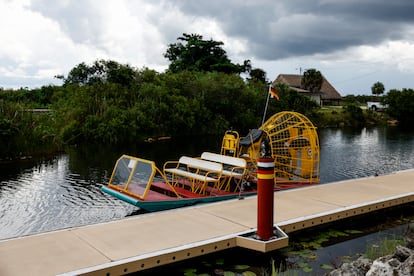
In the Everglades there is a rainy season and dry season, Sanders explains showing photographs. “In the photos of here, you can see the Everglades in dry season. People dragging their canoe by the Everglades. People in ox carts in the Everglades. That was the dry season. We have not had that cycle since the 1980 flooded all year old.
The Miccosukee follow strict environmental norms to build infrastructure, and on many occasions the processes to make a new house, a school or a health clinic. When Aligator Alcatraz got up in a matter of days, something was clear. “They said they were not adding anything, that I was not going to bring anything harmful or destructive for the Everglades. We knew better than anyone we could not believe that,” says the museum’s guide.
In the Miccosukee reserve some 600 people live, distributed in some 13 smaller villages, all near the Tamiami road. Amber Sanders, 23, an ambassador of the tribe, tells how they have sought more recognition for their conservation work, although most Everglades remain fundamentally private. It is a mission that carries in the blood, he says. “This is the place where I grew up, this is the reserved area Miccosukee, but I also grew up in my mother’s tribal village, I also go and come to my dad’s tribal village.”
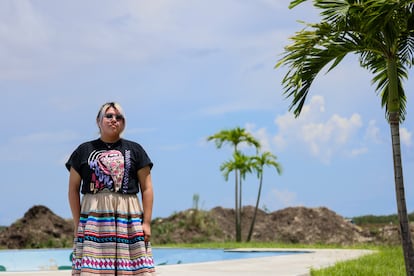
It is a small world. The main school of the reserve follows public studies programs, but also give native cultural classes. Next to the school is the austere town hall building, the police station, a medical center of about two or three floors and a home of the elderly. Next to it there is a newly opened skateboard ramp where two young people practice under the relentless Sun of Florida.
“If you look out here,” says the young Sanders pointing to the horizon, “it is because it is.” And the mycosukee are dedicated to that it will continue to be.
For more updates, visit our homepage: NewsTimesWire