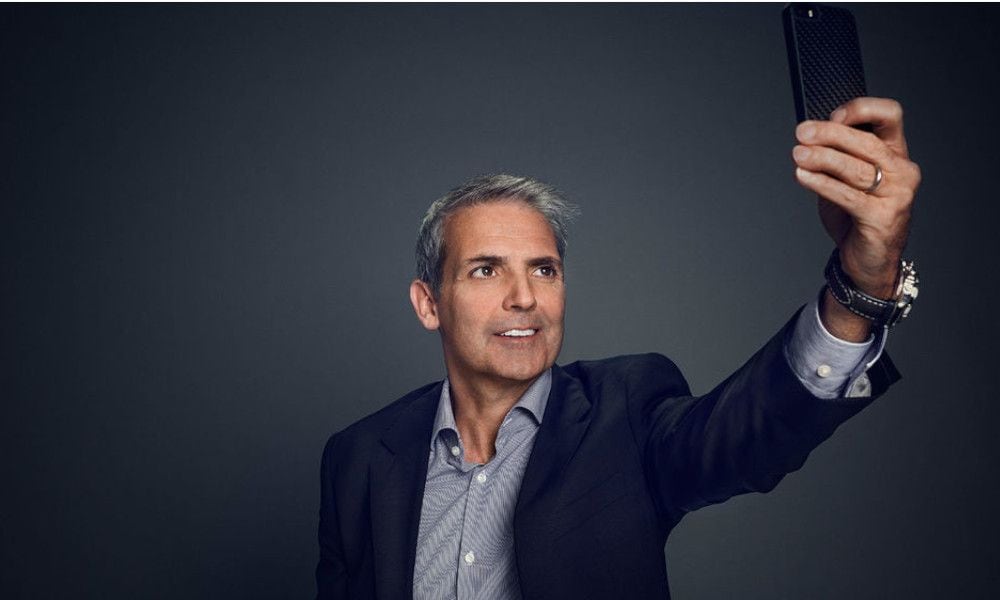
The president and CEO of Zegona, Eamonn O’Hare, can go to the Olympus of Corporate Information. Under his tutelage, the British investment manager bought Vodafone Spain in June 2024 for 5,000 million euros to the multinational Vodafone Group. One more operation among the hundreds that close every year. But what nobody expected – Salvo perhaps O’Hare himself – is that an incentive plan for managers was to convert, thanks to this operation, in the Executive with a millionaire bonus that aims to be, if it materializes, one of the largest in financial history.
O’Hare received in October 2024 as a reward of the aforementioned Plan 34.26 million shares of Zegona, which at that time quoted 3,571 pounds per title (4.29 euros at the change from then on), so its prize rose to 122.35 million pounds (147 million euros). The manager preferred to maintain those actions in his possession at least two years, instead of selling them, as proof of confidence in the firm. And since then the value of Zegona has risen as the foam and, consequently, the latent capital gains of the first beneficiary of the plan have been multiplied. Today, Zegona’s titles quote 11.6 pounds, so the prize received by O’Hare has revalued up to 397.4 million pounds (about 460 million euros).
If he decided to sell that participation, he would not only multiply his assets but would become the manager who has received one of the greatest bonus in history worldwide. The entity’s director of Operations, Robert Samuelson, received a somewhat lower prize, but also very juicy: 16.16 million shares that, at the current price, are worth 187.4 million pounds (217 million euros). All this, with current stock assessment figures.
The case is unpublished from many points of view. To begin with, corporate awards are usually associated with the sale of companies, not to their purchase. In addition, Zegona’s financial situation is not the most buoyant. Vodafone Spain bought through credits and the help of the seller itself (Vodafone Group), without paying virtually no amount of its own except for a capital expansion of 300 million euros. As a result, it maintains a huge debt of 3,715 million euros, which has had to refinance three times in the last year. The payment of the high interest for that debt has motivated Zegona to lose 439 million euros in its last fiscal year (April 1, 2024 to March 31, 2025).
In addition, Vodafone Spain, his only asset, is also in losses. Although the new managers, headed by the CEO, José Miguel García, have partially straightened their commercial drift, the operator lost 82.12 million euros in the last fiscal year for non -recurring expenses such as the cost of the employment regulation file that the company executed and the closure of its own stores.
And it is that another of the edges of the matter is that the billionaire incentive plan for Zegona managers was virtually granted on the same dates in which the ERE was executed for 898 workers, 28% of the workforce, of Vodafone Spain. A hard adjustment that Zegona justified in “economic, productive and organizational reasons, determined by the strong financial and commercial deterioration.”
But if Zegona is a company in losses and barely known in the City, strongly indebted, which has bought another company for now also in losses and that has had to cut its workforce, why has it quadrupled its bag value in a year? As analysts point out that explosive revaluation is mainly due to the air consolidation airs and, in particular, to the statements of Marc Murtra, president of Telefónica, the top rival of Vodafone in Spain. The Catalan manager has insisted again and again since he took the reins of the operator on the need for the EU to allow consolidation processes in each country. The market could have interpreted these words as a sign of Telefónica’s interest in getting Vodafone Spain.
O’Hare, a aerospace training engineer, was a financial director of the popular British supermarkets Tesco between 2005 and 2009 and Virgin Media from 2009 to 2013. In 2015, Zegona founded, which presumes that his business is based on the motto “Buy, Fix, Sell” (Sell ”(Buy-Fix-Sell), But some managers of telecommunications companies that have suffered the onslaught of the British fund change the assertion of “buying, looting and selling”. The semantic joke has to do with the aggressive strategy of the entity when it bursts into the capital of a company, minimizing the risks, leveraging in the society that buys to contribute the least possible money, for a few years to sell it with strong surplus value. With that philosophy he soon directed his gaze to Spain, with which he bought the Telecable Asturian, sold to Euskaltel, an operation for which O’Hare, his inseparable partner Samuelson and other managers took a prize of 21 million euros.
Well above average
The remuneration of the main executives of Zegona is well above the British listed firms. The average remuneration of an CEO of the FTSE 100, the City’s reference index, is 4.2 million pounds per year (4.9 million euros). The bonus paid by the large corporations multiply the emoluments of the managers, but without reaching the amount of those of the British fund. In 2024, Joe Bae, from the KKR fund, received a bonus of 73.1 million dollars (63 million euros). And Hock Tan, CEO of Broadcom, took a bonus of 161.7 million dollars (140 million euros).
In the United States, the remuneration of the senior executives of the large corporations, salary and bonus included, are very splendid. The best paid classification headed it in 2024, Peter Gassner, head of Veeva Systems, a cloud computing company focused on applications of the pharmaceutical industry, which took 172.4 million dollars (148 million euros). It is followed by Rick Smith, Chief of Axon Enterprise, who bases his business on the manufacture of defense or táser weapons, with 164.5 million dollars (142 million euros). Tobias Lütke, CEO of Shopify, a Canadian electronic commerce company, took 150 million dollars. The best paid CEO in the United States is a perfect unknown to the general public. This is Jim Anderson, the new coherent chief, a technological firm manufacturer of optical materials that pocketed 101.5 million dollars. In fifth place appears a company well known by the public, the Starbucks coffee shop chain, which rewarded its boss, Brian Niccol, with 95.8 million dollars. In Spain, remuneration is more modest. Ignacio Sánchez Galán, president of Iberdrola, was the best paid: he received 14.14 million euros in 2024, including base salary and bonus.
For more updates, visit our homepage: NewsTimesWire