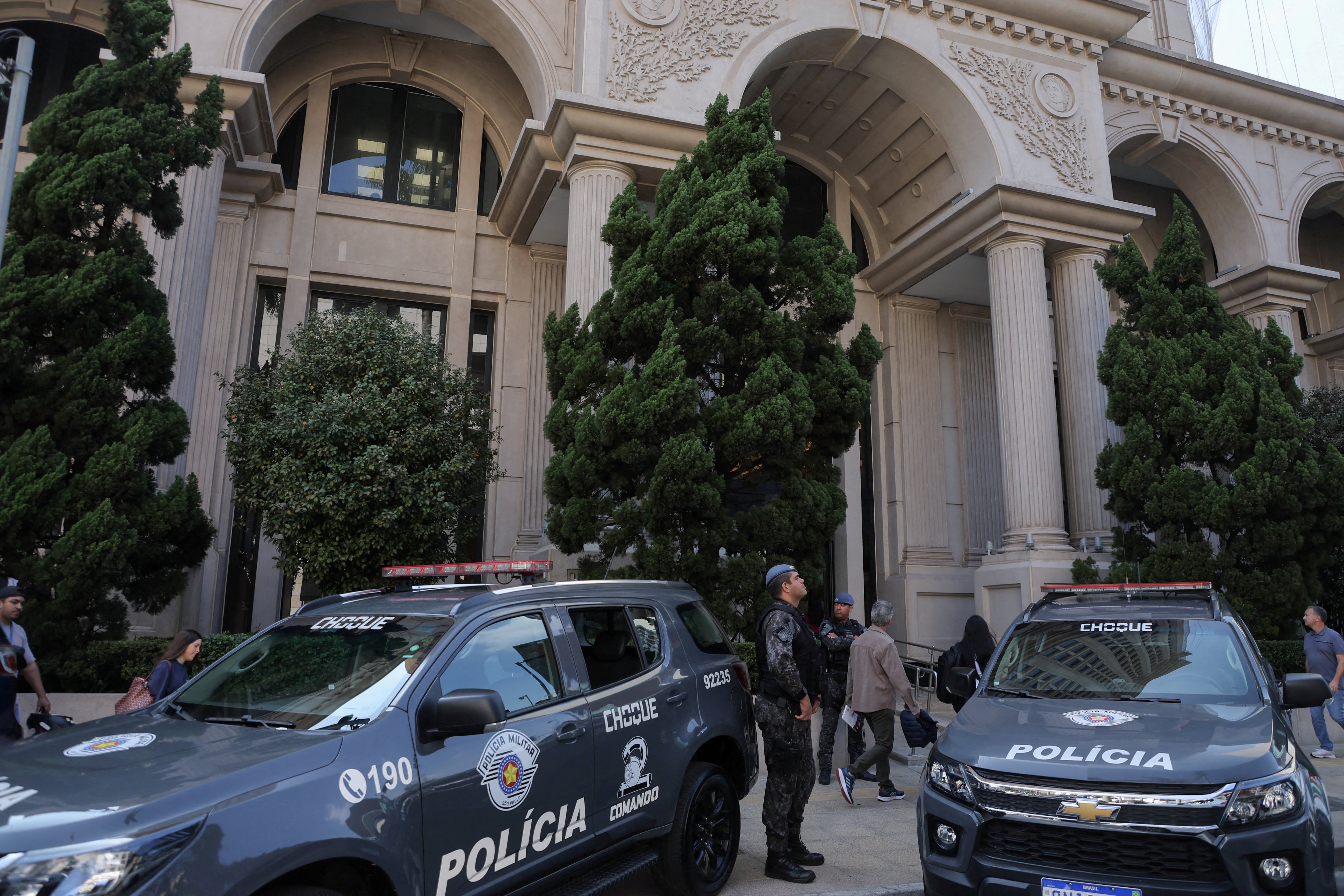
The Brazilian authorities have deployed on Thursday one of their most ambitious operations against organized crime, specifically, against the business framework of the formal economy he uses to profit and wash the money of their illicit businesses. Some 1,400 agents from several police forces have been deployed in eight of the 27 Brazilian states to stop about 40 people and register 255 companies. In the sight of the researchers, the Primeiro Da Capital Command (the PCC), the most powerful mafia in Brazil, which has about 35,000 members and, in addition to devoting themselves to drug trafficking, has created a wide portfolio of illegal and legal business.
The operation has dismantled a network with which the PCC managed a thousand gas stations and about 40 investment funds. “With this operation, we inaugurate a new way of working. We try to dismantle the organized crime refinery,” said Finance Minister Fernando Haddad.
The mechanics was as follows: the money that the PCC earned with fuels invested in the purchase of companies, including energy production plants, or investing funds entered. The people and companies indicated are accused of multiple crimes, including money laundering, fiscal evasion, fuel adulteration, environmental crimes … Some of the suspicious companies have their headquarters in Faria Lima, the Financial District of São Paulo, the Wall Street in Brazil.
The PCC is a brotherhood of criminals that was born three decades ago in a prison in São Paulo after the worst slaughter in a Brazilian prison. Its original objective, defend the most basic human rights of inmates. Over time, he dominated dozens of prisons and imposes his law in hundreds of neighborhoods, in addition to creating a lucrative drug trafficking business.
For a few years it is a multinational crime that rewards entrepreneurship among criminals. The Brazilian authorities estimate that, in addition to some 30,000 members in national territory, who pay a share, it has about two thousand members spread over thirty foreign countries, including all Latin Americans, several Europeans, Turkey and even Japan. His growing infiltration in the formal economy greatly worries authorities.
The Minister of Justice, Ricardo Lewandowski, stressed that this megaperation involves “a promising advance.” And he added: “For a long time, we have witnessed the migration of (organized crime) from illegality to legality.”
This unpublished police operation occurs at a time when the US government presses Latin American countries so that organized crime organizations, such as PCC Brazilians and the Vermelho command, are declared international terrorist groups. Luiz Inacio Lula da Silva’s government opposes that classification. The relationship between the two countries lives its worst crisis in two centuries. The Trump administration has punished Brazil with tariffs and sanctions for judges to free its ally Jair Bolsonaro to account for the courts for trying to perpetrate a coup d’etat.
The Brazilian hacienda estimates that the mafia organization won about 52,000 million reais (more than 8,000 million euros, almost 10,000 million dollars) between 2020 and 2024 with the sale of fuels in Brazil and another 10,000 million reais with the importation of gasoline. The authorities have ordered to block goods worth 1.4 billion reais.
In the chapter of financial companies, the PCC had created a wide structure that included stock assets, various types of investment funds, including some dedicated to real estate business. One of the accused companies, Inversiones Reag, has collapsed 17% in the São Paulo stock market after the police record of its headquarters.
The operation includes arrest and registration orders in the states of São Paulo, Rio de Janeiro, Espírito Santo, Goiás, Mato Grosso do Sul, Mato Grosso, Paraná and Santa Catarina. Two years have lasted the investigations and preparations to launch this wide operation.
The researchers argue that the PCC had practically kidnapped the fuel sector. I worked with gasoline, diesel, ethanol and methanol. Multinational energy companies have fought for years to eradicate organized crime of their distribution networks in Brazil, reports Reuters. The mafia had, according to the police, a wide network of gas stations, about 1,600 trucks for distribution and even controlled the refining and port infrastructure.
For Minister Haddad, this operation is a sign that, “as the crime is sophisticated, the State has to sophisticate in the fight against crime.” The network created by the PCC reduced cash – always complicated to store and, in these times, to bleach – and the need for tax havens to move it.
For more updates, visit our homepage: NewsTimesWire