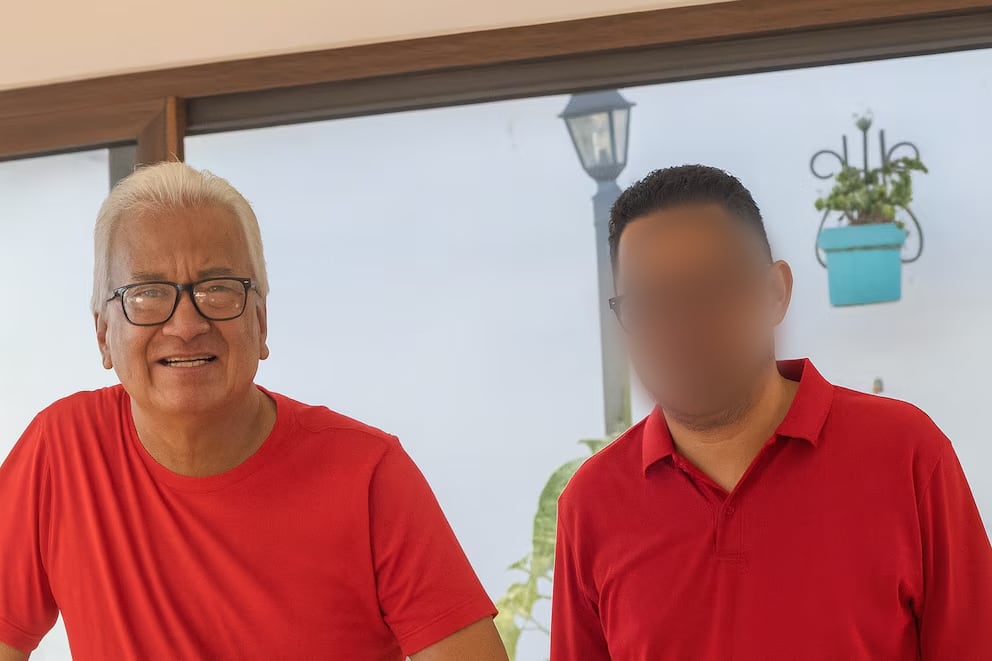
The telephone was repeated in the morning on August 25. It was an unusual hour and, after 38 days without knowing where the police of the regime of Daniel Ortega and Rosario Murillo had locked Mauricio Alonso Petri, his wife raised the horn in the hope of finally obtaining a track of the trail of her husband, or at least of the health status of this 64 -year -old political prisoner. The call brought, in effect, information about him: he came from the Institute of Legal Medicine and carried the worst feeling that the family always tried to dodge. The official quoted them to recognize his body to Managua.
Since Alonso Petri was arrested with his son on July 18 in the city of Jinotepe, within the framework of massive police raids for the 46th anniversary of the Sandinista Revolution, both were in “forced disappearance condition”, denounced the blue and white monitoring, an instance in the exile that documented the political persecution in Nicaragua.
Alonso Petri’s wife looked for her son, Mauricio Alonso Estrada, in almost all prisons and hospitals in the country, but always denied information. It was as if after the detention there was no trace of them. The same as for another 26 people, including five complete family nuclei, which were arrested in those raids executed by officers in the departments of Carazo, Granada, Masaya and Rivas against people considered opposition.
When Alonso Petri’s family arrived in Legal Medicine confirmed that it was his body. The news of his death in Sandinista police custody is not the first of a political prisoner. Between 2019 and 2025, six people have died captives of the regime, including two renowned historical sandinists: Hugo Torres and Humberto Ortega Saavedra, both generals in retirement. The first saved his life in the eighties to the Sandinista leader and the second was his blood brother, always confronted with his sister -in -law, co -president Murillo.
However, the death of Alonso Petri – who was once part of the Sandinista Renewal Movement (MRS), the party hated and outlined by the presidential couple – has revealed to the forced disappearances as one of the most cruel faces of repression and political prison in Nicaragua, according to the report the report ‘Where else do I look for?’: Suspended lives, forced disappearances and the resistance of those who are looking for thempresented this Friday and prepared by a coalition of human rights organizations in exile: Legal Defense Unit, Nicaragua Collective, Autonomous Movement of Women, Defensor and Race and Equality. .
The evolution of forced disappearance
After the 2018 protests against Ortega, the mass arrests were the main dagger to dismantle the opponents. The report
It makes an exhaustive count on the use of forced disappearance of short and long duration in the Sandinista repressive cocktail as a systematic practice.
At the beginning they were short arrests without official notification, with transfers to clandestine prisons. In 2021, with the entry into force of Law 1060, incommunication could extend up to 90 days. But since the end of 2023 the pattern worsened: the deadlines ceased to be temporary and became indefinite. At present, most political prisoners remain incommunicado until they are released, without contact with lawyers or relatives. In many cases, their judicial processes develop in secret and the files are not accessible to defense. The UN work group itself has warned that “every minute” in which a person is out of legal protection constitutes a forced disappearance.
The report document that during the time of disappearance the victims are subjected to cruel torture and treatment. Among the methods denounced are the hanging, simulated drowning, beating, suffocation, forced positions, violations and penetrations with objects. Death threats, sleep deprivation, exposure to extreme temperatures and severe water and food restrictions are also recorded.
To this is added censorship: police and custodians condition family visits to the prisoners do not reveal what happens within prisons. Secret judicialization, without lawyers or access to files, functions as a control and cover -up mechanism that guarantees impunity and maintains fear.
Differentiated impact
Forced disappearance hits specially vulnerability groups, highlights the report. The most affected people suffer from chronic or serious diseases and are deprived of medicines and essential treatments, which accelerates their deterioration and can cause death. Older adults suffer accelerated aging in conditions of isolation and poor diet, with vital risk due to the interruption of their treatments. In adolescents organizations have registered suicidal thoughts during total isolation. Among the indigenous peoples, the disappearance of leaders affects not only the individual, but the entire community: it dismantles their organization and weakens the defense of the territory.
In the case of women, political violence acquires forms of gender: forced nakedness, humiliations, sexual violence, threats against their sons and daughters and denial of gynecological attention. According to the report, women’s body is used as a “social control tool”.
The heaviest load falls on the “seeking people”, mostly women: wives, mothers and daughters who cover police stations and prisons without receiving information, such as Alonso Petri’s wife. “They suffer cruel treatment and deliberate misinformation: they send them from one place to another without answers, forcing them to spend money and energy that they do not have,” the publication collects.
“In many cases they are harassed, requisitioned humiliatingly and even victims of sexual touching as an intimidation method. Some must travel more than 200 kilometers from rural areas to Managua in search of news, others have had to exile and continue the search from the outside, carrying with the guilt and anxiety of not being able to protect their relatives,” the complaint continues.
“Each forced disappearance represents an outrage against human dignity, a crime against imprescriptible humanity and a serious and continuous violation of fundamental rights,” says the report. A horror that Alonso Petri’s family, especially his wife, lived on the morning of August 25, when they recognized the body. They could not buy flowers for a wake, nor was there space to say goodbye, even give him a response, because the authorities forced him to bury him expressly in the Jinotepe cemetery, under the surveillance of a police contingent armed with AK-47 rifles. Now, the woman loads again the same anxiety: Where is her son Mauricio? Dead?
For more updates, visit our homepage: NewsTimesWire