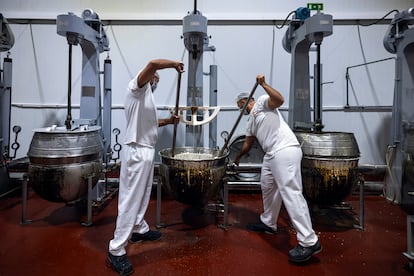
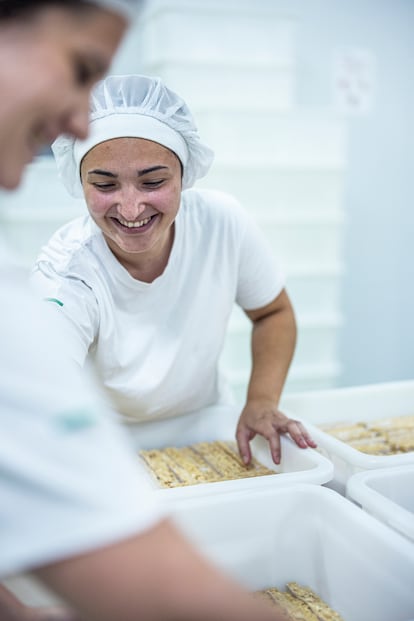
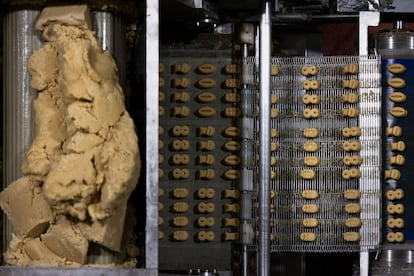
The first impression is smell. Sweet, dense, old. In a white and impoluta ship in Jijona, north of Alicante, something is smelled to home even before crossing the door. In the Family of the Sirvent family, the nougat of two of the best known brands in Spain and the wolf are made. The Sirvent celebrates their third century of history this year, since they have been manufacturing these sweets since 1725, although the recipe they use today for 1880 is written since that year. Upon entering the ship, time seems thickened, like honey that is slowly heated in steel boilers, the Boixets These instruments heat the mixture at a temperature between 83 and 90 degrees using a steam tube that surrounds the boiler and also carry Sirvent’s signature, since they patented their last and most advanced version. Beatriz Sirvent (Jijona, 32 years old), part of the eleventh generation, explains that this design of the Boixet It helps to distribute the heat in a homogeneous way among the entire mixture, which is removed at that temperature for at least two and a half hours.
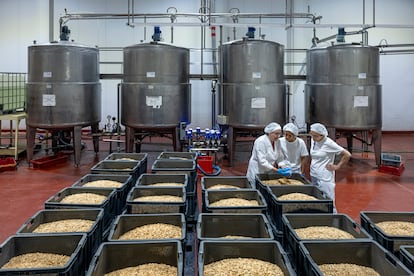
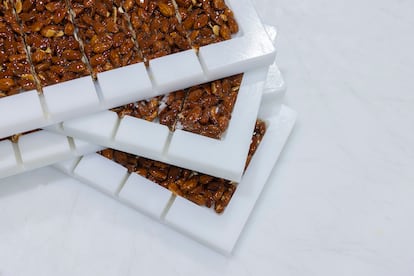
“We are Turroneros all year, even if people think we only work in November and December. In fact, almost all production is done between June and October, quite before Christmas,” says Beatriz with a smile. They make approximately 2,500 tons of nougat a year using 900 tons of almond. It is an almost sacred ingredient. They use those of Marona variety – characteristic due to their butter texture and special sweetness – of 100% national origin in the case of 1880. They are tuned in drums that revolve on their axis with a fixed heat point, so that all the fruits are homogeneous before being ground for the mixture of the nougat of Jijona or being mixed with the syrup for the nougat for the nougat. Honey comes from selected hives from the Mediterranean basin. “There are no secret recipes. What there is is a lot Caliualways present during the production process, while pouring the mixture with millimeter precision into a rectangular mold.
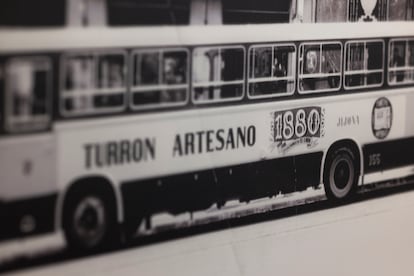
Jijona, at the foot of the Sierra de la Carrasqueta, keeps the soul of the nougat as few other things. The historian Fernando Galiana Carbonell holds in his book Annals and historical documents about Jijona’s nougat that the nougat was known here before the fourteenth century. In its streets, artisanal operators converge, large industrial ships – companies such as 1880 and other well -known such as Antiu XIXONA – and ice cream parlors in which the star product is always nougat ice cream. In their steep alleys, Turroneros graffiti pelando almonds decorate the walls of a town in which the poster “handmade nougat” wins the already classic “cold drinks and cold drinks by win Souvenirs “ from other locations.
The Denomination of Protected Origin Jijona and nougat of Alicante Vela so that only those who produce in the municipality respecting the traditional processes – 25 producers – can label their sweets with that seal. And, among them, Sirvent are not only the oldest family of Turroneros Jijonencos, but probably the most recognizable.
Despite having been building an Empire of the nougat, the challenges are daily. Competing with multinationals operating with very different margins demands a precise strategy and a powerful narrative. Therefore, the house not only sells sweets, but also stories: that of the grandfather that crossed the country with a nougat box under the arm, that of the overseas store in which every December was repeated the same opening ritual of the black box or that of the first black and white announcement that spoke of its “supreme quality”. That emotional capital is an essential part of the business. In this factory, the past is not an anchor, but an engine. And in each tablet that comes out of its molds there is more than almond and honey: there is a different way of looking at the world that still believes in the artisanal and authentic.
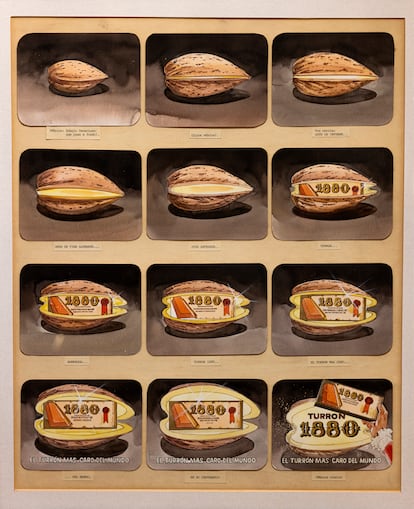
In the museum that presides over the entrance of the factory, a showcase shows original labels of the nineteenth century, press clippings, radio and television ads and wrappers that are part of the Spanish Christmas iconography. On one of the walls, the phrase that changed everything: “The most expensive nougat in the world”, a slogan more than daring than in full postwar period – when pockets were not for too many luxuries – became a Christmas icon. It was first used in 1939.
The challenge, now, is double: maintain the essence while the market is extended. In a corridor adjacent to the production area, where the offices are located, an R&D team develops new formulas. Here is proven from nougat without sugar to tablets designed for consumers with allergies or intolerances and even nougat and dog polvorones, the last audacies that will come to the market next winter. They also launch limited editions that every year test the imagination of the Turoneros teachers: from Roscón de Reyes, of Dónuts, with a port of Puerto de Indias …
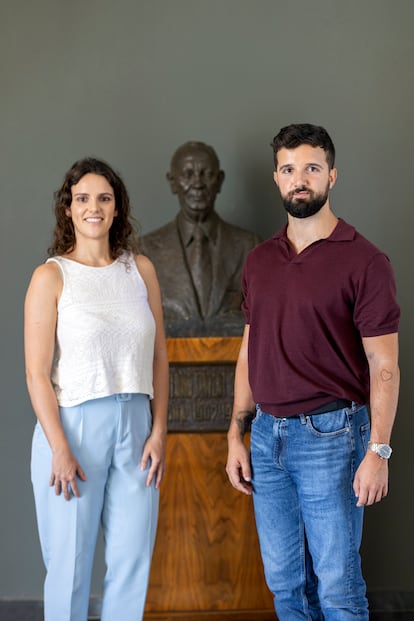
Beatriz Sirvent observes the family tree with photographs of all the generations of her family that have passed through the company, in which she appears with her two cousins, in the highest part, and ironic: “Two women up there … It was time!” While passing to a Rolls-Roycethe first with which they began to distribute the nougat in fairs and artisan markets and that today retain in their nougat museum, says that the vehicle continues to work: “We are perfectly. We have it exposed because it is part of our history, but we occasionally take it out of time to walk through the nougat market that is organized every year in the town.”
The nougat has some ritual. He leaves with his hands, shared as a family, is stored for the days indicated and creates memories. That ability to invoke the past, to associate with intimate memories, is what explains the persistence of a product that has remained faithful to itself while transforming. Perhaps that is why, when winter arrives and Christmas ads flood television, there is something comforting to listen to the Jingle of El Lobo or see the iconic black box of 1880. It is the finding that, however uncertain the present seems, some things remain.
For more updates, visit our homepage: NewsTimesWire